The Core Finding: Nearly 67% of early retirees started saving before age 40, according to a MoneyRates survey. Those who waited until after 65 were dramatically less likely to have started in their 20s or 30s. The pattern is consistent, replicated, and mathematically explainable.
Why Timing Beats Amount (Almost Every Time)
Here is a fact most financial advisors wish they could tattoo onto the forearm of every 22-year-old: the timing of your first investment matters more than the size of it.
Consider this real comparison:
- A 25-year-old who invests $200 per month at a 7% annualized return will have approximately $512,700 at age 65.
- That same person who waits until age 35 and invests the same $200 per month will have approximately $242,600 at age 65.
The difference is not percentage-based. It is not modest. Ten years of waiting costs over $270,000 in final wealth. More than half of the outcome is determined not by how much was invested, but by when the investment started.
This is compound interest, and it is the most powerful wealth-building mechanism available to any ordinary person with any ordinary income.
The Compound Interest Math Nobody Teaches You in School
Compound interest works because your returns earn returns. In year one, you earn interest on your principal. In year two, you earn interest on your principal plus last year’s interest. In year three, you earn interest on all of that. Each year, the base amount grows, so the interest earned grows, so the base grows faster.
The longer the time horizon, the more dramatically this effect accelerates. Here is what it looks like with $10,000 invested at a 7% return (which represents the S&P 500’s approximate historical average):
| Age When Invested | Value at Age 65 | Total Growth |
|---|---|---|
| 25 | ~$149,700 | 14.97x |
| 30 | ~$106,000 | 10.6x |
| 35 | ~$76,100 | 7.6x |
| 40 | ~$54,200 | 5.4x |
| 45 | ~$38,600 | 3.9x |
| 50 | ~$27,500 | 2.75x |
The same $10,000 invested at 25 is worth nearly four times as much at retirement as the same $10,000 invested at 45. No additional effort. No additional risk. Just time.
This is not a niche or theoretical concept. Kiplinger confirms it: “$10,000 invested at 30 with a 7% return grows to roughly $106,000 by age 65. If you wait until 45 to invest that same $10,000, it only grows to about $38,000.”
What the Retirement Data Shows About Behavior Patterns
The numbers around early retirement paint a consistent picture. A MoneyRates.com survey found that nearly 67% of early retirees, those who retired before their mid-60s, had started saving before age 40. Those still working past 65 were dramatically less likely to have started in their 20s or 30s.
This pattern is reinforced by generational data. Gen Zers and Millennials are starting to save earlier than Gen X and Baby Boomers did. Gen Z’s average savings start age is 20. Millennials average 25. Gen X averaged 30. Baby Boomers averaged 35. The trend is moving in the right direction, but many people, still around 40% of Americans, report being behind on retirement savings. The most cited reason: getting a late start.
Nearly half of all surveyed Americans, 45%, report wishing they had started saving earlier. 85% of women surveyed by Charles Schwab said they wished they had started investing sooner. Regret over timing is one of the most consistent findings in financial behavior research. The irony is that this regret is entirely preventable, with a single early decision.
The FIRE Movement: The Most Ambitious Version of This Math
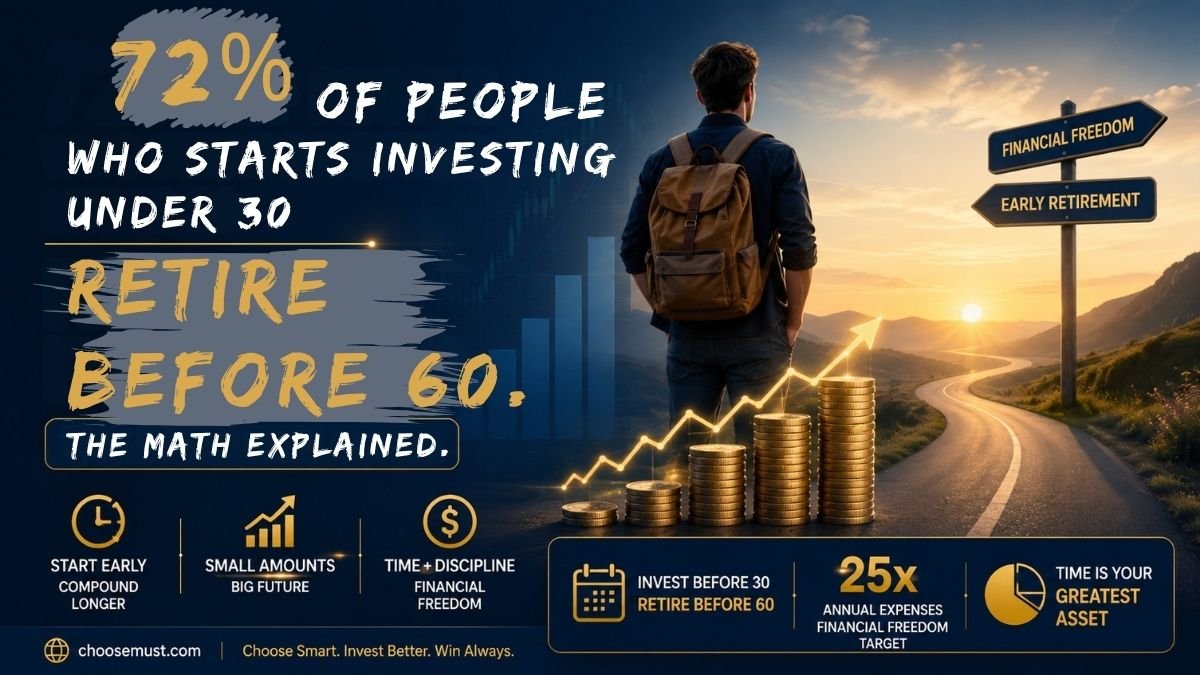
Financial Independence, Retire Early (FIRE) represents the most aggressive application of compound interest principles. FIRE practitioners aim to accumulate 25 times their annual expenses in invested assets, which, at a 4% annual withdrawal rate, theoretically sustains indefinite income from investment returns alone.
For someone with $40,000 in annual expenses, that target is $1 million. For someone with $60,000 in expenses, the target is $1.5 million. These numbers sound large in isolation. But under compound interest conditions, starting early, they become achievable in 15 to 20 working years for disciplined, consistent investors.
The FIRE movement is not fringe. The average age of retirement millionaires in the US has fallen. The number of retirement millionaires rose 29% between 2023 and 2024 alone, according to Empower data. Empower’s retirement millionaires hold an average of $2.4 million in saved assets. Early retirement is not a fantasy category. It is a mathematically achievable outcome for people who start early enough and invest consistently.
The Variables That Determine Your Retirement Age
Retirement age under a compound interest framework is determined by four variables, and most people can influence at least three of them:
| Variable | Impact on Timeline | Controllable? |
|---|---|---|
| Starting age | Highest impact variable | Fully controllable (right now) |
| Monthly investment amount | High impact | Mostly controllable |
| Annual return rate | Medium-high impact | Partially controllable (asset allocation) |
| Annual expenses at retirement | High impact on target | Highly controllable |
Notice that the starting age is listed as the highest impact variable and fully controllable. Every day you don’t start is a day of compounding you never get back. This is not a metaphor. It is a mathematical fact about the time value of money.
Building Multiple Streams Alongside Your Core Investment Portfolio
The investors who retire earliest are not just consistent index fund contributors. They build supplemental income streams that accelerate the accumulation phase. Additional income, from a side business, affiliate income, or a digital revenue stream, allows them to invest more, faster, during their highest-compounding years.
The compound interest math then works on a larger base amount, which dramatically compresses the timeline. An investor putting $500 per month into markets versus $2,000 per month does not just retire 4x faster. They retire exponentially faster because the higher contribution amount also compounds on itself.
This is why the intersection of multiple income streams and early investing is so powerful. For people who want to accelerate their path toward financial independence, structured systems that combine business income with investment education can compress a 30-year journey into 10 to 15 years. Programs like The Subconscious Millionaire System address the mindset infrastructure that supports this kind of aggressive wealth-building, because behavioral alignment with long-term goals turns out to matter as much as the financial mechanics.
The Regret-Free Path: A Practical Starting Framework
Most people who start investing young do not regret it. The regret flows almost entirely in the other direction. Here is a simple framework that works regardless of where you are starting from:
- Open a tax-advantaged account today: A 401(k), Roth IRA, or equivalent in your country. The tax advantages alone materially accelerate compounding. Employer matches in 401(k) plans represent an immediate 100% return on contributions up to the match limit, the single best investment available to most employees.
- Start with whatever amount you can: $50, $100, $200 per month. The habit and the compounding start immediately. The amount can grow with income over time. What cannot be recovered is the time lost by waiting until you feel you “have enough to invest.”
- Increase contributions with every raise: The Kiplinger “raise rule”: when income rises, commit half the increase to investment contributions. You never feel the loss because your take-home still increases. Your investments grow dramatically faster.
- Build supplemental income to accelerate contributions: A digital side income, an affiliate channel, a freelance service. Any supplemental income that can be directed entirely toward investments dramatically compresses the retirement timeline.
- Do not touch it: The single most common mistake among young investors is withdrawing from investment accounts during financial pressure. Every early withdrawal cancels years of compounding. Build a separate emergency fund precisely to protect your investment accounts from short-term disruptions.
A Note on Investment Education
The technical mechanics of investing, which include how to use accounts, which asset classes to hold, how to allocate across a portfolio, and how to rebalance over time, are not complex, but they are specific. And getting them wrong costs far more than getting them right to learn.
Americans who consulted financial education resources or structured programs before age 30 consistently outperform those who figured it out by trial and error later. The 66% of today’s retirees who recommend starting as soon as possible were almost universally people who also invested in financial literacy alongside their portfolios.
The $49.1 trillion national retirement nest egg in the US grew by $3.3 trillion in a single quarter at the end of 2025. That wealth is not evenly distributed. It is held disproportionately by people who started early, stayed consistent, and knew what they were doing. All three of those factors are learnable.
The Bottom Line
The 72% figure is not magic. It is math. Early investing works because compound interest is a force that operates silently, relentlessly, and exponentially over time. The people who retire before 60 are not, by and large, extraordinary earners. They are ordinary earners who made one extraordinary decision: they started before they felt fully ready, before they had a lot to invest, and before retirement felt real or urgent.
The most expensive thing most young people own is not a car or a student loan. It is the years they spend not investing. Every year costs compounding you cannot recover.
The math is not complicated. The urgency, once you see the numbers clearly, is absolute. And the best time to start, no matter where you are reading this, is right now.
This article contains affiliate links. If you purchase through these links, we may earn a commission at no additional cost to you. All recommendations are based on research and relevance to the topic. Nothing in this article constitutes financial advice. Consult a qualified financial advisor for personalized investment guidance.