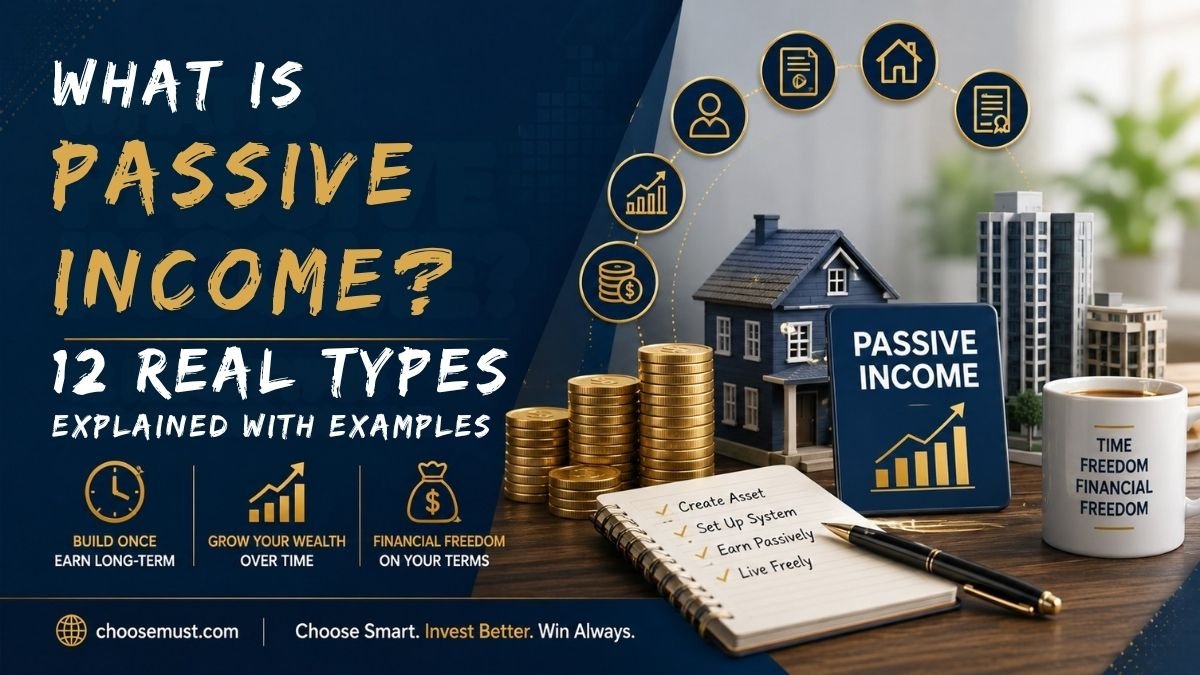
The phrase “make money while you sleep” gets thrown around so often it has almost lost its meaning. But the underlying concept it points toward is very real, and millions of people are building genuine income streams that do not require trading hours for dollars every single day.
This is not a list of get-rich-quick ideas. It is a practical breakdown of 12 real types of passive income, what each one actually requires to set up, what it realistically pays, and whether it might be the right fit for where you are right now.
What Passive Income Actually Means (And What It Does Not)
Passive income is money earned from sources that do not require constant active involvement. The key distinction from a traditional job is that you are not exchanging hours for dollars on a one-to-one basis.
However, it is important to be clear: passive income almost never starts passive. Most income streams require meaningful upfront investment, whether that investment is money, time, skills, or all three. The “passive” part refers to what happens after the initial setup, not before it.
A useful mental model is “set-and-optimize.” You build the system, then maintain and improve it over time. The goal is to reach a point where your income continues to grow without requiring proportional increases in your working hours.
Here is the honest framework:
| Income Type | Primary Upfront Investment | Time to First Income | Ongoing Effort Required |
|---|---|---|---|
| Dividend stocks | Money | Immediate (quarterly dividends) | Low (periodic portfolio review) |
| Rental property | Money + time | 1 to 3 months | Medium (tenant management) |
| Affiliate marketing | Time + skills | 3 to 9 months | Low to medium |
| Digital products | Time + skills | 1 to 6 months | Low (after creation) |
| High-yield savings | Money | Immediate | Very low |
| Online courses | Time + skills | 1 to 3 months | Low (after launch) |
| REITs | Money | Immediate (quarterly) | Very low |
| Crypto staking | Money + technical setup | Immediate after staking | Low |
| Peer-to-peer lending | Money | 1 to 2 months | Low (platform managed) |
| Stock photography | Skills + time | 1 to 6 months | Very low (after upload) |
| Income systems and programs | Money + learning | 1 to 4 months | Low to medium |
| Royalties (content, books) | Time + skills | 3 to 12 months | Very low (after publication) |
The 12 Real Types of Passive Income
1. Dividend Stocks
When you own shares in a company that distributes a portion of its profits to shareholders, those distributions are called dividends. Dividend income is one of the most well-established passive income types in existence.
How it works: You buy shares of dividend-paying companies through a brokerage account. Dividends are typically paid quarterly and deposited directly into your account. You can either take the cash or reinvest it to purchase more shares, which compounds your returns over time.
Real example: An investor with $50,000 in dividend stocks at an average 4% yield earns approximately $2,000 per year without selling a single share. Reinvested over 10 years, that same portfolio grows substantially through compounding.
What to know: Dividend stocks are less volatile than growth stocks, which helps stabilize a portfolio. However, dividends are not guaranteed and can be reduced or eliminated if a company’s financial situation changes.
2. High-Yield Savings Accounts and Money Market Funds
The most accessible form of passive income requires nothing but money already sitting in a bank account. High-yield savings accounts pay significantly more than standard savings rates, turning idle cash into working capital.
How it works: Deposit funds into a high-yield savings account or money market fund. The account pays you interest on your balance, typically calculated daily and credited monthly.
Real example: $20,000 in a high-yield account at 4.5% APY earns $900 per year with zero effort and full liquidity.
What to know: Returns are modest compared to other passive income types. This is a low-risk, low-reward option best used as a component of a diversified passive income strategy rather than a standalone approach.
3. Rental Property Income
Owning property and renting it to tenants is one of the oldest passive income strategies in human history. Rent payments from tenants represent income that, once the property is purchased and tenanted, requires relatively little active involvement.
How it works: You purchase a residential or commercial property. Tenants pay monthly rent. If the rent exceeds your mortgage, property taxes, insurance, and maintenance costs, the surplus is your passive income.
Real example: A duplex purchased for $250,000 rents both units for $1,200 each. Total rental income of $2,400 per month against a $1,600 mortgage payment and $400 in expenses yields $400 in monthly passive income, plus long-term equity building.
What to know: Rental property is “passive” in theory but involves real responsibilities: tenant vetting, maintenance issues, legal compliance, and vacancy management. Many investors hire property managers to handle these tasks, reducing their involvement but also reducing their profit margin.
4. Real Estate Investment Trusts (REITs)
For those who want real estate exposure without the complexity of property ownership, REITs offer a compelling alternative. These are companies that own income-producing real estate and are required by law to distribute at least 90% of their taxable income to shareholders as dividends.
How it works: You buy REIT shares through a standard brokerage account, exactly as you would buy any stock. The REIT pays regular dividends funded by the rental income and property appreciation of its portfolio.
Real example: A $10,000 investment in a diversified REIT ETF with a 5% yield generates $500 per year in passive income with no property management responsibilities.
What to know: REITs are highly liquid (you can sell shares at any time) and offer instant diversification across dozens or hundreds of properties. Returns continue to be a popular choice for generating passive income well into 2026.
5. Affiliate Marketing
Affiliate marketing is the practice of recommending other people’s products and earning a commission when someone purchases through your unique referral link. Done well, it creates a content library that generates income continuously without proportional time investment.
How it works: You join an affiliate program, receive a unique tracking link, and embed that link in content you create around a related topic. When someone clicks your link and buys, you earn a commission, typically ranging from 5% to 75% depending on the product type.
Real example: A blog post ranking for a high-intent search query generates 500 visitors per month. With a 2% conversion rate and a $50 average commission, that single post earns $500 monthly, every month, without additional work.
What to know: Affiliate marketing in the finance and online income niche offers some of the highest commission rates available. Platforms like Digistore24 host thousands of vetted products with commissions often ranging from 40% to 75%. The upfront investment is primarily time and skill, not capital, making it accessible to almost anyone willing to learn and create consistently.
For those looking for a structured approach to building this kind of income, the Subconscious Millionaire System is designed to help people shift their mindset and strategy around income building, including how to approach affiliate and digital income streams from a foundation of clear thinking rather than scattered effort.
6. Digital Products
Creating a digital product once and selling it repeatedly is one of the purest forms of passive income available. Once a digital product exists and is positioned in front of the right audience, each sale requires no additional labor from the creator.
Types of digital products:
- E-books and guides
- Templates (Notion, spreadsheets, Canva designs)
- Software tools and plugins
- Photography and stock assets
- Music and audio files
- Printables and planners
Real example: A personal finance spreadsheet template created in a weekend sells for $15 on Etsy. With 200 monthly downloads, that is $3,000 per month from a product that required a one-time creation effort.
What to know: The creation phase is the hardest part. Distribution and marketing are ongoing requirements, but automated sales through platforms like Etsy, Gumroad, or Digistore24 handle the transaction side entirely.
7. Online Courses
If you have expertise in any area that other people want to learn, packaging that knowledge into a structured online course creates a product that can be sold indefinitely without additional teaching time.
How it works: You record a series of video lessons, organize them on a course platform (Teachable, Kajabi, Udemy, etc.), and market the course to your target audience. Students purchase access and work through the material independently.
Real example: A personal finance course priced at $197 with 50 monthly enrollments generates approximately $9,850 per month from a course recorded once.
What to know: The highest-converting courses solve a specific, well-defined problem. General topic courses compete against hundreds of alternatives. Specificity is your competitive advantage.
8. Peer-to-Peer Lending
Online platforms now allow individuals to lend money directly to other individuals or small businesses, earning interest on those loans as passive income.
How it works: You deposit funds into a peer-to-peer lending platform. The platform matches your capital with borrowers and manages repayment. You receive regular interest payments as borrowers repay their loans.
Real example: $5,000 spread across multiple loans at an average 8% annual interest rate generates $400 per year in interest income.
What to know: This carries meaningful risk. Borrowers can default, and unlike bank deposits, peer-to-peer lending funds are not insured. Diversifying across many small loans rather than a few large ones reduces, but does not eliminate, this risk.
9. Cryptocurrency Staking
For those who hold cryptocurrency assets, staking allows you to earn rewards by participating in blockchain network validation. It is the crypto equivalent of earning interest on a savings account.
How it works: You lock up (stake) a portion of your crypto holdings in a compatible wallet or exchange. The network uses your staked assets to validate transactions and rewards you with additional cryptocurrency for your participation.
Real example: Staking $5,000 in a proof-of-stake cryptocurrency with a 6% annual staking reward generates $300 worth of crypto per year, automatically, without selling your original position.
What to know: Staking rewards are paid in the same cryptocurrency you stake. If that asset’s value drops significantly, your staking income may be worth less in real terms. Understand the volatility of any crypto asset before committing capital.
10. Stock Photography and Digital Asset Licensing
Professional and semi-professional photographers can upload their work to stock photography platforms and earn royalties each time someone licenses an image for commercial use.
How it works: Upload original photos, illustrations, or video clips to platforms like Shutterstock, Adobe Stock, or Getty Images. Each time a buyer licenses your work, you receive a royalty payment.
Real example: A portfolio of 500 high-quality images earns an average of $0.25 per image per month. That is $125 monthly with zero ongoing effort after the upload.
What to know: Individual royalty payments are small, but a large portfolio of consistently downloaded images creates meaningful cumulative income. This is a volume game that rewards patience and consistent uploading.
11. Royalties From Books and Written Content
Writing a book, guide, or other published work and collecting royalty payments from ongoing sales is one of the most classic examples of passive income. In the digital age, self-publishing has made this path accessible to anyone with knowledge worth sharing.
How it works: Write and publish a book through platforms like Amazon Kindle Direct Publishing (KDP). Each time a copy is sold, you receive a royalty ranging from 35% to 70% of the sale price.
Real example: A finance e-book priced at $9.99 earns 70% royalties ($6.99 per sale). Selling 100 copies per month generates $699 monthly from a book written once.
What to know: Discoverability is the primary challenge. A well-reviewed book on Amazon that ranks well for relevant search terms can sell continuously for years. Marketing the book, at least initially, is essential to building that ranking.
12. Structured Online Income Systems
This category has emerged as one of the most accessible passive income paths for people who want a clear roadmap rather than building from scratch. Structured income programs provide a complete system, including the product, the sales infrastructure, and the affiliate opportunity, allowing participants to generate income by promoting a ready-built business model.
How it works: You join a program that gives you access to a complete income-generating system. Depending on the program, this might include done-for-you marketing materials, a proven sales funnel, coaching, and a product suite you can promote as an affiliate. You earn commissions when others join through your referral.
Real example: A frugal-living income program where members learn to optimize their spending while simultaneously building a referral income through promoting the system to others seeking financial freedom.
What to know: Quality varies enormously in this category. Look for programs with clear value delivery beyond the referral income component, transparent commission structures, and a proven track record. Products like Frugal Freedom combine practical financial education with an income opportunity, which makes them more compelling to audiences seeking both learning and earning in a single system.
How to Choose the Right Passive Income Type for You
There is no single correct answer. The right passive income type depends on three variables specific to your situation:
1. What Resources Do You Have to Start With?
| If You Have… | Consider Starting With… |
|---|---|
| Capital but limited time | Dividend stocks, REITs, high-yield savings, crypto staking |
| Time but limited capital | Affiliate marketing, digital products, online courses, stock photography |
| Both time and capital | Rental property, structured income systems, peer-to-peer lending + affiliate marketing |
| Limited of both | Affiliate marketing (lowest barrier to entry), digital products |
2. How Much Risk Can You Tolerate?
- Low risk: High-yield savings, dividend stocks (blue chip), REITs
- Medium risk: Rental property, peer-to-peer lending, affiliate marketing
- Higher risk: Cryptocurrency staking, individual growth stocks
3. How Patient Are You Willing to Be?
Passive income that requires capital to start (dividends, savings) can deliver income relatively quickly. Passive income that requires content and skill-building (affiliate marketing, courses, books) typically takes 3 to 12 months before it generates meaningful income consistently.
Neither path is better. They simply require different things from you at the start.
The One Principle Every Passive Income Builder Needs
Across all 12 types covered here, the single most important principle is this: build systems, not single transactions.
A dividend portfolio is a system. A blog that generates affiliate commissions is a system. A rental property is a system. Each one, once functioning, produces income that does not require you to restart the process from zero each time you want another dollar.
The people who achieve real, lasting passive income are those who focus on building the system fully before expecting it to pay them. They are patient with growth, persistent with the work, and strategic about which income types align with what they actually have to offer at this stage of their financial life.
Pick one. Build it properly. Then, once it is stable and generating consistent income, add the next one. That is how passive income portfolios are built by real people in the real world.
Quick Reference: 12 Passive Income Types at a Glance
| # | Income Type | Capital Needed | Time Needed | Risk Level |
|---|---|---|---|---|
| 1 | Dividend Stocks | High | Low | Medium |
| 2 | High-Yield Savings | Medium | Very Low | Very Low |
| 3 | Rental Property | Very High | Medium | Medium |
| 4 | REITs | Low to Medium | Very Low | Low to Medium |
| 5 | Affiliate Marketing | Very Low | High (upfront) | Low |
| 6 | Digital Products | Very Low | Medium (upfront) | Low |
| 7 | Online Courses | Low | High (upfront) | Low |
| 8 | Peer-to-Peer Lending | Medium | Low | Medium to High |
| 9 | Crypto Staking | Medium | Low | High |
| 10 | Stock Photography | Very Low | Medium (upfront) | Very Low |
| 11 | Book Royalties | Very Low | High (upfront) | Low |
| 12 | Structured Income Systems | Low to Medium | Medium | Low to Medium |
Affiliate Disclosure: This article contains affiliate links. If you click through and make a purchase, we may earn a commission at no extra cost to you. We only recommend products we believe can genuinely help our readers. Results from any passive income method will vary based on individual effort, resources, and market conditions.