Fear does not protect your money. It quietly erases your future. And the numbers behind that statement will make you think twice before you let another month pass by sitting on the sidelines.
The Stat That Should Keep You Up at Night
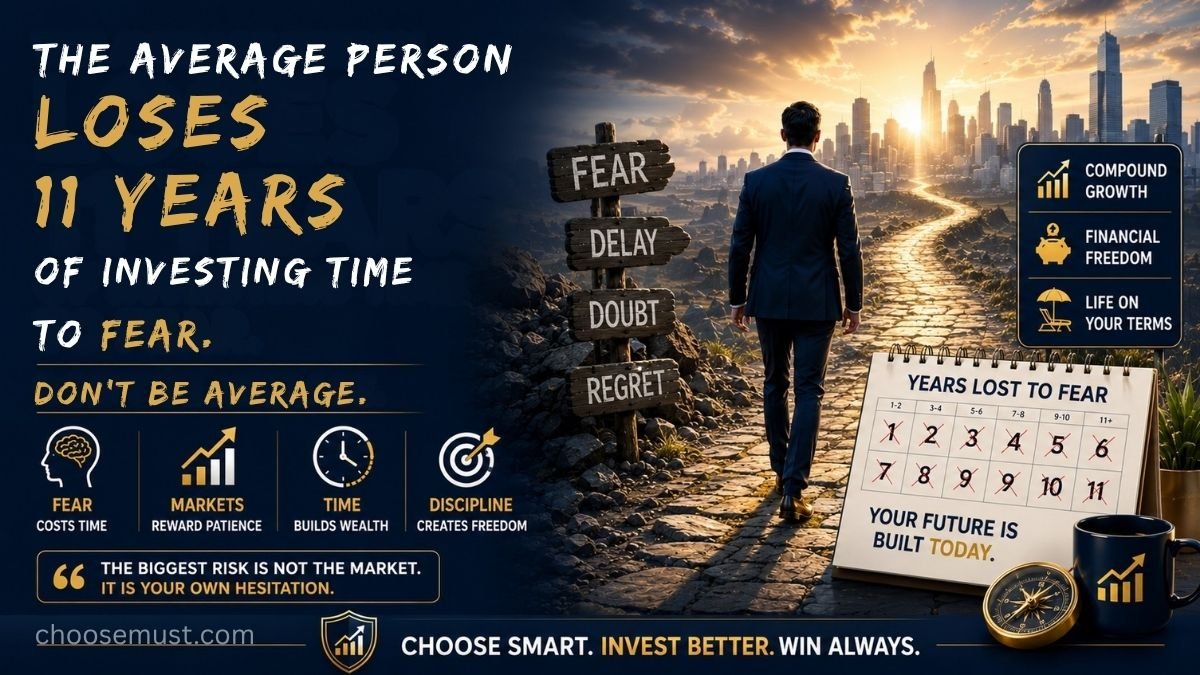
Here is a number that does not get nearly enough attention: the best-performing U.S. stock mutual fund of the entire 2000s decade delivered an annual return of over 18 percent. Impressive, right? Now here is the gut punch. Because of panic selling during downturns and delayed buying after market recoveries, the average investor in that same fund actually experienced an annual loss of 11 percent over the same ten-year period.
Let that land for a moment. The same fund. The same ten years. Two completely different outcomes, separated by nothing more than emotion.
This is not a fringe case. This is the documented, repeatable, proven pattern of what fear does to ordinary investors. And it compounds year after year until a decade or more of potential wealth has simply vanished.
“The biggest risk is not the market. It is your own hesitation.”
According to DALBAR’s 2025 Quantitative Analysis of Investor Behavior, over 30 years ending in 2024, the benchmark portfolio of 65% stocks and 35% bonds returned an average of 8.7% per year. The average investor returned just 6.5% annually over the same period. On a $100,000 initial investment, that gap translates to the benchmark growing to $1,220,000 while the average investor ends up with only $665,000. That is more than half a million dollars lost, not to market crashes, but to fear-driven behavior.
Why Fear Hijacks Even Smart Investors
You do not need to be careless or uninformed to fall into this trap. In fact, research suggests that intelligent people can make worse investment decisions precisely because they are better at rationalizing emotional reactions with logical-sounding explanations.
Behavioral economists Amos Tversky and Daniel Kahneman demonstrated through their landmark Prospect Theory that the psychological pain of a loss is roughly twice as powerful as the pleasure of an equivalent gain. This hardwired bias causes investors to feel losses much more intensely than wins, which leads to one predictable and destructive behavior: selling at exactly the wrong moment.
The pattern plays out in three stages that most people recognize only in hindsight:
- Fear drives selling at market bottoms. When prices fall and the news cycle turns negative, the emotional pain becomes unbearable. Investors sell their holdings precisely when those holdings are most undervalued and should be held or added to.
- Greed drives buying at market peaks. After the recovery, when confidence returns and everyone is talking about how well the market is doing, investors pour money back in near the top of the cycle.
- Regret fuels desperate decisions. Having missed gains or realized losses, investors chase performance, speculate, and take outsized risks in an attempt to catch up, often compounding the original damage.
This cycle, repeated across a working lifetime, is what steals those 11 years of compounding growth from the average person. The loss is not always visible in a single quarter. It accumulates silently, year after year, until the retirement calculation simply does not add up.
The Math Behind the Missed Years
Compounding is the most powerful force in personal finance, and fear is its only real enemy. Understanding how time interacts with returns makes the cost of fear-driven delays shockingly clear.
| Scenario | Monthly Investment | Years Invested | Approximate Final Value |
|---|---|---|---|
| Investor A (starts at age 25) | $500 | 40 years | $1,745,000+ |
| Investor B (starts at age 35) | $500 | 30 years | $745,000+ |
| Investor C (starts at age 45) | $500 | 20 years | $294,000+ |
The same monthly contribution. The same rate of return. The only variable is when the investor stops letting fear make the decision. Investor A ends up with more than five times the wealth of Investor C, not because of skill, not because of market timing, but simply because they started and stayed.
Compounding works quietly and almost invisibly in the early years. Many investors abandon their strategy precisely at the point where they feel like nothing is happening, not realizing that years 12 to 20 are when the snowball begins to accelerate dramatically. Patience at that stage is worth more than any indicator or market prediction.
What the Average Investor Actually Earns vs. What the Market Offers
Let us put the performance gap on the table directly.
| Investment Type | Market Return (Annual) | Average Investor Return (Annual) | Annual Gap |
|---|---|---|---|
| U.S. Equity (30 years to 2024) | 10.15% | 8.01% | -2.14% |
| Blended Portfolio (30 years to 2024) | 8.7% | 6.5% | -2.2% |
| S&P 500 in 2018 (bear year) | -4.38% | -9.42% | -5.04% |
That 2% annual gap sounds modest. But over 30 years on a $100,000 portfolio, the difference between 8.7% and 6.5% annual returns is more than $555,000. That is not a rounding error. That is a retirement.
And the gap widens further in volatile years. In 2018, when the S&P 500 declined by 4.38%, the average individual investor lost more than double that amount at 9.42%, simply because they panicked and sold on the way down and missed the partial recovery. Fear did not protect them. It amplified their loss.
The Real Reason Most People Stay Stuck
Fear of investing rarely announces itself as fear. It disguises itself as caution, research, timing, waiting for the right moment, or simply not having enough to start. These feel rational. They are not. They are the same emotional bias wearing a practical disguise.
Consider the four most common mental traps that keep people on the sidelines:
- Analysis Paralysis: Consuming endless information without ever acting. The more options available, the more overwhelming the decision feels. This is not diligence. It is a delayed fear.
- The Snake Bite Effect: A previous loss or near-loss causes excessive risk aversion going forward. An investor who lost money in 2008 or during the 2022 crypto correction may avoid all market exposure indefinitely, missing the recoveries that follow every major downturn.
- False Safety of Cash: Many people build large cash reserves instead of investing, believing they are being responsible. But idle cash loses purchasing power to inflation every year. After 10 years at even 3% inflation, $100,000 in cash is worth roughly $74,000 in real terms.
- Waiting for Certainty: Markets never offer certainty. Waiting for it is simply choosing guaranteed stagnation over managed, productive risk.
The investors who build lasting wealth are not the ones who feel no fear. They are the ones who developed a structured approach that removes emotion from the equation. Systems beat sentiment every single time over a long enough timeline.
Three Wealth-Building Lanes Most People Overlook
Once you accept that fear is the obstacle, not the market, the next step is identifying which vehicles can realistically move your wealth forward. The good news is that the landscape of income-generating opportunities has never been broader or more accessible to ordinary people.
1. Structured Investment Communities and Mentorship
One of the most effective ways to overcome fear-based paralysis is to operate within a structured community of experienced investors. Having access to vetted strategies, real-time guidance, and a network of people who have already navigated the emotional terrain of investing removes many of the psychological barriers that keep people frozen.
Programs like Keystone Investors Club are built around exactly this model, offering community-based investment frameworks designed to help members develop consistent, disciplined approaches to building wealth over time. When you learn alongside others who are holding steady through volatility, it becomes significantly easier to stay the course yourself.
2. Crypto and Digital Asset Income
Cryptocurrency has matured considerably since its early speculative days. As of late 2025, more than 33 million Ethereum tokens worth approximately $100 billion were actively staked by investors, generating passive yield. Strategies like staking, liquidity provision, and structured yield products now allow investors to earn annual returns ranging from 5% to 25% or more, depending on their risk profile, without needing to trade actively or monitor charts around the clock.
For those who want structured education before jumping in, a well-designed crypto masterclass can compress years of trial-and-error learning into a guided curriculum. Understanding the mechanics of how digital assets generate yield is the difference between informed participation and speculative gambling.
3. Online and Affiliate-Based Passive Income Systems
Beyond traditional markets, a growing number of individuals are building income streams through digital systems that leverage the internet’s distribution power. From affiliate marketing frameworks to AI-assisted income models, these approaches allow people with limited capital but significant time and focus to create recurring revenue outside of traditional employment.
The Passive Income System 2.0 is one example of a structured program designed to walk beginners through the process of setting up scalable online income streams using proven digital frameworks. The appeal for fear-prone investors is significant: lower barrier to entry, faster feedback loops, and the ability to build confidence through smaller, earlier wins before committing to larger financial markets.
How to Break the Fear Cycle Permanently
Breaking the fear cycle is not about becoming emotionally numb to market movements. It is about building systems and habits that make emotional reactions irrelevant to your financial decisions. Here is a practical framework that behavioral finance research consistently supports:
- Automate your investments. Automatic contributions remove the decision point entirely. When there is no moment of choosing to invest this month or not, fear has no entry point. Consistent automated investment across market conditions is one of the highest-leverage behaviors an ordinary investor can adopt.
- Define your strategy in writing before markets move. Know in advance what you will do if the market drops 20%. Will you hold? Add more? Rebalance? Having a pre-committed written plan eliminates real-time emotional decision-making.
- Limit how often you check your portfolio. Studies show that checking portfolio values daily dramatically increases the probability of making emotional short-term trades. Quarterly reviews are sufficient for long-term investors and dramatically reduce anxiety-driven interference.
- Anchor to outcomes, not prices. Remind yourself regularly what you are investing in. A specific number at retirement. Financial independence at a specific age. A funded education for your children. Keeping the end goal visible makes short-term volatility feel appropriately irrelevant.
- Surround yourself with the right information environment. News media are financially incentivized to maximize your emotional engagement, not your investment returns. Curating your information diet to exclude constant market noise is one of the simplest and most impactful moves a long-term investor can make.
The Compounding Cost of One More Year of Waiting
Here is the final number to sit with. If you are 35 years old and you delay starting a $400 monthly investment program by just one year, assuming an average 8% annual return over a 30-year horizon, that single year of delay costs you approximately $54,000 in final portfolio value. Not because of what you lost in the market. Because of what compounding would have built on the contributions you chose not to make.
Every year of waiting has a price tag. Every market cycle you sit out has a cost. And the average person, driven by fear, accumulates enough of these missed years over a lifetime to lose the equivalent of more than a decade of compounding growth.
The market’s long-term direction, across every major recession, financial crisis, pandemic, and geopolitical shock in recorded history, has been upward. Those who remained invested through the 2008 financial crisis were back in positive territory within six years. Those who sold at the bottom never recovered the same ground.
| Action | Final Portfolio Value (Approx.) | Difference |
|---|---|---|
| Start investing today for 30 years | $596,000+ | — |
| Wait one year, then invest for 29 years | $542,000+ | -$54,000 |
| Wait three years, then invest for 27 years | $450,000+ | -$146,000 |
You Are Not Average. Start Investing Like It.
The average investor lets fear make the decisions. They sell when they should hold. They wait when they should start. They sit in cash when compounding is trying to work on their behalf. And they arrive at retirement with half the wealth they could have built, not because the market failed them, but because their emotions did.
You do not have to be a financial expert to beat this pattern. You just have to be systematic, consistent, and willing to act before you feel ready. Because the feeling of readiness, the certainty that the time is right, never arrives. It is a moving target designed by your brain to keep you safe from discomfort, and in doing so, to keep you poor.
Whether your path runs through structured investment communities, digital assets, or online income systems, the most important step is the same: decide before fear makes it for you.
The investors who finish ahead are not the boldest risk-takers. They are the ones who showed up consistently, automated what they could, learned from those who had already done it, and refused to let a bad week become a permanent decision.
Stop being average. Start building.
Disclaimer: This article is for informational and educational purposes only and does not constitute financial advice. All investments carry risk. Please consult a qualified financial professional before making investment decisions. Results mentioned from third-party studies are for illustrative purposes, and past performance does not guarantee future results.