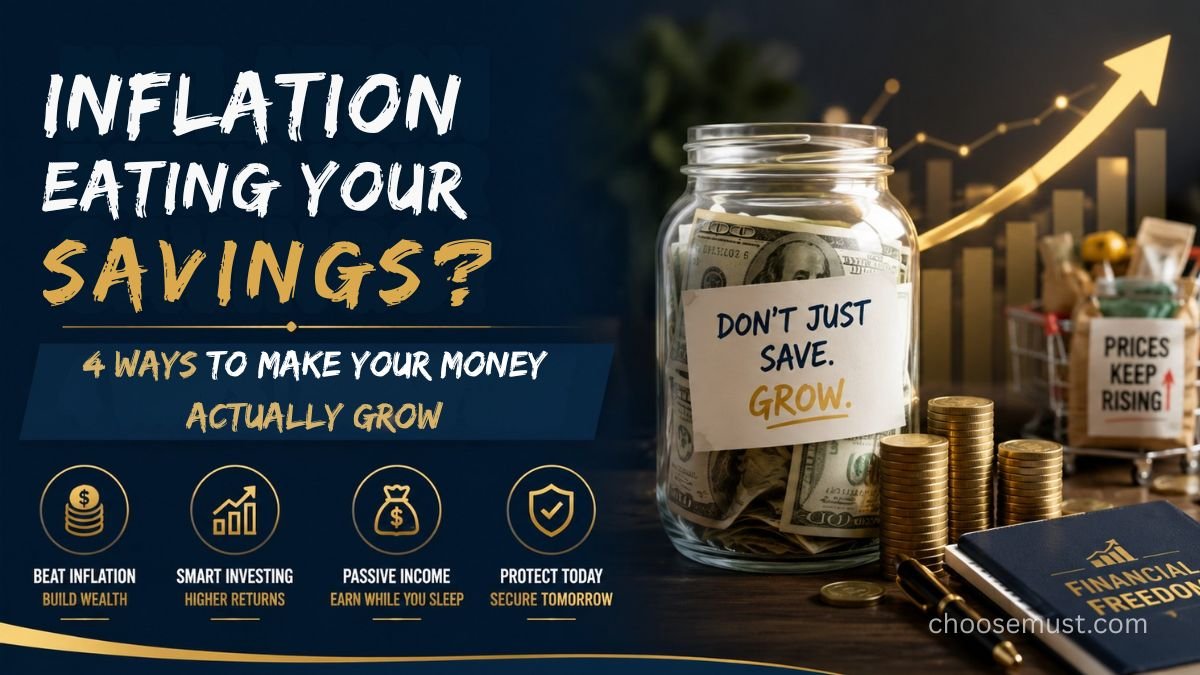
You saved hard. You did everything right. So why does your money feel like it is disappearing?
Every morning you wake up, prices on groceries, rent, fuel, and healthcare are a little higher than they were yesterday. Meanwhile, the balance in your savings account barely budges. That is not a coincidence. That is inflation at work, and it is one of the most quietly devastating forces in personal finance today.
Here is the uncomfortable truth most banks will never tell you: keeping your money in a standard savings account is not “safe.” It is a slow loss. With inflation running above 3% annually and most traditional savings accounts paying well under 1%, every single year your money sits still, it loses real purchasing power. Silently. Reliably. Relentlessly.
But here is what they also will not tell you: there are clear, proven strategies that everyday people are using right now to not just survive inflation, but to build genuine wealth despite it. This article breaks down four of those strategies in plain language, with real numbers, real examples, and real tools you can act on today.
Understanding the Problem: How Inflation Quietly Destroys Wealth
Before diving into solutions, it is worth being honest about the scale of the problem. Most people underestimate how destructive inflation is over time because the damage is invisible month to month.
Consider this: at just 3% annual inflation, $10,000 sitting in a low-interest savings account today will only carry the purchasing power of roughly $8,626 in five years. You have lost nearly $1,400 in buying power without spending a single dollar. After ten years, that same $10,000 will only buy what $7,441 buys today. That is over 25% of your money’s real value, gone.
Your bank statement never shows this. The numbers never drop. Your balance might even nudge slightly higher thanks to negligible interest. But the real value of your money is eroding every day, and that false sense of stability is exactly what keeps most people from taking action.
The good news? Once you understand the problem, the path forward becomes far clearer.
Inflation at a Glance: What the Numbers Are Telling Us in 2026
| Year | Real Purchasing Power | Loss vs. Today |
|---|---|---|
| Today | $10,000 | $0 |
| Year 3 | $9,127 | $873 |
| Year 5 | $8,626 | $1,374 |
| Year 10 | $7,441 | $2,559 |
| Year 20 | $5,537 | $4,463 |
The data is sobering. Inflation does not ask for permission. It does not care about your savings goals. Your only real defense is to make your money move faster than it can erode. Here is how.
Way 1: Build a Passive Income Stream That Beats Inflation by Design
The single most powerful shift you can make in an inflationary economy is moving from a mindset of “saving money” to a mindset of “making money work.” Passive income, money that flows in with minimal ongoing effort after an initial setup, is the closest thing most people will ever find to a genuine financial superpower.
Here is why passive income is especially powerful against inflation: when prices rise, your passive income streams often rise with them. Digital products, affiliate commissions, online courses, and membership programs are not fixed like a savings rate. They are tied to markets, demand, and value, which means they naturally expand over time.
What the Numbers Show
The creator economy reached $250 billion in 2025. Digital products now represent the most accessible path to earning money while you sleep. Realistic income ranges for common passive income models include the following:
- Digital products such as templates, eBooks, and printables: $1,000 to $5,000 per month within 6 to 12 months on 5 to 10 hours per week of initial setup.
- Affiliate marketing and referral programs: $500 to $3,000+ per month once traffic is established.
- Online courses and educational content: $3,000+ per month after a 6-month promotion period, according to documented creator case studies.
- Membership programs and subscription communities: Recurring monthly income with compounding growth over time.
The key insight that most people miss: passive income is not about luck or connections. It is about building a system. Once the system is live, it generates revenue independent of your active hours.
If you want a structured, step-by-step framework for building your first (or next) passive income system, the Passive Income System 2.0 is one of the most comprehensive programs available today. It walks you through the exact process of setting up automated income streams, even if you are starting from scratch with no existing audience or technical background.
Quick-Start Passive Income Comparison
| Income Method | Setup Effort | Monthly Potential | Inflation Resistance |
|---|---|---|---|
| Traditional savings account | None | Less than 1% annually | Very low |
| High-yield savings account | Low | 4% to 5% annually | Moderate |
| Digital products | Medium (one-time) | $1,000 to $5,000+ | High |
| Affiliate and referral marketing | Medium | $500 to $3,000+ | High |
| Online courses and memberships | Medium to High (one-time) | $2,000 to $10,000+ | Very high |
The contrast is stark. Traditional savings is fighting inflation with a toothpick. Passive income is fighting inflation with a compounding engine.
Way 2: Invest Strategically, Not Blindly
Investing during inflationary periods sounds intimidating, but the reality is simple: historically, people who invested intelligently during inflation came out ahead. People who kept their money in savings accounts fell behind. The difference was not timing or luck. It was strategy.
Here is how to think about smart investing in an inflationary environment:
Assets That Have Historically Beaten Inflation
- Index funds and ETFs: A $10,000 investment in an S&P 500 index fund at the end of 1993 would have grown to more than $182,000 by the end of 2023 with reinvested dividends, compared to just $102,000 without reinvestment. Long-term equity investing remains one of the most reliable inflation-beaters available to ordinary investors.
- Dividend stocks: Companies with strong pricing power, meaning they can raise prices without losing customers, tend to not only hold value during inflation but actively grow. Look for companies with a payout ratio under 60%, healthy free cash flow, and reasonable debt levels.
- Real Estate Investment Trusts (REITs): If direct property ownership is out of reach, REITs offer exposure to real estate income. Residential REITs yielded an average of 3.8% in 2025 and maintained payouts through recent market volatility.
- Treasury Inflation-Protected Securities (TIPS): TIPS are government bonds where both the principal and interest payments adjust upward with inflation. They are not glamorous, but they are a mathematically sound inflation hedge for conservative portions of a portfolio.
- Cryptocurrency and digital assets: Bitcoin’s fixed supply of 21 million coins makes it structurally resistant to the kind of monetary expansion that fuels inflation. With growing institutional adoption and regulatory clarity entering 2026, a measured allocation to crypto has become a legitimate inflation hedge for investors who can tolerate volatility. A solid understanding of the crypto landscape before investing is essential, which is where structured education becomes invaluable.
The Smart Investor’s Inflation Portfolio Framework
A practical, balanced approach to inflation-proofing a portfolio might look like this:
| Asset Category | Suggested Allocation | Primary Benefit |
|---|---|---|
| Index funds and growth ETFs | 40% to 50% | Long-term capital growth above inflation |
| Dividend stocks (pricing-power sectors) | 15% to 20% | Income growth and stability |
| Real estate or REITs | 10% to 15% | Tangible asset appreciation and rental yield |
| TIPS or inflation-linked bonds | 10% | Capital preservation during inflation spikes |
| Cryptocurrency (Bitcoin, Ethereum) | 5% to 10% | High-growth alternative, inflation hedge via scarcity |
| High-yield savings / emergency fund | 10% to 15% | Liquidity and immediate-needs buffer |
For investors who want more than general advice and are serious about building a disciplined, income-focused investment strategy, the Keystone Investors Club offers structured access to expert-guided investment frameworks designed around real-world income generation and long-term wealth building. It is the kind of resource that turns “I want to invest but do not know where to start” into a clear, systematic action plan.
One important note on timing: the best time to start investing was years ago. The second-best time is right now. Waiting for the “perfect moment” while inflation erodes your savings is itself a costly financial decision.
Way 3: Spend Smarter with a Frugal Freedom Mindset
There is a significant difference between being “cheap” and being financially strategic. Cheap means cutting everything indiscriminately and living miserably. Frugal freedom means ruthlessly optimising your spending so that every dollar you choose to spend is actively working toward your financial goals, and every dollar you save gets redirected into assets that grow.
Inflation makes the frugal freedom mindset not just sensible but essential. When prices rise 3% to 5% annually, the household that has already trimmed wasteful spending has a structural advantage over the one still paying for five streaming subscriptions, gym memberships they never use, and subscriptions they forgot to cancel.
High-Impact Frugal Habits That Actually Move the Needle
- Audit recurring charges monthly: Most people are shocked to discover how many small subscriptions and auto-renewals quietly drain hundreds of dollars each year. A single monthly audit of your bank and card statements can uncover significant savings immediately.
- Separate needs from wants before every purchase: In an inflationary environment, every discretionary purchase decision carries compounding cost. Ask yourself: does this spending bring me closer to or further from financial freedom?
- Pay yourself first, without fail: Set up automatic transfers to investment or savings accounts the moment your income arrives. If the money leaves your checking account immediately, you will not miss it, and you will not be tempted to spend it.
- Buy essentials in bulk when prices are stable: Strategic stockpiling of non-perishable household essentials at stable prices is a legitimate inflation hedge. What you buy today at today’s price is worth more tomorrow when prices rise.
- Refinance high-interest debt aggressively: Variable-rate credit card debt at 25% to 30% is one of the most destructive forces in a personal budget during inflation. Consolidating or eliminating this debt is one of the highest guaranteed-return moves available to most households.
- Negotiate longer lease agreements before rents rise further: Locking in stable housing costs before the next round of rent increases is a practical form of inflation-proofing your monthly budget.
The frugal freedom mindset is not about deprivation. It is about alignment, making sure the way you spend reflects what you actually value and redirecting the rest into assets that compound over time. For a structured approach to implementing this mindset alongside a practical wealth-building system, Frugal Freedom offers a proven framework that helps everyday people dramatically reduce unnecessary spending while simultaneously building the financial habits that lead to long-term wealth. It is one of the most underrated tools available for people who want real change without extreme sacrifice.
The Frugal Freedom Formula: Where Savings Meet Growth
The real power of frugal habits is not the savings themselves. It is what you do with those savings. Consider this compounding chain:
- You identify and cut $300 per month in wasteful recurring spending.
- That $300 is automatically redirected to an investment account each month.
- Over 10 years, at a conservative 7% annual return, that $300 per month grows to approximately $52,000.
- At a more aggressive 10% annual return, the same contributions reach approximately $61,000.
Three hundred dollars a month in redirected spending, over a decade, builds a meaningful wealth cushion. The habit is simple. The compounding is powerful. The only thing standing between most people and this outcome is getting started.
Way 4: Leverage the Power of Financial Education to Outpace Inflation
This is the strategy most financial articles forget to mention, and it may be the most important of all. In an inflationary economy, the single best investment you can make is in your own financial knowledge and earning capability. Inflation cannot erode a skill. It cannot devalue expertise. And it cannot take away the income streams you build once you understand how money actually works.
Consider what financial education actually does for you:
- It teaches you to identify opportunities that most people walk past without recognising.
- It gives you frameworks for decision-making that protect your wealth in uncertain markets.
- It equips you to build income systems that run independently of your time and labour.
- It removes the fear and paralysis that keeps most people stuck in savings accounts while their purchasing power erodes.
- It expands your earning ceiling by giving you skills and knowledge that the market values and pays for.
Financial education is not about reading more articles or watching more YouTube videos. It is about investing in structured, proven systems delivered by people who have already built the outcomes you are working toward.
The Mindset Shift That Changes Everything
Most people operate from a scarcity mindset around money: there is never enough, every financial decision is risky, and building wealth is something other people do. This mindset is itself a form of inflation, quietly eroding your potential rather than your savings balance. The shift from scarcity to abundance thinking, grounded in real financial education and practical systems, is what separates people who get ahead during inflationary periods from those who merely survive them.
Research consistently shows that millionaires are not primarily people who earned extraordinary salaries. They are people who developed extraordinary financial habits: living below their means, investing consistently, diversifying income streams, and continuing to learn and adapt. The investment in education and mentorship that drives those habits pays compounding returns for the rest of your life.
A Note on Crypto and Digital Asset Education
One of the fastest-growing areas of opportunity for inflation-resistant wealth building is the digital asset space. With Bitcoin logging 60%+ annualized returns from 2015 to 2025 and institutional adoption accelerating rapidly, the question for many investors is no longer whether to pay attention to crypto, but how to participate intelligently and safely.
The challenge is that the crypto space rewards those with genuine knowledge and punishes those who operate on rumour and speculation. This is precisely where structured education makes the difference between building real wealth and making costly, avoidable mistakes.
Putting It All Together: Your Inflation-Beating Action Plan
Here is a clear, prioritised action plan for moving from “inflation victim” to “inflation-resistant” in the shortest possible time:
Step-by-Step Inflation-Beating Roadmap
| Timeframe | Action | Expected Outcome |
|---|---|---|
| Week 1 | Audit all recurring subscriptions and cancel anything non-essential | Immediate monthly savings of $100 to $300+ |
| Week 2 | Open a high-yield savings account for your emergency fund | Emergency cash earning 4% to 5% instead of near zero |
| Week 3 | Set up automatic monthly investment contributions to an index fund or ETF | Begin compounding growth immediately, remove human decision friction |
| Week 4 | Research and commit to one passive income stream that fits your schedule and skills | First steps toward income that inflation cannot erode |
| Month 2 | Invest in structured financial or investing education | Accelerated clarity on opportunities and risk management |
| Month 3 | Review portfolio, optimise asset allocation, and reinvest passive income earnings | Compounding income and investment growth begins to accelerate |
This is not a theoretical exercise. Every single action in this plan is something you can begin today, without a financial advisor, without a large starting balance, and without any special credentials. What you need is decision, direction, and the willingness to act.
Common Mistakes to Avoid When Inflation Is Rising
Knowing what to do is only half the picture. Here are the most common and most costly mistakes people make when inflation is eroding their savings:
- Waiting for inflation to “settle down” before acting: Inflation does not wait for you. Every month of inaction is another month of purchasing power loss. The cost of delay compounds just like investment returns do, only in the wrong direction.
- Holding all cash in a standard checking or savings account: This is the single most common wealth-eroding mistake in an inflationary environment. Idle cash in low-yield accounts is a guaranteed loss in real terms.
- Trying to time the market: Countless studies confirm that time in the market consistently outperforms timing the market. Regular, automated contributions beat the average investor who tries to buy low and sell high every single time over long periods.
- Treating debt as normal: High-interest, variable-rate debt is one of inflation’s most powerful allies. Every dollar in credit card debt at 25% interest is actively destroying your financial position. Eliminating it is one of the highest-return moves available to most households.
- Diversifying without understanding: Owning 20 different assets that all move in the same direction under stress is not real diversification. True inflation resistance requires genuine variety across asset classes with different inflation sensitivities.
- Neglecting income growth in favour of expense cutting alone: Cutting expenses is powerful, but there is a floor to how much you can cut. There is no ceiling on how much you can earn. The most financially resilient households in inflationary periods combine rigorous spending discipline with aggressive income expansion.
The Bottom Line: Inflation Rewards Action and Punishes Inaction
Inflation is not going away. It is a permanent feature of modern economies, and the historical average since 1976 sits at 3.6% per year. Over any meaningful time horizon, the gap between money that grows and money that sits still is enormous.
The four strategies in this article, building passive income, investing strategically, adopting a frugal freedom mindset, and investing in financial education, are not complicated. They do not require a six-figure starting balance or a finance degree. They require a decision to stop being passive about your financial future and start being intentional.
Every wealthy person you admire, every family that achieves financial independence, every investor who builds lasting security, they all share one trait: they took action when most people were waiting. Inflation does not discriminate, but strategy does.
Start with one step from the 90-day plan above. Take it today. Your future purchasing power depends on what you do right now, not on what you plan to do someday.
“Inflation quietly erodes wealth, but informed strategy quietly rebuilds it. With thoughtful allocation and a long-term mindset, inflation can be transformed from a threat into a manageable factor within a resilient financial plan.”
Frequently Asked Questions
How does inflation affect my savings account?
When the inflation rate is higher than your savings account interest rate, your money loses real purchasing power over time even though the numerical balance stays the same or grows slightly. At 3% inflation with a 0.5% savings rate, you are effectively losing 2.5% of your money’s real value every year.
What is the fastest way to protect savings from inflation?
Moving your emergency fund to a high-yield savings account is the fastest first step. Beyond that, investing in broad market index funds, building passive income streams, and reducing high-interest debt are the most impactful long-term actions you can take.
Is cryptocurrency a good inflation hedge?
Bitcoin’s fixed supply of 21 million coins gives it a structural resistance to monetary inflation that traditional fiat currencies do not have. However, cryptocurrency is volatile and should represent only a small, carefully considered portion of a diversified portfolio. Structured education before entering the space is strongly recommended.
Can I build passive income with no money to start?
Yes. Many passive income models, including content creation, digital products, affiliate marketing, and online education, require time and knowledge more than capital. The barrier to entry is lower than most people assume, particularly with the right system and guidance in place.
How much should I have in an emergency fund during inflation?
Most financial experts recommend three to six months of essential living expenses in an accessible, high-yield account. During periods of elevated inflation, erring toward six months provides a stronger buffer against both unexpected costs and rising prices.