You open your phone to get one simple money tip. Forty-five minutes later, you’ve watched three YouTube videos, read two Reddit threads, and scrolled through a dozen TikToks, and you feel more confused than when you started.
Sound familiar? You’re not alone, and you’re not the problem. The financial advice industry is the problem.
The Real Cost of Financial Information Overload
Here is a number that should shock you: 57% of Americans have made regrettable financial decisions based on misleading online information, according to a 2025 CFP Board national survey. Nearly 2 in 5 (39%) lost $250 or more due to bad advice, and almost 1 in 5 (18%) suffered losses exceeding $1,000.
Think about that for a moment. Millions of people went looking for help and came out worse off.
Even more alarming, the same research found that fewer than 2 in 5 Americans (39%) believe online financial content actually serves their best interests, yet they keep going back to it because they feel they have no alternative. More than 3 in 5 (62%) now spend more time verifying financial information than they did just five years ago. The noise has become deafening, and the signal is nearly impossible to find.
This is not a personal failure. It is a systems problem, and it has a systems solution.
Why Online Financial Advice Contradicts Itself
Before we get to the framework that fixes everything, you need to understand why the advice ecosystem is broken in the first place. Once you see the mechanics, you stop blaming yourself and start making smarter choices.
The Three Root Causes of Financial Advice Chaos
- Incentive misalignment: Most financial content creators earn money by keeping you engaged, not by making you wealthy. Controversy, fear, and hype drive clicks. Steady, boring, compounding wealth does not.
- Context stripping: Advice that works for a 28-year-old software engineer in Austin means absolutely nothing for a 45-year-old retail worker in rural Ohio. Online content almost never accounts for your specific situation, timeline, or risk tolerance.
- Popularity mistaken for credibility: According to CFP Board research, many people mistake popularity for expertise when turning to social media and AI for financial guidance. A video with 2 million views is not peer-reviewed financial research.
The result? You end up paralyzed. Paralysis in personal finance is extremely expensive. Every month you delay starting an emergency fund, investing, or building a passive income stream is a month of compounding growth you can never recover.
“Americans are drowning in online money advice, much of it misleading. That gap between easy access and reliability puts financial futures at risk.” – CFP Board CEO Kevin R. Keller (June 2025)
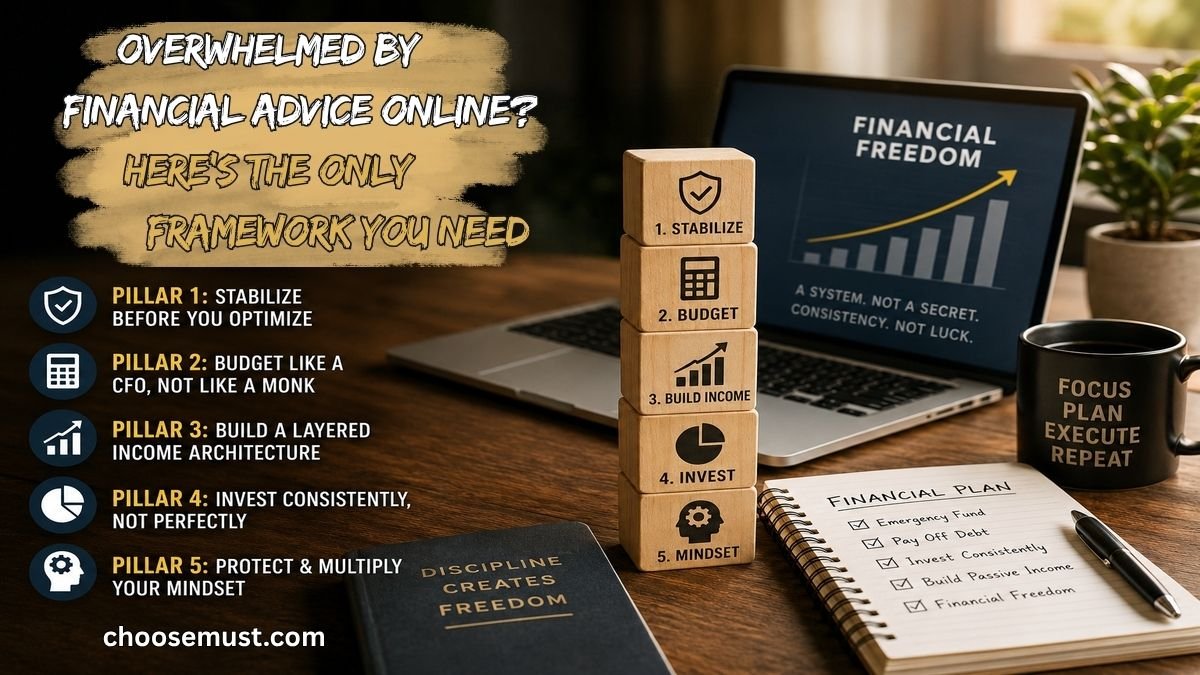
The Solution: A 5-Pillar Financial Framework That Actually Works
The most successful investors and wealth builders throughout history do not chase every new tip. They operate from a framework, a clear set of principles that filters out the noise and guides every decision. This is your framework.
Think of it as a financial operating system. Instead of reacting to every new piece of advice you encounter, you run it through this system first. If it fits, you use it. If it does not, you discard it, no matter how viral the source is.
Pillar 1: Stabilize Before You Optimize
The single biggest mistake people make is trying to invest before they have a stable financial base. They buy crypto on day one while still carrying high-interest credit card debt. That is like trying to fill a bucket with a massive hole in the bottom.
Your stabilization checklist:
- Track every dollar you spend for 30 days (no exceptions)
- Build a minimum emergency fund of 1 month of living expenses
- Eliminate all consumer debt with interest rates above 8%
- Set up automatic savings for at least 10% of your income
- Review and cut subscriptions and recurring charges you have forgotten about
Only when these boxes are checked do you move forward. This is not exciting advice. It is, however, the advice that actually works.
Pillar 2: Budget Like a CFO, Not Like a Monk
Budgeting has a terrible reputation because most people approach it as an exercise in deprivation. A great budget is not about saying no to everything you enjoy. It is about being intentional so the money you do spend goes exactly where you want it to go.
The most practical framework for most people is the 50/30/20 rule:
| Category | Percentage of Take-Home Pay | What It Covers |
|---|---|---|
| Needs | 50% | Rent/mortgage, utilities, groceries, transport, insurance |
| Wants | 30% | Dining out, entertainment, travel, hobbies, subscriptions |
| Savings and Investments | 20% | Emergency fund, retirement accounts, investments, debt repayment |
If your “Needs” are currently consuming 70% or more of your income, that is the signal to either cut costs aggressively or increase your income, and ideally both simultaneously. Adjusting that ratio is the single highest-leverage financial action most people can take.
One powerful way to reshape that ratio is by eliminating what financial behaviorists call “lifestyle creep”: the automatic upgrading of your spending every time your income rises. Credit card debt in the United States hit an all-time high of $1.21 trillion in 2025, driven largely by people funding lifestyles they cannot actually afford with cash.
Pillar 3: Build a Layered Income Architecture
One income stream is a financial liability. Two is an improvement. Three or more is a foundation. The wealthiest people do not rely on a single paycheck. They build what we can call a layered income architecture, where multiple streams work simultaneously, even while they sleep.
Here is how the layers typically stack:
- Layer 1 – Active Income: Your job, freelance work, or primary business. This is your foundation and the capital source for everything else.
- Layer 2 – Semi-Passive Income: Side businesses, content creation, affiliate marketing, or digital products that require initial effort but generate ongoing returns.
- Layer 3 – Passive Income: Dividends, rental income, royalties, automated online businesses, or investment returns that require minimal day-to-day involvement.
- Layer 4 – Compounding Assets: Long-term investments in index funds, real estate, or other appreciating assets that quietly grow in the background.
You do not build all four layers at once. You start with Layer 1 and systematically add layers as your capital, skills, and time allow. The goal is to gradually make Layer 1 optional, not to replace it overnight.
For many people, the fastest entry point into semi-passive income is through structured online income systems. If you want a tested, step-by-step approach to building your first digital income stream, the Passive Income System 2.0 walks you through building an automated online income from scratch, even with no prior experience.
Pillar 4: Invest Consistently, Not Perfectly
The number one investing mistake is waiting for the “perfect” moment to enter the market. There is no perfect moment. There is only consistent action over time.
Over 80% of individual investors consistently underperform the market, and the primary reason is behavioral: buying high during excitement, selling low in panic, and waiting too long to start in the first place.
The core principles of consistent investing:
- Start as soon as possible, even if the amount is small
- Automate your contributions so willpower is not required
- Diversify across asset classes (stocks, bonds, real estate, alternatives)
- Never invest money you cannot afford to leave untouched for at least 3 to 5 years
- Rebalance your portfolio at least annually
- Never make investment decisions based on a single source of advice
As you grow more comfortable with traditional investing, many experienced investors also allocate a portion of their portfolio to alternative and emerging assets. Cryptocurrency, for instance, has transitioned from a speculative novelty to a recognized component of diversified portfolios. However, it requires real education before you commit capital. If you want to understand how to navigate crypto markets intelligently rather than reactively, the Millionaire Partner System offers structured guidance from professionals who have built real wealth in digital asset markets.
Pillar 5: Protect and Multiply Your Mindset
This pillar is the one most financial advice skips entirely, which is precisely why so many people with good financial knowledge still fail to build wealth.
Your relationship with money, your beliefs about what is possible for you, and your ability to make clear-headed decisions under financial stress are as important as any technical strategy you can learn. Research shows that financial stress actively impairs cognitive function, making it harder to make the clear-headed decisions that accumulate into long-term wealth.
Practical mindset habits of financially successful people:
- They review their financial situation weekly, not monthly or annually
- They make decisions from goals, not from emotions or social comparison
- They invest in their own financial education before investing in any asset
- They treat mistakes as data, not as evidence of permanent failure
- They surround themselves with communities and mentors who have already achieved what they want to achieve
This last point is critical. The fastest way to upgrade your financial knowledge and accountability is to be around people who are playing the game at a higher level. Communities of serious investors expose you to strategies, opportunities, and mindsets that simply do not show up in a viral TikTok video.
Comparing Common Advice Sources: What the Data Says
| Advice Source | Credibility | Context-Specific | Risk of Misinformation | Best Used For |
|---|---|---|---|---|
| Social Media Influencers | Low to Moderate | Rarely | High | Initial awareness only |
| Financial News Outlets | Moderate | No | Moderate | Market updates and macro trends |
| Books and Courses | High | Partial | Low | Deep financial education |
| Certified Financial Planners | Very High | Yes | Very Low | Personalized planning and strategy |
| Structured Online Programs | High (when vetted) | Partial | Low | Specific skills and income strategies |
| Investment Communities | Moderate to High | Moderate | Moderate | Accountability and peer learning |
The takeaway from this table is not to distrust all online sources. It is to be deliberate about which sources you use for which purposes. Social media is fine for discovering that a topic exists. It is a terrible place to make a $10,000 investment decision.
The Biggest Traps to Avoid on Your Financial Journey
Even with the right framework, certain patterns consistently derail people who are otherwise doing everything right. Knowing them in advance gives you a significant edge.
Trap 1: “I’ll Start When I Have More Money”
This is perhaps the most expensive sentence in the English language. The compounding effect of even small investments made early dramatically outperforms large investments made late. A person who invests $200 per month starting at age 25 will likely end up with significantly more wealth than someone who invests $500 per month starting at 40, assuming similar returns. Starting is always the right move, regardless of the amount.
Trap 2: Diversifying Before You Have Depth
Spreading your attention and capital across 12 different passive income ideas simultaneously is a guaranteed way to succeed at none of them. Most financially successful people built their first wealth pillar by going deep on one strategy, mastering it, automating it, and only then adding the next layer. Focus is a competitive advantage.
Trap 3: Confusing Activity with Progress
Reading 10 finance books, taking 5 online courses, and watching 200 YouTube videos feels productive. But knowledge without implementation is just expensive entertainment. At some point, you have to act. The framework above is designed to be immediately actionable, not just intellectually interesting.
Trap 4: Ignoring the Frugality Lever
Most financial advice focuses almost exclusively on earning more and investing better. But reducing your cost of living is one of the most powerful, immediate, and guaranteed financial improvements you can make. Every dollar you stop spending unnecessarily is a dollar that can be deployed into income-generating assets. The discipline of living below your means, even temporarily, is what creates the capital base for every other strategy in this framework.
Trap 5: Chasing Trends Instead of Building Systems
Every year, there is a new “best investment.” NFTs. Meme stocks. Certain cryptocurrencies. AI-related plays. Some people get very lucky chasing trends. The vast majority lose money. The people who consistently build wealth are not the ones who caught the right trend at the right time. They are the ones who built systems that generate, protect, and compound money regardless of what the market is doing.
Your 30-Day Implementation Plan
A framework without a timeline is just a theory. Here is exactly what to do over the next 30 days to get this system working in your life.
| Week | Focus Pillar | Key Actions |
|---|---|---|
| Week 1 | Stabilize | Track all spending. Calculate net income vs. expenses. Identify and eliminate 3 unnecessary costs. Open a dedicated emergency fund account. |
| Week 2 | Budget | Set up your 50/30/20 budget. Automate your savings transfer on payday. Review and adjust the budget for your actual numbers. |
| Week 3 | Income Architecture | Identify your top 2 viable semi-passive income opportunities. Research one structured program in depth. Take your first concrete step (sign up, create an account, publish your first piece of content). |
| Week 4 | Invest and Protect | Open or review your investment account. Set up a recurring monthly contribution. Join one financial community for accountability. Schedule a monthly “money date” with yourself to review everything. |
This plan is deliberately simple. Simple plans get executed. Complex plans get abandoned.
How to Filter Any Financial Advice You Encounter Going Forward
You will continue to encounter financial advice online. Here is a quick mental checklist to run every new piece of advice through before you act on it:
- Does this person have verifiable results, not just followers? Social proof and financial credibility are very different things.
- Does this advice apply to someone in my specific situation? Age, income, risk tolerance, and goals all matter. Generic advice is often useless.
- What does this person gain if I follow this advice? Understand the incentive structure before trusting any recommendation.
- Does this fit within my framework? Run it against the 5 pillars. If it does not align with stabilizing, budgeting, building income, investing consistently, or protecting your mindset, it probably does not belong in your financial life right now.
- Can I find at least two credible, independent sources that agree? Verification is not paranoia. It is financial hygiene.
This five-question filter alone will save you from a significant portion of the mistakes that cost average consumers hundreds or thousands of dollars every year.
The Bottom Line: Stop Consuming, Start Executing
The internet has given us access to more financial information than any previous generation in history. That access is genuinely valuable. But information without a filtering framework does not produce wealth. It produces anxiety, indecision, and eventually, regret.
The 5-pillar framework you now have is not magic. It is not a get-rich-quick shortcut. What it is, is a coherent, proven, sequentially logical system that eliminates the chaos of online financial advice and replaces it with a clear path forward.
You now know:
- Why the online financial advice ecosystem is broken by design
- How to stabilize your financial foundation before you optimize anything
- How to build a budget that creates freedom instead of restriction
- How to construct a layered income architecture that works while you sleep
- How to invest consistently with discipline rather than chasing trends
- How to protect the mindset that makes every other strategy possible
The only remaining question is this: what are you going to do with it?
If you are ready to stop absorbing advice and start building income, the best next step is to pick one income layer and go deep on it. For those serious about accelerating the process with a structured community of investors and income builders, Keystone Investors Club offers a premium membership environment where real strategies, real accountability, and real results come together. It is one of the few online financial communities where the emphasis is on execution, not entertainment.
The noise is not going away. But with the right framework, it no longer has to matter.
Your financial future is not built in a feed. It is built in a system. And now you have one.
Disclosure: This article contains affiliate links. If you click through and make a purchase, we may earn a commission at no additional cost to you. We only recommend products and programs we believe offer genuine value based on our research. Nothing in this article constitutes personalized financial advice. Always conduct your own due diligence before making financial decisions.