You are not bad with money. You are just scared of losing it. And that fear is completely rational — until it quietly becomes the most expensive mistake of your financial life.
The Real Problem Nobody Talks About
Every week, millions of people open their banking apps, look at money sitting idle in a savings account, and think: “I really should be doing something with this.” Then another week passes. Then a month. Then a year.
The fear of investing is not just emotional — it is expensive. While your money sits still, inflation silently chips away at its value. In 2026, with the Federal Reserve holding its benchmark rate at 3.5–3.75% and inflation continuing to eat into purchasing power, doing nothing with your savings is itself a financial risk. A very real, very costly one.
The good news? The barrier to safe, beginner-friendly investing has never been lower. This guide strips away the confusion, addresses your specific fears, and hands you a clear, step-by-step roadmap to start — even if your stomach turns at the word “stocks.”
Why Smart People Are Still Scared to Invest
First, let’s name the fears. Because they are real, they are common, and understanding them is the first step to dissolving them.
Fear #1: “What if I lose everything?”
This is the most common. And it makes sense — you worked hard for that money. But the data tells a different story: most long-term investors do not lose everything. They lose temporarily, during market dips, and recover. The only people who truly “lose everything” are those who panic-sell at the bottom, locking in losses that the market would have reversed over time.
Fear #2: “I don’t know enough to start.”
You do not need an MBA to begin. The most successful beginner strategy in history — simply buying low-cost index funds and holding — requires zero expertise and outperforms most active fund managers year after year.
Fear #3: “I need a lot of money to invest.”
Many platforms now allow you to start with as little as $5 to $50. The amount matters far less than the act of starting. Thanks to compound interest, even small, consistent contributions grow into something significant over time.
Fear #4: “Now is the wrong time.”
There is never a “perfect” time. Waiting for one is just fear wearing a logical costume. Studies consistently show that “time in the market” beats “timing the market” for almost all retail investors.
The Lowest-Risk Investment Options in 2026 (Ranked)
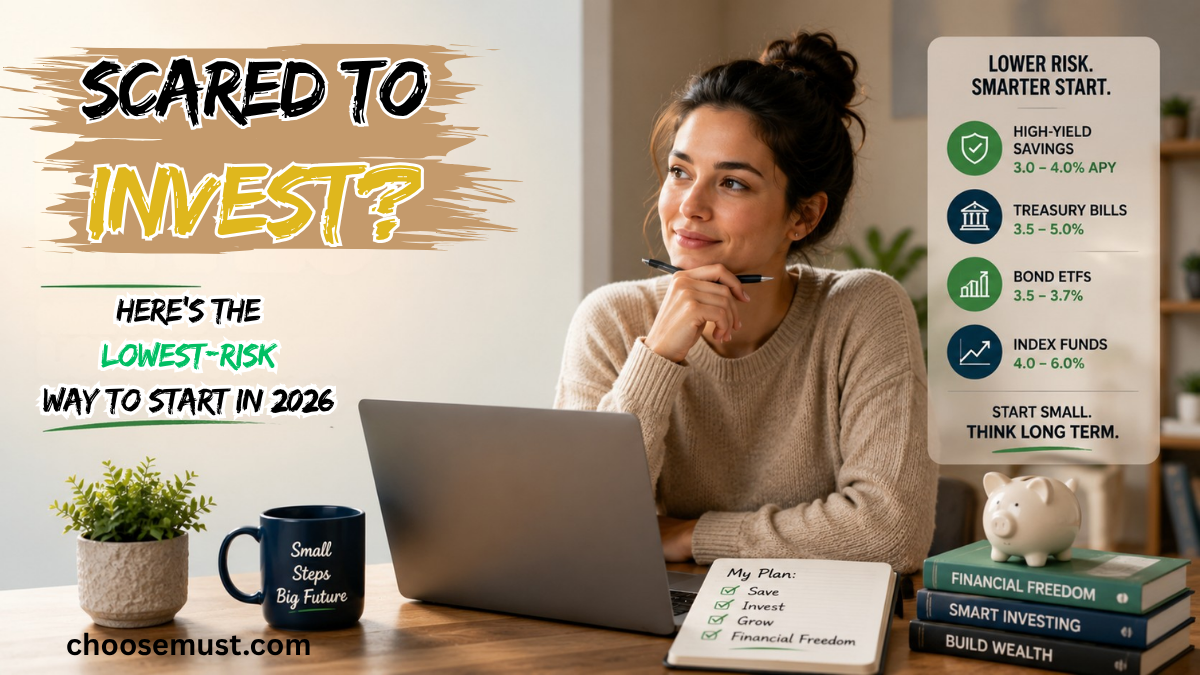
Not all investments carry the same risk. Here is a clear breakdown of the safest starting points available right now, ranked from lowest to slightly higher risk — all still firmly in the “beginner-safe” zone.
| Investment Type | Estimated Return (2026) | Risk Level | Best For |
|---|---|---|---|
| High-Yield Savings Account | 3.0 – 4.0% APY | Very Low | Emergency fund, short-term goals |
| US Treasury Bills / I-Bonds | 3.5 – 5.0% | Near Zero | Capital preservation |
| Certificates of Deposit (CDs) | 3.3 – 4.0% | Very Low | Locked savings with guaranteed return |
| Short-Term Bond ETFs (e.g., BSV) | 3.5 – 3.7% | Low | Passive investors wanting market access |
| Money Market Funds | 3.5 – 4.0% | Very Low | Near-cash parking with daily liquidity |
| Dividend-Paying Index Funds | 4.0 – 6.0% | Low to Moderate | Long-term passive income builders |
| Fixed Annuities | Up to 6.5% (7-year term) | Low | Near-retirement stability seekers |
The reality is that in 2026’s rate environment, high-yield savings accounts and Treasury instruments are delivering returns that genuinely beat inflation — something that was simply not possible for most of the 2010s. This is a window of opportunity that may not stay open for long.
The Beginner’s Step-by-Step Investment Plan for 2026
Here is exactly how to start, in the right order, without overwhelming yourself.
Step 1: Build Your Financial Foundation First
Before you invest a single dollar in the market, you need a safety net. A 3-to-6-month emergency fund in a high-yield savings account is not optional — it is what keeps you from panic-selling investments when life throws you a curveball. This fund should be in a separate account, earning 3.0–4.0% APY, and completely off-limits for everyday spending.
Step 2: Eliminate High-Interest Debt
No investment reliably returns 20%+ per year. Credit card debt regularly charges 20%+ per year. Paying that debt off is the highest guaranteed return available to you. Handle it before investing anything beyond your employer’s 401(k) match.
Step 3: Take the Free Money First
If your employer offers a 401(k) match, contribute at minimum enough to capture the full match. This is an immediate 50–100% return on your money. Nothing in the market can compete with that.
Step 4: Open a Low-Cost Index Fund Account
Once your foundation is solid, start a brokerage account and invest in broad-market index funds. The S&P 500 has returned an average of approximately 7% annually after inflation over long periods. You do not need to pick stocks. You do not need to watch the news daily. You just need to contribute consistently and let time do the heavy lifting.
Step 5: Automate Everything
Set up automatic contributions so investing becomes invisible. When it is automatic, you cannot talk yourself out of it during a bad week in the markets. This strategy, called dollar-cost averaging, is one of the most proven and beginner-friendly approaches in investing history.
The Hidden Risk Nobody Warns You About: Doing Nothing
Most financial fear focuses on the risk of losing money. But there is a quieter, more insidious risk that receives far less attention: the guaranteed erosion of your purchasing power when you keep everything in cash.
Consider this: if inflation runs at 3% per year and your savings account earns 1.5%, you are losing 1.5% of your real wealth every single year. You cannot see it. Your balance does not drop. But ten years later, the same amount of money buys noticeably less. This is not a worst-case scenario — it is the mathematical certainty of inaction.
“The biggest risk for most people is not in their portfolio. It is in never having one.”
Beyond Traditional Investing: Building Passive Income Online
Low-risk traditional investments are a fantastic foundation. But many readers in 2026 are also looking for ways to actively grow income streams — not just preserve capital. This is where the landscape gets genuinely exciting.
Digital-first passive income systems have matured considerably. What once required coding skills and a large audience can now be started with almost no technical background, thanks to structured programs that walk beginners through each step.
What Makes an Online Income System “Low Risk”?
- Low or zero upfront capital required: The best beginner systems do not ask you to invest money you cannot afford to lose.
- Proven, repeatable method: Systems backed by real case studies and documented results carry far less guesswork than starting from scratch.
- Income that compounds over time: Unlike a second job, a well-structured online income system can earn while you sleep once it gains momentum.
- No inventory, shipping, or physical product: Digital-based models eliminate the logistical risk of traditional businesses.
- Community and mentorship included: Access to experienced practitioners dramatically shortens the learning curve and reduces costly trial-and-error.
Over 80% of brands now incorporate affiliate programs, and more than 90% of e-commerce businesses are expected to have them by the end of 2026. The infrastructure for building a real digital income stream is already in place — and it rewards people who start now before the window becomes even more competitive.
For those who want a structured, community-backed path into this world, the Keystone Investors Club offers a 3-Year VIP access program that walks members through building sustainable income systems with community accountability and expert guidance. It is one of the more comprehensive beginner-to-advanced programs available in 2026 for those serious about changing their financial trajectory.
The Psychology Shift That Changes Everything
Here is what the numbers cannot tell you: investing is 20% mechanics and 80% psychology.
The investors who succeed over the long term are not the ones with the highest IQs or the best stock-picking instincts. They are the ones who stay consistent when the market drops. They are the ones who do not check their portfolios 12 times a day. They are the ones who understand that short-term pain is the price of long-term gain.
Fear is not your enemy. Acting irrationally because of fear is. The most powerful thing you can do right now is not find the “perfect” investment — it is to build a mindset that can weather uncertainty without flinching.
For those who want to go deeper on reprogramming limiting beliefs around money and wealth, there are structured systems specifically designed to address the subconscious blocks that keep people stuck. The Subconscious Millionaire System is one such program — a science-informed approach to shifting the deeply held beliefs about money that cause most people to self-sabotage even when they have the right information in front of them.
Practical Frugality: The Forgotten Multiplier
No conversation about low-risk wealth-building is complete without addressing one of the highest-leverage tools available to any beginner: spending less than you earn, strategically and sustainably.
Frugality gets a bad reputation because most people associate it with deprivation. But true financial frugality is not about cutting joy from your life — it is about cutting waste. Every dollar you stop losing to subscriptions you forget, impulse purchases, and lifestyle inflation is a dollar that can compound in your investment account instead.
The math is staggering. An extra $200 per month invested at 7% annually becomes over $120,000 in 20 years. The discipline of conscious spending is arguably the single most accessible wealth-building tool available to ordinary people, requiring no special skills, no market knowledge, and no startup capital.
For a practical, structured roadmap to achieving genuine financial freedom through smart money habits, Frugal Freedom offers actionable frameworks that help you redesign your spending without sacrificing quality of life — while accelerating your path to investment-ready cash flow.
Common Beginner Mistakes to Avoid in 2026
Knowing what not to do is just as valuable as knowing what to do. Here are the most damaging mistakes new investors make:
- Waiting for the “perfect moment” to invest: Markets do not wait for your confidence to build. Start small and adjust as you learn.
- Chasing returns based on headlines: Social media makes the hot investment of the month look irresistible. Most hot picks cool off quickly.
- Buying a single stock instead of a diversified fund: Concentration without knowledge is speculation, not investing. Index funds spread your risk across hundreds of companies automatically.
- Panic-selling during a market downturn: Selling when prices fall locks in losses. The best buying opportunities in market history occurred at moments of maximum fear.
- Ignoring tax-advantaged accounts: A 401(k) or IRA is not a type of investment — it is a tax-sheltered wrapper that makes your investments more efficient. Use them first.
- Not automating contributions: Manual investing requires willpower. Automated investing requires none. Remove yourself from the equation wherever possible.
- Confusing activity with progress: Checking your portfolio daily and making frequent trades feels productive. It is not. Inaction, when guided by a solid plan, consistently outperforms reactive trading.
Your 2026 Low-Risk Investment Starter Checklist
Use this checklist to move from paralyzed to prepared:
| Action Item | Priority | Timeline |
|---|---|---|
| Open a high-yield savings account | Critical | This week |
| Build a 3-month emergency fund | Critical | Within 3 months |
| Pay off all high-interest credit card debt | High | Before market investing |
| Capture your full employer 401(k) match | High | Immediately |
| Open a Roth IRA or taxable brokerage account | High | This month |
| Set up automatic monthly contributions to index fund | High | Within 30 days |
| Review and cut unnecessary recurring expenses | Medium | Ongoing |
| Explore structured passive income programs | Medium | Once foundation is solid |
The Bottom Line: The Biggest Risk Is Waiting
Fear of investing in 2026 is understandable. The world feels uncertain. Markets can be unpredictable. It is tempting to wait until things “settle down.” They never fully do.
But here is the truth that every financial expert across every era has agreed on: time is the single most powerful force in wealth-building. Every year you wait is a year of compounding you cannot get back. The person who starts investing $200 a month at age 25 will almost always retire wealthier than the one who starts investing $500 a month at 40, simply because of the years of growth they allowed.
You do not need certainty to start. You need a plan simple enough to stick to, a foundation solid enough to withstand volatility, and the discipline to leave your money alone long enough for it to grow.
Start where you are. Use what you have. Build from there. The lowest-risk move in 2026 is not a specific investment vehicle — it is the decision to finally start.
Disclosure: This article contains affiliate links. If you choose to purchase through them, we may earn a commission at no additional cost to you. All recommendations are made in good faith based on publicly available information. This article is for informational purposes only and does not constitute financial advice. Please consult a qualified financial professional before making investment decisions.