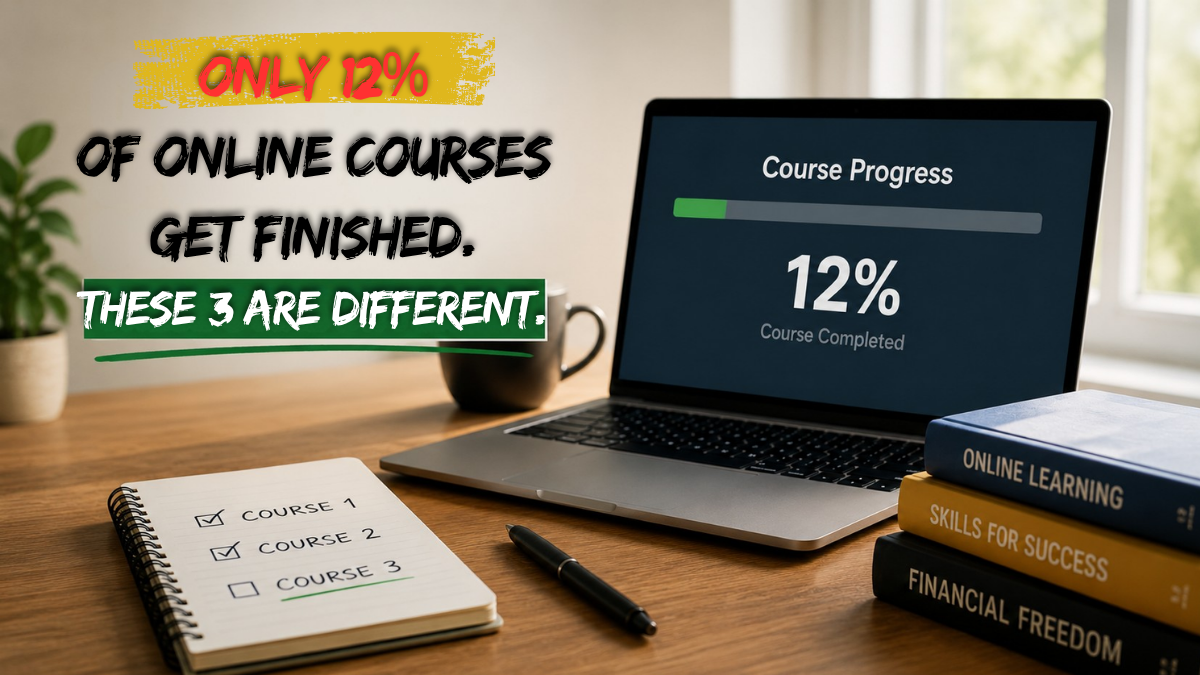
You bought a course. You probably did not finish it. Neither did almost everyone else.
That is not an insult. It is a documented crisis that the e-learning industry quietly knows about and rarely admits out loud. The completion rate for most online courses sits at a dismal 10 to 15 percent. Which means for every 100 people who sign up, 85 to 90 walk away without finishing. Many never even open the first lesson.
But here is the part nobody talks about: a small number of programs are built differently. They are structured around real outcomes, real accountability, and real income potential. They get finished. And more importantly, they deliver results.
Below, you will find exactly why most courses fail, what separates the ones that work, and three programs worth your serious attention in 2025.
The Uncomfortable Truth About Online Learning
The global e-learning market is racing toward $350 billion. Millions of people are signing up for courses every single month. And the overwhelming majority of those courses are sitting unfinished inside someone’s account, never to be opened again.
Here is what the data actually says:
| Course Type | Average Completion Rate | Key Factor |
|---|---|---|
| Free MOOCs (Coursera, edX, etc.) | 5% to 15% | No skin in the game |
| Standard paid self-paced courses | 12% to 20% | No accountability structure |
| Courses with community support | 30% to 40% | Peer pressure and engagement |
| Courses with coaching and accountability | 70% and above | Active human involvement |
That gap is not a coincidence. It is design. The courses that produce completions and results are built with a completely different philosophy than the ones gathering digital dust in your downloads folder.
Why Most Online Courses Fail Before They Even Start
Understanding the root cause matters. Because once you know why courses fail, you can immediately recognize the ones built to succeed. Research and behavioral science point to a consistent cluster of failure points:
1. No Accountability and No Community
When you enroll in a course alone and no one notices whether you show up or not, your motivation becomes entirely self-driven. And self-driven systems collapse under real-world pressure. Studies in behavioral science consistently show that people are far more likely to follow through on commitments when others are watching, involved, or affected. Anonymous enrollment in a massive course removes that psychological pressure entirely.
2. Cognitive Overload From Poorly Structured Content
Many courses are designed to impress, not to teach. Forty-plus hours of video, dense reading lists, and complex assessments piled on top of one another create what researchers call cognitive overload. Attention and retention collapse. The learner quits. The creator wonders why their “comprehensive” program has a 9% completion rate.
3. Mismatched Expectations
Learners often enroll in a course expecting it to be easier or faster than it actually is. When reality sets in after the first few modules, momentum dies. There was no clear promise, no structured path, and no visible finish line. Just a long list of lessons that feels endless.
4. The “Buying Feels Like Progress” Trap
This one is particularly important. The act of purchasing a course creates a temporary psychological reward. Your brain registers the action as an achievement. Which means many people never feel the urgency to actually start. The enrollment itself becomes the win. Finishing becomes optional.
5. No Direct Connection Between the Course and Real Income
If a learner cannot see a clear, logical line between completing the course and improving their financial life, urgency evaporates. Most courses teach theory without application. They hand you knowledge without a vehicle to use it. That gap between information and income is where most learners permanently stall.
“52% of people who sign up for online courses never even look at the course materials.” — eLearning Industry Research
What Actually Makes a Course Work
The courses with dramatically higher completion and outcome rates share a common set of structural features. These are not cosmetic differences. They are fundamental design choices that change how learners behave.
- Built-in accountability: Whether through a community, a coach, a cohort, or a live component, high-performing courses create social pressure that self-paced modules cannot replicate.
- A clear income or outcome path: The best courses do not just teach. They show you exactly what to do with what you learn, and they connect that action directly to a tangible result.
- Structured milestones: Small wins built into the curriculum keep motivation alive. Progress feels visible. Completion feels achievable.
- Skin in the game: Higher-investment programs attract more committed learners. A $997 commitment creates urgency that a $19 Udemy sale never will.
- Real human involvement: Courses with active instructor presence, live sessions, or community Q&A see dramatically better results than passive video libraries.
With those criteria in mind, here are three programs built from a completely different blueprint.
The 3 Online Programs Built to Actually Deliver
1. Passive Income System 2.0: A Repeatable Online Income Model
Most courses teach you concepts. This one teaches you a system. The Passive Income System 2.0 is structured around a step-by-step framework designed to generate income online without requiring technical expertise, a prior audience, or a large upfront investment.
The core philosophy here is action before perfection. Rather than spending weeks watching videos and taking notes, learners are pushed into implementation early. That early momentum is one of the most reliable predictors of whether someone will complete a course and, more importantly, whether they will see results.
What separates this from the typical “passive income” course that floods every marketplace:
- The system is designed to be replicated, not just studied
- It addresses the gap between learning and earning directly
- The structure creates natural checkpoints that keep learners moving forward
- It is built for people who have already tried and failed with other programs
If you have ever bought a course, felt inspired for a week, and then watched it collect digital dust, this was built with that exact pattern in mind. Access the Passive Income System 2.0 here and see if it fits your situation.
2. Millionaire Partner System: Leveraged Income Through Partnership
The Millionaire Partner System takes a different angle. Instead of teaching you to build a product or a brand from scratch, it places you inside an existing system designed for leverage. The idea is that most people do not need to invent something new. They need access to a proven vehicle and the training to drive it.
This program focuses on affiliate-style income partnerships, where your earning potential is tied to your ability to promote and refer, not to your ability to create. For a large segment of the population, that is a more realistic and faster path to meaningful online income.
Here is why it belongs in this conversation about completion rates and outcomes:
| Feature | What It Means for You |
|---|---|
| Done-for-you system components | Reduces the overwhelm that kills most learners |
| Partnership income model | Income potential tied to action, not just completion |
| Step-by-step onboarding | Clear path from day one reduces dropout risk |
| Live training access | Human involvement dramatically increases follow-through |
The practical, income-first structure is what keeps people inside this program instead of walking away after lesson three. Explore the Millionaire Partner System and check if enrollment is open.
3. Keystone Investors Club (3-Year VIP Access): Long-Term Investing Intelligence
Most investing courses teach you what to buy. Keystone Investors Club teaches you how to think. That distinction matters enormously over a multi-year horizon.
The 3-Year VIP access structure is itself a design decision worth noting. Long-term membership programs have fundamentally different completion and engagement dynamics than short-term courses. When learners know they have ongoing access, ongoing updates, and ongoing community, the sense of urgency shifts. They do not need to consume everything in week one. They can apply, revisit, and refine over time. That mirrors how real wealth-building actually works.
What the Keystone Investors Club VIP membership includes:
- Ongoing investment intelligence and market analysis
- Access to a community of serious, long-term investors
- Training frameworks for building and protecting a portfolio
- Regular content updates that keep the curriculum relevant as markets evolve
- A 3-year commitment structure that creates continuity, not just a moment of motivation
The investing education space is flooded with short-term hype. This is built for people who are done chasing. If you are thinking in years, not weeks, the structure here matches that mindset. Visit Keystone Investors Club and review the 3-Year VIP access details.
How to Choose the Right Program for Where You Are Now
Not every program is right for every person. Here is a quick diagnostic to help you self-select honestly:
| Your Current Situation | Best Starting Point |
|---|---|
| You want to earn online but need a simple, proven system | Passive Income System 2.0 |
| You want to leverage an existing structure rather than build from scratch | Millionaire Partner System |
| You want to invest smarter and build long-term wealth | Keystone Investors Club VIP |
| You have tried courses before and quit | Any of the above, but prioritize the one with live or community components |
The honest answer is that the best course is the one you will actually use. Program design matters, but your self-awareness about what keeps you engaged matters even more. If community drives you, choose a program with a live element. If you need early wins to stay motivated, choose the one with the fastest path to action.
The 5 Questions to Ask Before You Enroll in Any Online Course
Use this checklist every time you consider a new program. It will save you money, time, and frustration.
- Is there a community or accountability element? If the answer is no, your completion odds drop significantly. Research consistently shows that peer involvement is the single strongest predictor of whether a learner finishes.
- Is there a clear, direct link between the course and a financial outcome? Knowledge without application is expensive entertainment. The program should show you what to do with what you learn and how that creates income or value.
- Does the curriculum have visible milestones? Long, unstructured content creates the cognitive overload that kills momentum. Look for clear modules, defined checkpoints, and a logical progression.
- Is the investment level right? Counterintuitively, too cheap is a problem. A program priced so low that losing it would not sting tends to produce exactly that level of commitment.
- Is there ongoing access and support? A course that updates, a community that stays active, and an instructor who remains involved creates an environment where continued engagement feels natural rather than forced.
Why Most “Best Online Course” Lists Are Wrong
A significant portion of the online course recommendation content you will find is built around one thing: what pays the highest affiliate commission, not what actually works. That is a real problem for anyone genuinely trying to improve their financial situation through online education.
The three programs featured in this article were selected based on structural criteria, not commission rates. They were evaluated on:
- Evidence of a real completion-driving structure
- A clear, credible income or outcome model
- Community and accountability features that behavioral science supports
- Pricing aligned with genuine commitment rather than impulse purchase
- A track record with a defined, targeted audience
That does not mean these programs are the right fit for every reader. But it does mean the selection process started from the learner’s outcomes, not from a spreadsheet of commission percentages.
The Bottom Line
Eighty-eight percent of people who enroll in an online course never finish it. That number should alarm anyone who has ever spent real money on a program and walked away with nothing to show for it.
But the problem is not online learning itself. The problem is how most online courses are designed. Built for enrollment, not completion. Built for sales pages, not outcomes. Built to impress at first glance and disappear three weeks later.
The three programs outlined here take a different approach. They are structured around what behavioral science and completion data actually support: accountability, community, clear income pathways, and an architecture that makes finishing the natural next step rather than an act of sheer willpower.
If you are genuinely serious about building income online, investing smarter, or finally finishing something you started, start here. Not with the cheapest option on the page, and not with the one with the flashiest sales video. Start with the one built to get you to the finish line.
- Passive Income System 2.0 – Access here
- Millionaire Partner System – Check availability
- Keystone Investors Club 3-Year VIP – Review the details
Disclosure: Some links in this article are affiliate links. If you choose to enroll through them, we may earn a commission at no additional cost to you. We only feature programs we believe offer genuine value based on their structure and outcome model.