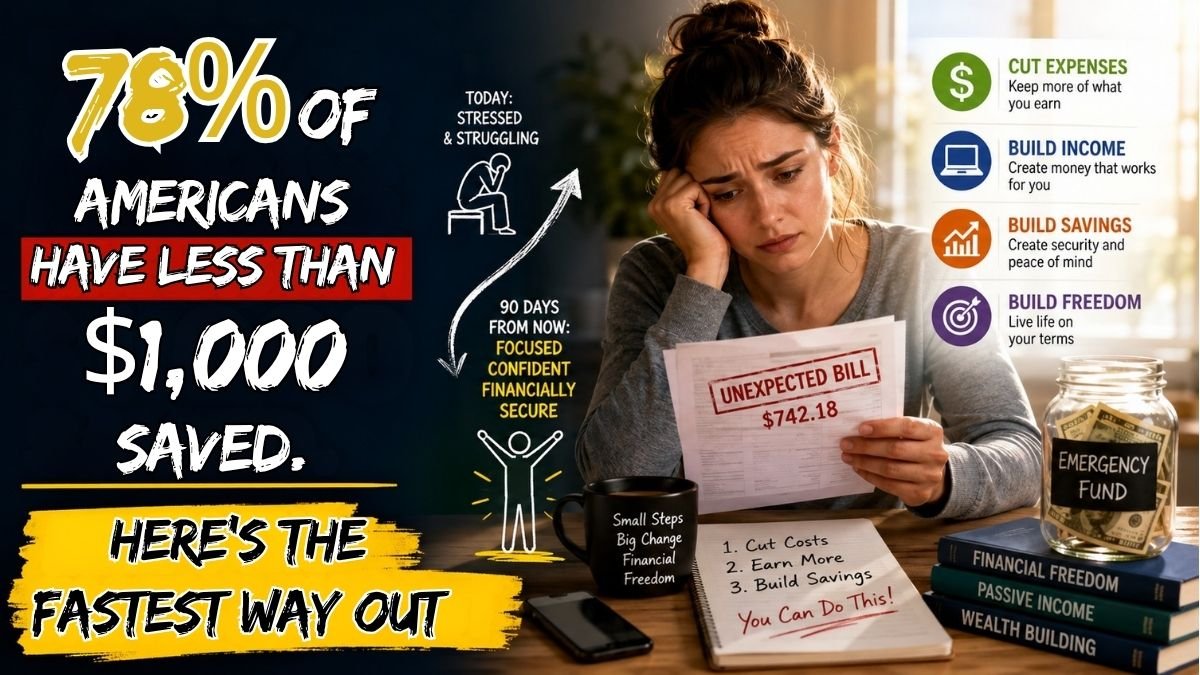
One unexpected bill. That’s all it takes to wipe out most Americans’ entire financial safety net.
If you just felt a sting reading that, you’re not alone. And if your savings account looks closer to zero than a thousand dollars right now, this may be the most important article you read this year.
The Savings Crisis Nobody Is Talking About Loudly Enough
The numbers are staggering. Multiple surveys and financial research studies confirm what millions of Americans already feel in their gut every month:
- According to a GOBankingRates survey, nearly 60% of Americans have less than $1,000 saved, and a full 36% report having less than $100 in their savings accounts.
- A 2025 Credible survey of over 1,000 Americans found that 2 in 3 Americans do not believe they will ever save enough to feel financially secure.
- 1 in 5 Americans had $0 in their savings account at some point in the past six months.
- A 2025 Bankrate report confirmed that 27% of U.S. adults have absolutely no emergency savings at all.
- More than one-third (36%) of Americans carry more credit card debt than emergency savings.
- 89% of younger Americans surveyed believe saving money is harder today than it was for their parents’ generation.
- The U.S. personal savings rate stood at just 5.1% as of mid-2025, compared to a historical average of nearly 9% and a peak of 16.3% during 2020.
These are not abstract economic statistics. They describe real families, real people, real stress. The gap between where most Americans are financially and where they need to be is enormous. And conventional advice like “skip your morning coffee” or “pack your lunch” is simply not going to close it fast enough.
The question is not whether you are behind. The question is: what do you do about it right now?
Why Most People Stay Stuck: The Real Reason Saving Is So Hard
Before diving into solutions, it is worth understanding why the savings gap keeps growing. Many people assume the problem is discipline or laziness. The data says otherwise.
Here are the core forces working against the average American’s savings:
| Factor | Impact on Savings |
|---|---|
| Rising cost of living (rent, groceries, healthcare) | Leaves little to no surplus after basic expenses |
| Credit card debt | 36% have more debt than savings; interest payments drain income |
| Stagnant wages vs. inflation | Real purchasing power has declined for most households |
| Single income dependence | One job loss equals immediate financial crisis for 69% of households |
| No financial education | Most schools never teach wealth-building strategies |
| Subscription and lifestyle creep | Recurring charges silently drain hundreds per month |
The combined weight of these forces means that budgeting alone cannot solve the problem for most households. You cannot simply cut your way to financial freedom when expenses are rising faster than income. The math does not work. That means the only real path forward involves two things working together: spending smarter and earning more.
Step One: Plug the Leaks First (Frugal Living Done Right)
The foundation of any savings recovery plan starts with stopping the bleeding. This is not about punishing yourself. It is about removing friction between your current income and your savings goal.
Here are the fastest high-impact moves to cut costs immediately:
Audit and Cancel Subscriptions
Most households are paying for 3 to 5 services they no longer actively use. Streaming platforms, gym memberships, apps, and software subscriptions can easily add up to $150 to $300 per month. Cancel anything you have not used in the last 30 days.
Switch to Store Brands and Buy in Bulk
On groceries alone, switching from name brands to store brands and planning meals in advance can save a household $200 to $400 per month without changing what you eat.
Track Every Dollar for 30 Days
Financial research consistently shows that people who track their spending, even for just one month, identify an average of $300 to $500 in unnecessary expenses they did not know they had. Use any free budgeting app or a notebook. The tool does not matter. The habit does.
Negotiate Your Recurring Bills
Internet, insurance, and phone bills are all negotiable. A single 15-minute phone call to your provider, asking for a loyalty discount or threatening to cancel, can cut those bills by 20% to 40%. Most people never ask.
The 24-Hour Purchase Rule
Before any non-essential purchase over $50, wait 24 hours. This one habit alone eliminates most impulse spending and is one of the simplest tools frugal high-earners use consistently.
If you want a structured, step-by-step system for mastering frugal living without feeling deprived, a resource like Frugal Freedom gives you a proven framework to spend strategically and redirect money toward real wealth-building goals rather than just surviving paycheck to paycheck.
Step Two: Build Income That Does Not Depend on Trading Hours for Dollars
Here is the hard truth that most financial advice skips over: you cannot save money you do not have.
For the millions of Americans whose income barely covers their basic needs, frugality alone is a band-aid on a broken arm. The real breakthrough comes when you add new income streams that operate independently of your main job.
The good news? The digital economy has made this more accessible than at any point in history.
What Is Passive Income and Why Does It Change Everything?
Passive income refers to money earned with minimal active effort after the initial setup. Unlike a traditional job where you trade time directly for pay, passive income systems can generate revenue while you sleep, while you work your regular job, or while you spend time with your family.
According to US Census Bureau data, around 20% of US households already earn passive income, with a median earning of approximately $4,200 per year. That figure alone, added to a regular income, could more than double the savings of most struggling Americans within a single year.
The most accessible passive income models in 2025 include:
- Affiliate marketing: Earning commissions by promoting other people’s products or services online
- Digital products: Creating and selling ebooks, courses, or templates that deliver value at scale
- Automated online systems: Leveraging done-for-you platforms that handle the heavy lifting of selling, delivery, and customer service
- Dividend investing: Owning shares in dividend-paying companies or ETFs that pay you regularly
- Content monetization: Building a blog, YouTube channel, or newsletter that attracts an audience and earns advertising or affiliate revenue
According to 2025 research, digital product affiliates routinely earn commissions of 20% to 50% per sale, compared to single-digit returns on physical goods. That commission structure means you can earn meaningful income faster with less traffic and fewer customers.
Step Three: Use a Proven System, Not Guesswork
Most people who attempt to build passive income online fail not because the opportunity is not real, but because they are trying to figure everything out alone. They spend months consuming free content, watching tutorials, and switching from strategy to strategy without ever committing to one proven path long enough to see results.
The difference between people who successfully build financial freedom online and those who give up after three months usually comes down to one thing: following a structured system designed by someone who has already done it.
What to Look for in an Online Income System
- A clear step-by-step roadmap designed for beginners with no prior experience
- Done-for-you components that reduce the technical barrier to entry
- Access to a community and ongoing mentorship
- Multiple income streams built into a single platform
- A realistic timeline and honest expectations about what it takes to succeed
One of the most talked-about systems for building automated online income in 2025 is the Passive Income System 2.0, which walks you through building a fully automated online income machine from scratch, even if you have never made a dollar online before. It combines affiliate marketing, email list building, and automated funnels into a single integrated approach that many beginners have used to generate their first consistent online income.
There are also more advanced investment-focused systems for those who want to build serious wealth beyond a side income. The Keystone Investors Club offers a VIP investment education community focused on helping everyday people access strategies typically reserved for high-net-worth investors, covering everything from portfolio building to wealth protection systems.
The Fastest Path From Zero to $1,000 Saved: A Practical Roadmap
Theory is useful. A concrete action plan is better. Here is a realistic 90-day roadmap for someone starting from near zero:
| Week | Action | Estimated Impact |
|---|---|---|
| Week 1 | Audit all subscriptions, cancel unused services, negotiate bills | Save $100 to $300 per month |
| Week 2 | Set up a dedicated savings account; automate $25 per week transfer | Build the savings habit immediately |
| Week 3 to 4 | Choose one online income system; complete onboarding and setup | Foundation for new income stream |
| Month 2 | Publish first content or activate affiliate system; build consistently | First income signals ($0 to $200) |
| Month 3 | Scale what is working; redirect all new income to savings | First $500 to $1,000+ milestone |
This is not a get-rich-quick plan. It is a get-started-now plan, which is what most people actually need. The goal in the first 90 days is not wealth. It is momentum, a real emergency fund, and a functioning income system that keeps growing.
Why Most Financial Advice Fails People in This Situation
A significant part of mainstream personal finance advice is designed for people who already have a surplus. Advice like “max out your Roth IRA” or “invest 15% of your income” is excellent guidance, but it assumes you have 15% of your income to spare. Most Americans do not.
What people in a genuine savings crisis need is:
- Immediate cash flow relief, not long-term portfolio allocation
- New income sources, not just tighter budgets
- Accessible tools that do not require $10,000 to get started
- Community and accountability to stay consistent through the early months
- Honest, realistic expectations rather than overnight-success promises
The digital economy satisfies all five of these requirements. Affiliate marketing, online courses, automated sales funnels, and investment education platforms can all be started with minimal capital and scaled at your own pace, while still holding down your regular job.
Common Mistakes to Avoid When Trying to Build Savings Fast
Even with the right plan in place, certain mistakes can derail your progress. Here are the most common ones, and how to avoid them:
- Trying to do everything at once. Pick one income system and master it before adding a second. Spreading attention across five strategies guarantees mediocre results in all of them.
- Saving what is left over instead of paying yourself first. Automate your savings transfer the moment your paycheck arrives. Do not wait to see what is left at the end of the month. There will never be anything left.
- Waiting for the perfect moment to start. There is no perfect moment. Every week you delay is another week of lost compounding, both on savings and on the growth of any online income system.
- Ignoring the psychology of money. Financial stress is one of the biggest drivers of poor financial decisions. Small wins matter enormously. Hitting your first $100 saved, then $500, then $1,000 rewires your relationship with money in ways that compound over time.
- Buying into “zero-effort” income promises. Real passive income systems require real work upfront. Any program promising instant wealth with no effort deserves skepticism. Legitimate systems promise a proven roadmap, not a magic button.
Who This Path Is For and Who It Is Not For
It is important to be honest about this. Building passive income online is not for everyone in every situation. Here is a quick clarity check:
| You Are a Good Fit If… | This May Not Be Your First Step If… |
|---|---|
| You can dedicate 5 to 10 hours per week to learning and building | You are in a debt emergency that requires immediate debt restructuring |
| You are willing to follow a proven system consistently for 90+ days | You are expecting fast results with no effort or investment of time |
| You want to build income that outlasts your job | You have never budgeted before and need cash flow basics first |
| You are open to learning new digital skills | You need immediate income within the next 7 days |
If you are in the “good fit” column, the combination of smart frugal habits plus a structured online income system is genuinely one of the fastest paths to building your first $1,000 and beyond.
The Bottom Line: Your Savings Crisis Is Solvable
Here is what the data actually tells us when you step back and look at the full picture:
- Tens of millions of Americans are in the same financial position as you right now
- The traditional “work more, spend less” approach is no longer sufficient in today’s economy
- The digital economy has created legitimate, accessible pathways to additional income that did not exist a decade ago
- The gap between people who build financial security and people who do not is increasingly about the systems they use, not their intelligence or work ethic
You do not need to go from $0 to $100,000 overnight. You need to go from financial paralysis to financial momentum. That starts with one decision: to do something different than what you have been doing.
The most powerful first move you can make today is to commit to two things simultaneously:
- Immediately cut the 3 biggest unnecessary expenses in your current budget
- Begin building one structured online income stream using a proven system
The statistics say most Americans are stuck. But statistics describe populations, not individuals. Individuals with the right tools, the right system, and the right commitment write completely different stories.
Your financial future is not determined by where you are today. It is determined by what you do next.
Disclosure: This article contains affiliate links. If you purchase through these links, we may earn a commission at no extra cost to you. We only recommend resources we believe provide genuine value to our readers.