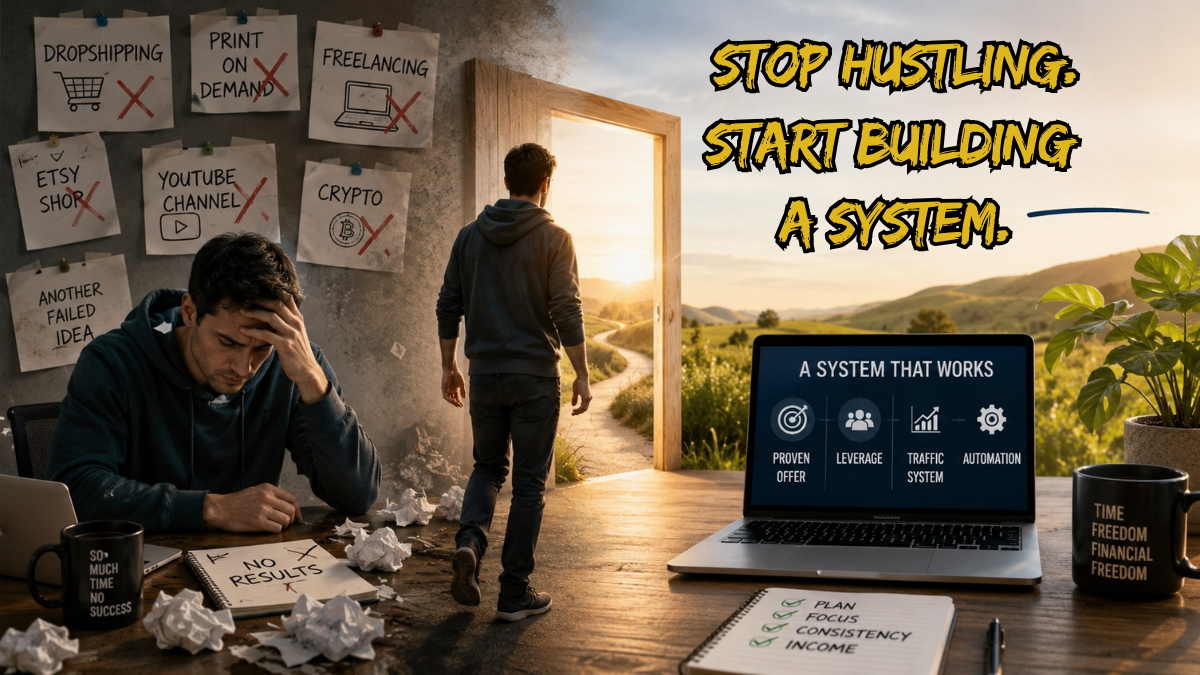
You did everything the internet told you to do. You tried dropshipping. You dabbled in print-on-demand. You opened an Etsy shop, launched a freelance profile, maybe even started a YouTube channel. And yet, here you are — still waiting for that first real paycheck that changes things.
You are not lazy. You are not unlucky. And you are almost certainly not the problem.
The problem is that you were handed a hustle, not a system.
This article breaks down exactly why most people cycle through side hustles and get nowhere, what the actual difference is between a hustle and a system, and how to step into the model that quietly earns for people while they sleep — without needing to reinvent the wheel.
The Brutal Truth Behind Side Hustle Failure Rates
Before diving into the solution, you need to understand the scale of the problem — because it goes far deeper than “not working hard enough.”
A staggering 70% of side hustles fail within their first year. In communities without access to proper frameworks, that number climbs even higher, with only 8% generating consistent income. A 2024 SideHustle Nation survey found that over 35% of people said their side gig cost them more than it ever earned them.
Meanwhile, a 2025 survey revealed that 67% of side hustlers are experiencing burnout, and 52% say it only feels worth it if they earn more than $500 per week — a threshold most never reach.
These are not isolated horror stories. This is a pattern. And patterns have causes.
Why the Hustle Model Is Broken by Design
Most side hustle advice online is built around one thing: activity, not architecture. Here is what is actually killing your results:
| Common Hustle Mistake | Why It Fails |
|---|---|
| Jumping from one idea to the next | Builds zero compounding momentum or reputation — you reset to zero every single time |
| Chasing trending niches | Markets are already saturated by the time most people arrive to them |
| Treating it like a hobby | No systems, no scaling, no sustainability — hobbies do not compound into income |
| Vague goals like “make extra money” | Research shows 60% of failed hustles lacked specific, measurable targets |
| Building before validating demand | 42% of side hustles collapse because no one actually wanted the product or service |
| Optimizing for passion, not problems | Markets pay for solutions to real problems — not for enthusiasm about the topic |
The side hustle content machine thrives on what researchers now call opportunity addiction — the cycle of jumping from dropshipping to affiliate marketing to crypto trading to print-on-demand, where each new idea feels like progress but is, in reality, sophisticated procrastination. The entrepreneurs making six figures from online income are not necessarily smarter. They simply stayed in one lane long enough to build systems, reputation, and compound returns.
The Missing Piece: A System, Not a Side Hustle
Here is a distinction that almost no one talks about, yet it changes everything:
A side hustle trades your time for money.
A system builds an asset that earns without your constant presence.
Think about it this way. A freelancer who writes articles for $30 each is hustling. A person who builds a content platform that attracts traffic and earns commissions around the clock — that person has a system. Both may start from the same place. The difference is the architecture they chose.
The highest-earning online income earners are not working ten times harder than you. They are working inside proven frameworks that have built-in leverage, automation, and compounding. And the good news is that access to those frameworks has never been more open.
The 4 Pillars of a Real Income System
Every sustainable online income model shares four structural pillars. If any one of these is missing, the whole thing collapses:
- A proven offer. You need something the market already wants to buy — not something you hope they will. Validated demand is non-negotiable.
- Leverage. Your income must not be directly tied to hours worked. Digital products, affiliate commissions, and recurring memberships all have leverage built in.
- A repeatable traffic source. Whether organic SEO, email, or paid traffic, you need a consistent way to get people in front of your offer without starting from zero each time.
- Automation and systems. The work you do today should continue earning tomorrow. Email sequences, sales funnels, and platforms that handle transactions while you sleep are how this happens.
This is what separates the 10 to 20% of side income earners who actually succeed from the 80% who burn out and quit. Not talent. Not luck. Structure.
Where Most People Are Right Now (And Why That Is Actually Good News)
If you have tried multiple side hustles and failed, you are not behind. You are, in fact, farther along than you realize — because you have already cleared the most dangerous obstacle in the path: blind optimism.
You now know what does not work for you. That narrows the field considerably. The next step is not trying harder at the same broken model. It is choosing the right model to begin with.
The three income models with the highest success rates for beginners with limited time are:
- Affiliate marketing — Earning commissions by promoting products that already have proven sales and customer bases, with no inventory, no customer service, and no product creation required.
- Passive income systems — Structured programs that provide the offer, the funnel, and the training in one package, so you are not building from scratch.
- Investment and wealth-building frameworks — Learning how money actually moves and grows, through equity, crypto, or structured investment programs, with guidance from those who have already done it.
These are not new ideas. But most people approach them incorrectly — by jumping in without a system behind them. The solution is not the idea itself. It is the infrastructure you plug it into.
Proven Systems Worth Your Serious Attention
After filtering through the noise, here are structured programs and systems designed specifically to give you the architecture that most side hustles never provide. These are not get-rich-quick promises. They are systems with track records, clear frameworks, and communities of real people generating real results.
1. Passive Income System 2.0
One of the most structured beginner-to-advanced affiliate income systems available today. Passive Income System 2.0 is built around giving you a complete, step-by-step blueprint — from selecting the right offers to driving consistent traffic and building automated income streams. Rather than leaving you to figure out the pieces individually, this system provides the full architecture from day one. For anyone who has tried and failed at unstructured side hustles, this is the type of structured framework that changes outcomes.
2. Millionaire Partner System
Most people fail because they try to build everything alone. The Millionaire Partner System solves that problem by pairing you with a proven system where the heavy lifting — the offers, the funnels, the sales process — is already handled. Your role is to drive traffic. This model works especially well for people who have strong communication skills or an online presence but have no product of their own to sell. It is a leverage-based income model, not a time-for-money trade.
3. Keystone Investors Club
For those ready to go beyond basic affiliate income and into serious wealth building, the Keystone Investors Club offers a 3-year VIP access program with a one-time investment. This is a community and education platform focused on real investment strategy, monetary distribution, and building long-term financial momentum. If your goal is not just extra income but genuine financial independence, understanding how to allocate and grow capital is the skill set that makes everything else compound faster.
The Mindset Shift That Changes Everything
There is a deeply uncomfortable truth at the center of all of this. Most people who fail at side hustles are not failing because the market rejected them. They are failing because they never truly committed to one thing long enough for it to work.
A real-world example: Marcus, who now earns $3,500 per month online, almost quit at month four when he was only making $200. He stayed. Month eight is when results exploded. This is not an outlier story — it is the pattern. Success in online income systems comes right after the point where most people quit to chase the next trend.
Here is the mental model that protects you from the cycle:
- Stop measuring by weeks. Commit to a minimum 12-month horizon on any single system before evaluating its potential.
- Stop optimizing for passion first. Start by identifying what problems people already pay to solve, then build enthusiasm around becoming great at solving them.
- Stop building in isolation. The fastest learners join communities and programs where others are already succeeding at what they are trying to do.
- Start measuring by systems, not activity. Ask yourself not “how many hours did I work this week” but “what asset did I build or grow this week?”
- Reinvest early wins. The compounding snowball that leads to significant income starts with reinvesting your first commissions back into the system.
A Practical Roadmap: From Failed Hustle to Working System
If you are starting from scratch or starting over, here is a clear, step-by-step path forward based on what actually works:
| Phase | Action | Timeline |
|---|---|---|
| Phase 1: Choose | Select one income model — affiliate, partner system, or investment program — and commit to it fully. No side experiments. | Week 1 |
| Phase 2: Learn | Study the system you chose deeply. Understand the offer, the traffic source, and the funnel before taking any outward action. | Weeks 2 to 3 |
| Phase 3: Build | Create your traffic asset — a content channel, an email list, or a social presence. One platform only at this stage. | Weeks 4 to 8 |
| Phase 4: Optimize | Analyze what is working. Double down on the highest-performing content or traffic source. Cut what is not moving the needle. | Months 3 to 6 |
| Phase 5: Scale | Reinvest earnings into tools, paid traffic, or additional income streams within the same proven system. | Months 6 to 12 |
Notice that this roadmap does not include “launch five different things simultaneously” or “pivot to whatever is trending.” Clarity and consistency — executed inside a proven system — are the entire strategy.
What You Should Honestly Ask Yourself Before Starting Again
Before you invest time or money into any new income system, these are the questions that protect you from repeating the same cycle:
- Does this system have a proven track record, or is it based primarily on testimonials from people I cannot verify?
- Does this model require my constant, active attention to generate income, or does it have built-in leverage and automation?
- Is there a community of real practitioners I can learn from and stay accountable to?
- Am I willing to commit to this for at least 12 months without chasing the next opportunity?
- Does this system solve a real problem people are already paying to have solved?
If you can answer yes to all five, you are not looking at a side hustle. You are looking at a business system. That distinction is everything.
The Bottom Line
The internet is not short on side hustle ideas. What it is genuinely short on is honest guidance about the infrastructure those ideas need to actually work. Dropshipping is not a bad idea — unstructured dropshipping without a validated niche, a repeatable traffic source, and an automated backend is a bad implementation. Affiliate marketing is not a bad model — affiliate marketing done without a proven system, a clear offer, and a committed 12-month runway is a bad execution.
You have not failed at side hustles. You have been given hustles when what you needed was a system.
The shift is available to you right now. Choose a proven framework, commit to the architecture, and give it the runway it deserves. The compounding will come — but only if you are still standing when it does.
Start with one. Build the foundation. The income follows the system, not the hustle.
Disclosure: This article contains affiliate links. If you click through and make a purchase, we may earn a commission at no additional cost to you. We only recommend systems and programs we believe provide genuine value.