Most people will read this headline, scroll past it, and return to trading 40 hours a week for a paycheck that barely keeps pace with inflation. You are not most people.
Between 2020 and 2024, wages grew 18%. Inflation grew 21%. The math is not in your favour. Yet right now, a historic wealth transfer is quietly underway, and the people positioning themselves inside it are not hedge fund managers or Silicon Valley insiders. They are writers, investors, content creators, and ordinary individuals who decided to stop renting out their time and start building systems that earn while they sleep.
This is not hype. The data behind the passive income economy is staggering, and most people have no idea how accessible it has become. Read every word of what follows. The statistics alone will change how you think about money.
The Numbers That Should Stop You Cold
Before exploring the how, it is worth sitting with the why, because the scale of this opportunity is genuinely difficult to absorb.
| Metric | Figure | Source |
|---|---|---|
| Global passive AuM projected by 2030 | $70 trillion (CAGR: 10%) | PwC 2025 Global Asset & Wealth Management Report |
| Global affiliate marketing industry value (2025) | $17+ billion | Authority Hacker / Yahoo Finance |
| Affiliate marketing projected value by 2030 | $38.35 billion | Authority Hacker / Yahoo Finance |
| Affiliate marketing CAGR | 15.44% | Multiple industry reports |
| Creator economy value (2025) | $250 billion | Creator Economy Survey Data |
| Americans who believe passive income is essential for retirement | 88% | IPX1031 Survey, August 2025 |
| Americans with at least one passive income stream (2026) | 28% (up from 16% in 2021) | AFEUSA, 2026 |
| Americans earning meaningful passive income (>$500/month) | Only 12% | Federal Reserve Survey of Household Economics, 2024 |
| Brands using affiliate programs | 81% | Rakuten |
| Average affiliate marketer monthly income | $8,000 to $10,000 | HubSpot / Influencer Marketing Hub |
Let that last row sink in. The average affiliate marketer earns between $8,000 and $10,000 per month. Not the top 1%. The average. Meanwhile, only 12% of Americans earn meaningful passive income. That gap, between what is possible and what most people are actually doing, is the opportunity.
Why Right Now Is the Critical Window
Passive income has always existed. What has changed is accessibility.
Ten years ago, building a meaningful income stream outside a 9-to-5 required significant capital, connections, or both. Today, the barriers are lower than they have ever been, and three macro forces are compressing the window to act:
- Inflation erosion is permanent. Real purchasing power for the average worker has declined. A single income stream tied to employment is structurally fragile in a way it was not a generation ago.
- Digital infrastructure is now mature. The platforms, tools, and marketplaces that make passive income scalable were either experimental or non-existent five years ago. They are now stable, tested, and growing.
- AI is radically compressing setup time. Tasks that once required months of manual work, from content creation to SEO optimisation to building digital products, can now be completed in days. The people who combine AI tools with smart income strategies are accelerating far ahead of everyone else.
The window is open. But markets mature. The affiliate marketing space, for example, is growing at a 15.44% CAGR, which means early participants compound advantages that later entrants cannot replicate. The investors who entered dividend ETFs in 2015 are collecting yields that new investors can only dream of achieving on the same capital.
This is not a warning to panic. It is a reason to move with intention, starting today.
The 5 Most Proven Passive Income Streams in 2025-2026
Not all passive income is equal. Some streams require capital. Others require time and creativity. The ones below represent the highest ratio of proven results to realistic entry requirements for most people.
1. Affiliate Marketing: The Highest-Leverage Digital Income Stream
Affiliate marketing is the practice of promoting other companies’ products and earning a commission on each sale made through your unique link. It requires no inventory, no customer service, and no product development. Once a piece of content is live and ranking, it generates commissions around the clock with no additional input from you.
The numbers behind this channel are exceptional:
- The global affiliate marketing industry is projected to grow from $17 billion in 2025 to $38.35 billion by 2030, a near-doubling driven by a 15.44% annual growth rate.
- 81% of brands now use affiliate programs, meaning the supply of offers available to affiliates is essentially unlimited.
- Affiliate channels influence 16% of all e-commerce sales in North America.
- 35% of affiliates earn at least $20,000 per year. The top 9% earn over $50,000 annually.
- 86% of publishers expect their affiliate revenue to remain stable or increase in the near future.
- Companies earn between $6.50 and $15 for every $1 spent on affiliate commissions, which is why 81% of brands maintain programs and are unlikely to cut them.
The most effective approach in 2026 is niche authority content. Rather than promoting random products to a broad audience, the highest earners build trust in a specific domain, whether that is personal finance, home improvement, software tools, or health and wellness, and recommend products with genuine insight. The trust gap between a generic review and an expert recommendation translates directly into conversion rates, and conversion rates translate directly into income.
SaaS products and financial tools are particularly lucrative in the affiliate space, with commission rates between 20% and 70% on software subscriptions. Because subscription products recur monthly, a single referral continues generating income for as long as the customer remains subscribed. This compounding effect is why the top affiliate earners in these niches generate income that looks more like investment returns than earned wages.
| Income Tier | Annual Earnings | % of Affiliates |
|---|---|---|
| Beginners / early stage | Below $10,000 | ~57% |
| Intermediate earners | $10,000 to $50,000 | ~29% |
| Advanced earners | $50,000 to $150,000 | ~11% |
| Top performers | Above $150,000 | ~3.78% |
The key variable separating the top tier from beginners is not luck or connections. It is strategy, consistency, and niche depth. Affiliates with more than three years of focused experience earn 9.45 times more than those just starting.
2. Dividend Investing: The Compounding Machine
Dividend investing is the oldest form of passive income, and it remains one of the most reliable. The principle is straightforward: you own shares in companies that distribute a portion of their earnings to shareholders regularly, typically quarterly. The income arrives whether or not you check your portfolio.
What makes dividend investing particularly powerful in the current environment is the combination of yield and compounding. When dividends are reinvested, they purchase more shares, which generate more dividends, which purchase more shares. Over 10 to 20 years, this compounding effect transforms modest initial investments into significant income streams.
For investors seeking diversification without the risk of picking individual stocks, dividend ETFs like SCHD offer a compelling structure: broad exposure to high-quality dividend-paying companies, low expense ratios, and a track record of consistent, growing payouts. The Schwab U.S. Dividend Equity ETF, for example, has grown its dividend payments by 16.4% annually since 2011, far outpacing inflation.
Key benchmarks for dividend investors to understand:
- The S&P 500 has returned approximately 10% annually over 50 years, including dividends reinvested.
- Many established companies offer dividend yields of 3% to 5%, with histories of consistent annual increases.
- A $10,000 investment in a stock yielding 4% generates $400 per year passively, before compounding.
- Passive AuM globally is projected to grow at a 10% CAGR to reach $70 trillion by 2030, according to PwC’s 2025 Global Asset & Wealth Management Report.
- Real estate investment trusts (REITs) offer real-estate-linked dividends without property management, with platforms reporting average annual returns between 8% and 12%.
The common mistake beginner investors make is seeking the highest yield rather than the most sustainable yield. A 12% yield that gets cut in a downturn produces less long-term income than a 4% yield that grows reliably for 20 years. Quality and consistency beat short-term maximisation every time.
3. Digital Products: Create Once, Sell Forever
The creator economy reached $250 billion in 2025, and within it, digital products represent the highest ratio of passive income to ongoing effort. An e-book, template, course, or software tool is created once and sold an unlimited number of times with zero marginal cost per unit.
The global e-learning market alone is projected to reach $457.8 billion by 2026, signalling the scale of appetite for knowledge-based digital products. Creators who identify a specific skill or problem and package the solution into a clear, well-positioned product are finding that their digital storefronts generate consistent monthly revenue with minimal maintenance.
What works in 2025 and 2026:
- Templates and tools (spreadsheet templates, Notion dashboards, Canva kits) for small business owners and freelancers
- Niche online courses solve a specific, high-value problem rather than broad beginner surveys
- E-books and guides are positioned around search intent rather than broad topics
- Premium newsletter subscriptions combining curated insight with original analysis
The realistic income range for digital product creators spans from $100 to over $10,000 per month, with the primary differentiator being the quality and specificity of the product and the effectiveness of the distribution channel used to reach buyers.
4. Content Monetisation Through Affiliate Channels
A blog, YouTube channel, or podcast built around a specific topic can generate income from multiple streams simultaneously: advertising revenue, sponsored placements, and affiliate commissions. The last of these typically produces the highest return per visitor because the income scales with conversion rather than with raw traffic volume.
Podcast ad revenue hit $4 billion in 2025. YouTube creators earn between $3 and $5 per 1,000 views through AdSense alone, with affiliate income layered on top. Evergreen content, tutorials, reviews, and comparison pieces that answer search queries continue to generate traffic and income long after it is published, making them a genuine passive asset.
The most successful content-based passive income strategies in 2026 combine SEO-driven content with affiliate partnerships in high-commission niches. Finance, software, health, and home improvement consistently produce the highest affiliate earnings per piece of content because the products carry high price points and strong customer intent.
5. Real Estate Crowdfunding and REITs
Real estate has historically been the most reliable path to generational wealth, but direct property ownership requires significant capital and active management. Modern platforms have removed both barriers. Real estate crowdfunding allows investors to participate in commercial and residential properties with as little as $10, receiving quarterly dividend distributions from rental income and property appreciation.
Platforms in this space report average annual returns of 8% to 12%, significantly higher than most savings instruments. REITs traded on public exchanges offer even more liquidity, allowing investors to enter and exit positions without the complexity of direct property transactions.
The 28% Problem (And How You Solve It)
Here is the uncomfortable reality that most passive income content glosses over.
Only 28% of Americans currently have even one passive income stream. Of those, only 12% earn more than $500 per month from it. The gap between the 72% who want passive income and the 12% who are actually earning meaningful amounts from it comes down to one pattern: scattered effort.
Most people who fail at passive income try multiple strategies simultaneously, build nothing to completion, generate no meaningful results, and conclude that passive income does not work. The people who succeed pick one vehicle, build it to a functioning level before adding a second, and treat the initial phase as the most demanding and important work they will do.
The honest timeline for common passive income streams:
- Affiliate marketing: First commissions within 1 to 3 months. A consistent four-figure monthly income typically requires 12 to 24 months of focused effort.
- Dividend investing: First payout at the next quarterly distribution date after purchase. Meaningful income at scale requires years of consistent capital deployment and reinvestment.
- Digital products: First sale possible within weeks of launch. Consistent monthly income typically develops over 6 to 12 months as distribution channels mature.
- Content monetisation: Initial ad and affiliate income typically appears within 3 to 6 months. Substantial passive income usually requires 18 to 36 months of consistent content publishing.
These timelines are not discouraging. They are clarifying. The person who starts today and works consistently for 24 months will be generating income that the person who waits another year simply cannot match, because time in the market, whether in investment accounts or content libraries, compounds.
What Millionaires Actually Do (The IRS Data)
The IRS data on high-net-worth individuals reveals a pattern that personal finance professionals reference constantly: the average millionaire maintains seven income streams. Not seven jobs. Seven streams, most of which operate simultaneously without requiring proportional time input.
Those seven streams typically include a combination of:
- Earned income from primary employment or business ownership
- Dividend income from stocks and ETFs
- Interest income from bonds and savings instruments
- Rental income from real estate or REITs
- Capital gains from investment portfolios
- Business income from side ventures or digital assets
- Royalties or commission income from intellectual property or affiliate channels
The insight here is not that you need seven streams immediately. It is that financial resilience is built through diversification over time. Each stream you add reduces your dependence on any single source and increases the total income floor that protects you in downturns.
As Warren Buffett put it: “If you don’t find a way to make money while you sleep, you will work until you die.” This is not a quote about wealth as a luxury. It is a structural observation about the economics of labour versus capital.
Building Your Passive Income Stack: A Practical Framework
The following framework is designed for someone starting from scratch or looking to systematise scattered efforts into a coherent strategy.
Step 1: Audit Your Current Position
Before adding any stream, understand where you are. Answer these four questions:
- Do you have capital to invest, or time to invest, or both?
- Do you have an existing audience, professional expertise, or creative skill that can be monetised?
- What is your realistic monthly time budget for building a new income stream?
- What is your risk tolerance? (Capital-based streams like dividend investing carry market risk; content-based streams carry time risk)
Step 2: Choose Your Primary Vehicle
| Your Primary Asset | Best Starting Stream | Time to First Income | Upside Ceiling |
|---|---|---|---|
| Capital ($1,000+) | Dividend ETFs / REITs | Next quarterly payout | Scales with capital deployed |
| Writing skill + SEO knowledge | Affiliate content blog | 1 to 3 months | $10,000+ per month at scale |
| Professional expertise | Digital product (course/template) | 2 to 8 weeks post-launch | $5,000 to $50,000+ per month |
| Video / audio presence | YouTube or podcast + affiliate | 3 to 6 months | Substantial; grows with audience |
| Capital ($10+) | Real estate crowdfunding | Next quarterly distribution | 8% to 12% average annual return |
Step 3: Execute With Depth Before Width
The most common passive income mistake is horizontal expansion before vertical depth. Build one stream to the point where it generates a consistent monthly income before starting a second. This approach ensures you actually understand what works, which makes building subsequent streams dramatically faster.
Step 4: Reinvest Early Returns
In the first 12 to 24 months, resist the temptation to spend passive income as it arrives. Reinvest it. In dividend accounts, this means activating dividend reinvestment. In content-based streams, this means reinvesting earnings into better tools, content promotion, or paid traffic to accelerate the compounding of audience growth.
Step 5: Add a Second Stream at the 12-Month Mark
Once your primary stream is stable and generating consistent income, add a complementary stream. The most effective pairings are:
- Affiliate content blog + dividend investing (earned and capital income)
- Digital products + affiliate marketing (complementary monetisation of the same audience)
- Dividend ETFs + real estate crowdfunding (diversified capital income)
- YouTube channel + digital products (audience monetised through multiple conversion points)
The Affiliate Marketing Deep Dive: Your Fastest Path to Digital Passive Income
Given its combination of low entry cost, high earning ceiling, and structural growth, affiliate marketing deserves closer examination as a starting point for most people who do not yet have significant investable capital.
The mechanics are simple. You create content (a blog post, YouTube video, social media profile, or newsletter) that helps people make informed decisions about products or services. Within that content, you include tracked links to those products. When someone clicks your link and makes a purchase, you earn a commission. The content keeps earning for as long as it gets traffic.
What distinguishes the people earning $8,000 to $10,000 monthly from those earning nothing:
- Niche specificity: The highest earners own a specific territory, personal finance for freelancers, project management software comparisons, and plant-based nutrition for athletes. Generalist content converts poorly.
- Search intent alignment: Content created around phrases that buyers type when they are close to a purchasing decision (“best X for Y”, “X vs Y”, “X review 2026”) converts far better than informational content.
- Product selection: High-commission categories (SaaS, financial products, education, health) generate far more income per conversion than low-margin physical goods.
- Trust building: Readers who believe a recommendation is genuine click and convert. Readers who sense they are being sold do not. The entire structure of successful affiliate content is built on earning and maintaining genuine trust.
For those ready to begin building a content-based affiliate income stream, a tool like SEMrush provides the keyword research, competitor analysis, and content audit capabilities that remove the guesswork from building content that ranks and converts. Understanding what your target readers are searching for, how competitive those search terms are, and how existing content is performing transforms content creation from creative guesswork into a data-driven income-building process.
Platforms and Networks Worth Knowing
- Amazon Associates: Market leader with over 900,000 affiliates and a 46.27% market share. Lower commission rates but unparalleled product range and conversion rates.
- ShareASale and CJ Affiliate: Broad networks covering thousands of merchants across every niche imaginable.
- Impact and Awin: Enterprise-grade networks used by major brands, typically offering higher commissions and more reliable tracking.
- Direct SaaS programs: Many software companies run their own programs, paying 20% to 70% recurring commissions. These are the highest-value relationships for serious affiliate marketers.
Avoiding the Traps That Kill Passive Income Businesses
For every person generating meaningful passive income in 2026, several others have tried and failed. Understanding the common failure patterns protects your time and effort.
- Treating passive income as immediately passive. Every income stream requires significant upfront work. The passive element comes later, after the system is built. People who expect passive results from week one will abandon strategies that would have produced significant income by month twelve.
- Chasing commission rates over audience fit. A product paying 50% commission generates zero income if your audience has no interest in it. Match products to genuine audience needs, not maximum commission potential.
- Ignoring platform dependency risk. Income that flows entirely through one platform (a single social channel, a single affiliate network) is fragile. The most resilient passive income businesses own their audience through email lists and build income across multiple platforms.
- Optimising too early. Many content creators spend enormous time tweaking their website design or social profiles when they should be creating the content that drives traffic. Volume and quality of output, in the early stages, matter more than visual polish.
- Comparing month-one results to someone’s year-five results. The passive income space is full of income reports from established creators. These are useful for understanding ceiling potential, not for benchmarking your early progress.
The $7.4 Trillion Context: Where This Is All Heading
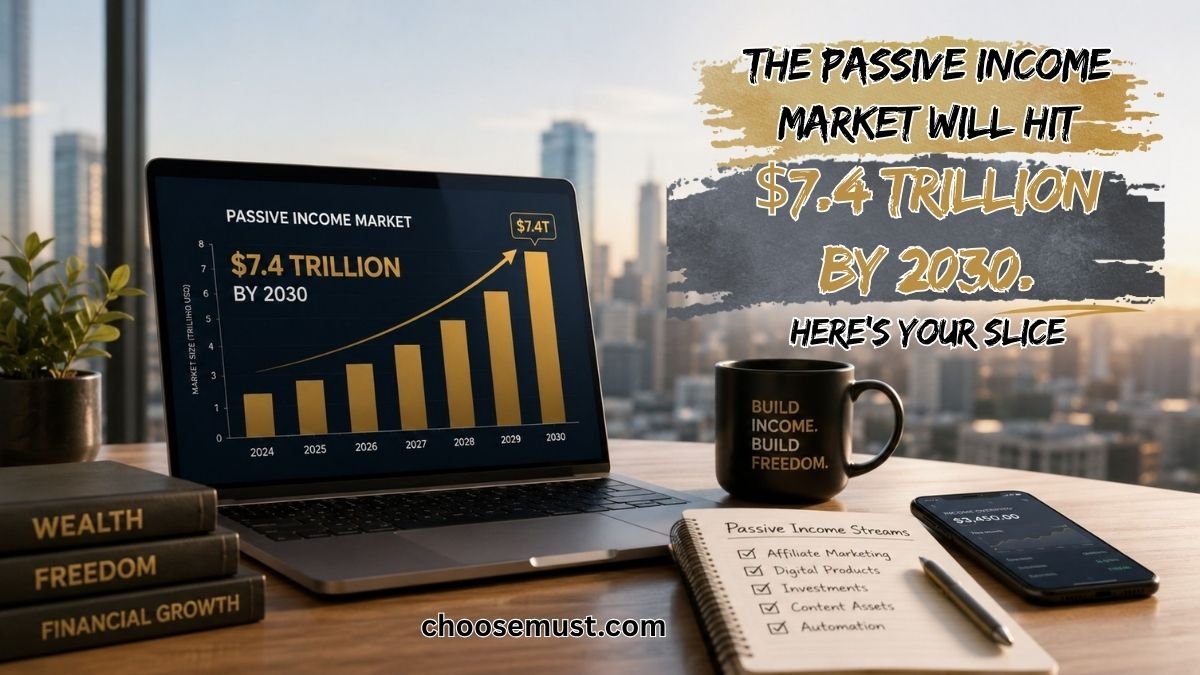
The $7.4 trillion figure in this article’s headline reflects the aggregate growth trajectory of passive income-generating assets: passive investment funds, creator economy revenues, affiliate and performance marketing, digital products, and real estate income streams, all of which are growing simultaneously and feeding into each other.
To put the scale in context:
- Passive AuM is projected to reach $70 trillion by 2030, growing at 10% annually.
- The affiliate marketing industry alone will reach $38.35 billion by 2030.
- The gig and creator economy, much of which is passive income-adjacent, is projected to reach $2.15 trillion by 2033.
- Global total investable wealth is projected to exceed $481 trillion, with passive income instruments accounting for a growing share.
The people who position themselves within this shift, even modestly, even with one well-chosen income stream started this year, will be compounding advantages in 2028 and 2030 that will feel unassailable to those who are still waiting for the right moment.
There is no right moment. There is only now, and the decision to either be inside the $7.4 trillion expansion or outside it, watching it happen to someone else.
Your Next Move: A No-Fluff Action Plan
Abstract strategy does not generate income. Specific action does. Here is what to do in the next seven days if you are serious about building a passive income stream in 2026:
- Day 1 to 2: Complete the self-audit from Step 1 of the framework above. Write down your answers. Be honest about your available time, capital, and skills.
- Day 3: Choose one vehicle from the framework table. Not two. One. Commit to building it for 90 days before evaluating results.
- Day 4 to 5: If your chosen vehicle involves content and affiliate marketing, research your niche using keyword tools. Identify 20 to 30 content topics with clear search intent and affiliate monetisation potential. If your chosen vehicle is dividend investing, open a brokerage account if you do not have one, and research two to three dividend ETFs that match your income and risk goals.
- Day 6 to 7: Create your first output. Publish your first content piece, make your first investment, or launch your first digital product listing. Imperfect action on day seven beats perfect planning that never reaches day eight.
For those building a content-based business with affiliate components, a host like Bluehost provides the foundation, domain, hosting, and WordPress integration that most affiliate blogs and content sites are built on, at a cost that removes any financial barrier to entry for a serious income-building project.
Final Word: The Real Question
The passive income market is not going to wait. The $7.4 trillion expansion is happening regardless of whether you participate in it. Every quarter that passes represents compounding that you either benefit from or watch others benefit from.
The statistics in this article are not designed to impress. They are designed to illustrate a simple, empirically supported truth: building income that does not require your direct daily labour is possible for ordinary people with ordinary starting points, it is happening right now at scale, and the primary barrier is not capital or talent or opportunity. It is the decision to begin.
83% of Americans believe having multiple income streams is essential for financial security. The question is not whether you agree. The question is whether you are going to do anything about it.
Frequently Asked Questions
What is the fastest passive income stream to start with no money?
Affiliate marketing through content creation (a blog or YouTube channel) is the fastest entry point with minimal upfront cost. First commissions can arrive within 1 to 3 months if the content is targeted toward purchasing-intent search queries in a focused niche.
How much money do I need to start dividend investing?
Many platforms now offer fractional shares, meaning you can begin with as little as $1. A meaningful income stream typically requires $10,000 or more invested at average dividend yields of 3% to 5%. The key is consistency of contribution and dividend reinvestment over time.
Is affiliate marketing still worth starting in 2026?
Yes. The affiliate marketing industry is growing at 15.44% annually and is projected to reach $38.35 billion by 2030. 81% of brands maintain affiliate programs, and 86% of publishers expect their affiliate revenue to grow or remain stable. The market is maturing but far from saturated in most niches.
How long does it realistically take to earn $1,000 per month passively?
For affiliate marketing: 12 to 24 months of consistent effort in a well-chosen niche. For dividend investing: depends on capital, but a $30,000 portfolio yielding 4% generates approximately $1,200 per year, not per month. For digital products, typically 6 to 18 months after launch, with effective distribution in place.
What do millionaires do differently with income?
IRS data consistently shows that high-net-worth individuals maintain an average of seven income streams, combining earned income with capital income (dividends, interest, rental income), business income, and royalties or commission-based income. The discipline is building multiple streams sequentially, not all at once.