What if your bank account grew while you slept, commuted, or spent a Saturday at the park with your family, and you didn’t have to walk away from your day job to make it happen?
That’s not a fantasy. That’s passive income done right. And right now, in 2025, it has never been more accessible to ordinary people with ordinary schedules.
I know what you might be thinking: “I’m already stretched thin. I don’t have time for a second job.” Here’s the truth: passive income isn’t a second job. It’s a system you build once (or plug into strategically) that pays you repeatedly. The goal is to front-load the effort so that the income flows long after you’ve stepped away.
The strategies below are the ones that have genuinely helped everyday people, nurses, teachers, accountants, and warehouse workers build an extra $500, $1,000, or even $3,000 per month on the side. Some require a small upfront investment of time or money. Others can start with zero dollars today. All of them are realistic.
If you want to skip the learning curve and plug straight into a proven income system, here are three highly recommended programs that thousands of people are using right now to build passive income from scratch:
- Passive Income System 2.0, A complete, step-by-step blueprint for building automated online income streams, even if you’re starting with zero experience.
- Millionaire Partner System, A structured affiliate income framework designed to help beginners generate commissions from day one, without needing a product, website, or technical skills.
- Keystone Investors Club, A VIP membership with training, tools, and an investor community to help you build AI-assisted, diversified income streams from the ground up.
Or keep reading to explore all 8 strategies in depth, understand which one fits your life, and take the first step with total confidence.
In this guide, you’ll learn:
- The 8 most effective passive income streams available in 2025
- Realistic income estimates and time commitments for each
- Exactly how to get started, step by step
- The biggest mistakes beginners make (and how to avoid them)
Let’s build your first $1,000/month, one stream at a time.
Why You Can Trust This Guide
The passive income space is littered with hype. “Make $10,000 in 30 days!” “I quit my job in a week!” You’ve seen the headlines. You’re right to be skeptical.
This guide is different. Every strategy listed here is grounded in how real passive income actually works, which means upfront effort, consistent systems, and realistic timelines. The income figures cited are drawn from verified reports, platform data, and documented case studies, not YouTube thumbnails.
The problem: Most people have no idea where to start, and they waste months spinning their wheels on the wrong strategies for their situation.
The solution: A clear, ranked list of income streams, organized by accessibility, time investment, and earning potential, so you can match the right method to your life.
The proof: According to data from multiple financial platforms, affiliate marketing, digital products, and dividend investing are consistently among the top sources of scalable passive income for people working full-time jobs. These aren’t experimental ideas. They’re established, working income models used by millions of people worldwide.
Now, let’s get into the strategies.
1. Affiliate Marketing, The Fastest Path to Passive Income Online
Time Commitment: 5–10 hours/week upfront; minimal ongoing
Income Potential: $300–$5,000+/month
Startup Cost: $0–$100
Affiliate marketing is one of the most powerful passive income models in existence, and it’s the one most recommended by financial experts for beginners. Here’s why: you don’t create a product, you don’t handle customer service, and you don’t manage inventory. You simply recommend products or programs you believe in, using a unique tracking link, and you earn a commission every time someone purchases through that link.
Unlike dropshipping or print-on-demand, which require product selection and design skills, affiliate marketing leverages your ability to recommend products and create content, skills anyone can develop. You could be working at your 9-to-5, sleeping, or on vacation when a commission hits your account.
The key is to choose high-quality, high-converting programs in niches with strong demand; finance, health, self-improvement, and online business education are perennial winners. Programs like the Passive Income System 2.0 and the Millionaire Partner System (featured at the top of this guide) are excellent starting points precisely because they are built around affiliate principles with done-for-you frameworks.
How to Get Started with Affiliate Marketing
- Choose your niche. Pick a topic you know or are genuinely curious about: finance, fitness, parenting, tech, or cooking. Passion keeps you consistent; demand keeps you profitable.
- Build a content platform. This could be a blog, a YouTube channel, a Pinterest account, or an email newsletter. Your platform is where your audience finds you.
- Join affiliate programs. Look for programs relevant to your niche with competitive commission rates. Many high-ticket programs pay 30–50% per sale.
- Create helpful, honest content. Write reviews, tutorials, comparisons, and guides that naturally include your affiliate links. Value-first content converts far better than hard selling.
- Drive traffic. Use SEO, social media, Pinterest, or email marketing to consistently bring new readers to your content.
Pro Tip: One major mistake beginners make is posting affiliate links randomly without providing value. Instead of spamming links, focus on creating helpful content — a blog post, review, or tutorial that naturally includes your affiliate links will convert better and build trust with your audience.
Common Pitfall: Trying to promote too many products at once. Start with 2–3 programs, master them, and then expand.
2. Sell Digital Products, Create Once, Earn Forever
Time Commitment: 5–20 hours upfront (one-time creation); 1–2 hours/week ongoing
Income Potential: $100–$3,000+/month
Startup Cost: $0–$50
Digital products are the definition of passive income. You create something once, an eBook, a template, a preset, a printable planner, a swipe file, and you sell it indefinitely with zero additional manufacturing cost. Every sale is pure profit minus platform fees.
Successful digital product creators often earn $500–$5,000 monthly by creating multiple complementary products that serve the same audience. The beauty of this model is that your digital product library compounds over time; each new product brings in new buyers who often purchase your other products too.
Best Types of Digital Products to Sell
- eBooks and guides: Share your expertise in a structured, downloadable format
- Templates: Canva templates, spreadsheet templates, resume templates, social media templates
- Printables: Planners, trackers, checklists, educational worksheets
- Digital art and photography: Sold on platforms like Etsy, Creative Market, or Adobe Stock
- Software tools and plugins: If you have coding skills, this is incredibly scalable
Where to Sell Your Digital Products
- Etsy: Best for printables, templates, and creative assets; massive built-in traffic
- Gumroad: Zero monthly fees, great for writers and creators
- Payhip: Simple setup, good commission structure
- Your own website: Maximum control and profits using Shopify or WooCommerce
Pro Tip: Use AI tools to accelerate the creation process. AI can help you outline eBooks, write first drafts, and generate design ideas, cutting your production time in half.
Common Pitfall: Creating products without first validating demand. Before spending 20 hours building something, do keyword research or check what’s already selling on Etsy to confirm people want it.
3. Create and Sell Online Courses, Turn Your Knowledge into Income
Time Commitment: 20–40 hours upfront; 2–3 hours/week ongoing
Income Potential: $500–$10,000+/month
Startup Cost: $50–$300 (microphone, basic video setup)
If you have expertise in anything, cooking, Excel, photography, fitness, personal finance, language learning, or dog training, you can package that knowledge into an online course and sell it to thousands of students around the world.
The e-learning industry is one of the fastest-growing sectors in the global economy. Platforms like Udemy, Teachable, and Kajabi have made it easier than ever to host and sell courses without building complicated infrastructure.
How to Build a Course That Sells
- Identify a specific transformation. The best courses take students from Point A (problem) to Point B (solution) with clear, measurable outcomes.
- Outline your curriculum. Break your knowledge into modules and lessons. Aim for 5–10 focused modules.
- Record your content. You don’t need a Hollywood studio. A decent smartphone, a $30 lapel mic, and good natural lighting are enough to start.
- Choose a platform. Udemy has built-in traffic; Teachable and Kajabi give you more control and higher margins.
- Market consistently. Email your list, post on social media, run webinars, and collect testimonials to build social proof.
Pro Tip: Focus on evergreen topics, subjects that remain relevant regardless of trends, such as personal finance, productivity, fitness, or professional skills.
Common Pitfall: Making the course too comprehensive and overwhelming. Students complete shorter, focused courses at higher rates, which leads to better reviews and more referrals.
4. Invest in Dividend Stocks and ETFs, Let Your Money Work for You
Time Commitment: 2–4 hours/month (research and review)
Income Potential: Scales with investment; $1,000/month typically requires $100,000–$300,000 invested
Startup Cost: As little as $50
Dividend investing is one of the most time-honored passive income strategies in existence. Dividend stocks pay you regular cash payouts simply for owning shares in stable companies. Companies like Coca-Cola, Apple, and Procter & Gamble have a history of consistent dividends.
The math is straightforward: if you invest in a diversified portfolio yielding an average of 4% annually, you need approximately $300,000 invested to generate $1,000/month. That sounds like a lot, but the key insight is that you start now and compound over time. Even $5,000 invested today grows substantially over 10–15 years when dividends are reinvested.
How to Get Started with Dividend Investing
- Open a brokerage account. Platforms like Fidelity, Charles Schwab, or M1 Finance offer no-fee accounts and fractional shares.
- Research dividend aristocrats. These are companies that have increased their dividends for 25+ consecutive years, a sign of financial stability.
- Diversify across sectors. Don’t put all your eggs in one basket. Spread across utilities, consumer staples, healthcare, and REITs.
- Reinvest your dividends. Use DRIP (Dividend Reinvestment Plans) to automatically reinvest payouts; compounding accelerates your growth significantly.
- Think long-term. Dividend investing rewards patience. The investors who win are those who stay consistent through market fluctuations.
Pro Tip: Real Estate Investment Trusts (REITs) are legally required to distribute at least 90% of taxable income to shareholders, making them excellent for dividend income without owning physical property.
Common Pitfall: Chasing ultra-high yields. A 15% dividend yield is often a red flag; the company may be in financial distress and likely to cut its dividend. Aim for sustainable yields in the 3–6% range from financially strong companies.
5. Print on Demand, Sell Custom Products with Zero Inventory
Time Commitment: 3–6 hours/week to set up designs; minimal ongoing
Income Potential: $200–$2,000+/month
Startup Cost: $0
Print on demand (POD) is a business model where you design custom products, such as t-shirts, mugs, tote bags, phone cases, and wall art, and a third-party service prints and ships them only when a customer orders. You never touch inventory, never ship a box, and never invest in bulk stock. When a sale happens, the platform handles everything; you simply collect your margin.
Top Print on Demand Platforms
- Printful, Premium quality, integrates seamlessly with Etsy and Shopify
- Redbubble, Built-in marketplace; great for artists and designers
- Merch by Amazon, Access to Amazon’s massive audience; competitive but lucrative
- Printify, Wide product range, competitive pricing
How to Succeed with Print on Demand
- Research winning niches. Target passionate communities, nurses, teachers, dog owners, gamers, and hikers. Niche-specific designs outperform generic ones dramatically.
- Create simple, high-quality designs. You don’t need to be a graphic designer. Canva offers hundreds of customizable templates.
- List products across multiple platforms. More listings mean more exposure and more chances to be found organically.
- Optimize your SEO. Use keyword-rich titles and descriptions to help customers find your products on marketplace platforms.
Pro Tip: Focus on evergreen designs that sell year-round rather than chasing seasonal trends exclusively. A great nurse humor t-shirt sells in January just as well as it does in May.
Common Pitfall: Creating designs that are too generic. “I Love Coffee” competes with thousands of listings. “NICU Nurse Fueled by Caffeine and Chaos” speaks directly to a specific, passionate audience.
6. Real Estate Crowdfunding, Own a Slice of Property Without Being a Landlord
Time Commitment: 1–2 hours/month
Income Potential: Scales with investment; typically 8–12% annual returns
Startup Cost: $500–$1,000 to start
Owning rental property is one of the most reliable paths to passive income, but it also comes with tenants, maintenance calls at midnight, and significant capital requirements. Real estate crowdfunding platforms solve all of that.
Platforms like Fundrise and RealtyMogul allow you to invest in real estate projects with as little as $500, without managing properties directly. You pool your money with other investors to fund commercial real estate developments, rental properties, and mortgage lending, and you receive quarterly distributions from the income those properties generate.
How Real Estate Crowdfunding Works
- Sign up on a platform like Fundrise, RealtyMogul, or Arrived Homes.
- Review available investment opportunities (residential, commercial, diversified portfolios).
- Invest your chosen amount; many platforms start at $10–$500.
- Receive quarterly or monthly distributions from rental income and property appreciation.
- Reinvest or withdraw your earnings as needed.
Pro Tip: Real estate crowdfunding is less liquid than stocks; some platforms lock up your funds for 5+ years. Only invest money you won’t need immediate access to.
Common Pitfall: Not diversifying across multiple properties or platforms. Spread your real estate investment across different geographic markets and property types to reduce risk.
7. Start a Niche Blog or YouTube Channel, Build an Audience That Pays You
Time Commitment: 5–10 hours/week for the first 6–12 months; reduces over time
Income Potential: $500–$10,000+/month at scale
Startup Cost: $50–$150 (domain, hosting)
A niche blog or YouTube channel is one of the best long-term passive income assets you can build. Once your content is published and ranking, it generates traffic and income indefinitely. A blog post you wrote two years ago can still bring in affiliate commissions and ad revenue today.
A blog is a powerful passive income asset that, once established, can generate income for years through display advertisements, affiliate marketing, digital product sales, and brand sponsorships. The critical word is “established”; this strategy takes longer to show results, but has enormous upside once it gains traction.
How to Start a Profitable Niche Blog
- Choose a profitable niche. Finance, health, self-improvement, technology, food, and parenting are proven categories with strong advertiser demand.
- Set up your blog. Use WordPress on a host like SiteGround or Bluehost. Purchase a custom domain, it signals professionalism to both readers and search engines.
- Publish consistent, high-quality content. Aim for at least 2 posts per week at launch. Focus on answering real questions your target audience is searching for.
- Apply semantic SEO principles. Don’t just target single keywords; create topic clusters that cover a subject comprehensively. This signals topical authority to Google.
- Monetize strategically. Start with affiliate marketing and ad networks (Google AdSense or Mediavine once you hit traffic thresholds), then add digital products and sponsorships.
Pro Tip: Semantic SEO, building interlinked content around a central topic, significantly boosts rankings compared to writing isolated posts. Think of your blog as a textbook: every article connects to and supports the others.
Common Pitfall: Giving up too early. Most successful bloggers saw little traffic in their first 6–9 months before search engines began rewarding their consistency. The bloggers who quit at month 4 never see the payoff that arrives at month 12.
8. Leverage AI-Powered Income Systems, The 2025 Accelerator
Time Commitment: 2–5 hours/week
Income Potential: $500–$5,000+/month
Startup Cost: Varies by program
Artificial intelligence has fundamentally changed the passive income landscape. What used to take months of content creation, coding, or design can now be accomplished in days using the right AI tools and frameworks. In 2025, people who understand how to deploy AI in their income systems will have a significant competitive advantage.
AI can help you write blog posts faster, create digital products in hours, automate email marketing sequences, generate social media content at scale, and build customer funnels that convert around the clock, all without requiring you to be a tech wizard.
For those who want a structured, done-for-you approach to leveraging AI for income generation, the Keystone Investors Club (linked at the top of this guide) offers a comprehensive VIP membership with training, tools, and community support to help you build AI-assisted income streams from the ground up. Programs like this are especially valuable for people who want a roadmap, not just raw information, so they can move from learning to earning as quickly as possible.
How to Use AI in Your Passive Income Strategy
- Content creation at scale. Use AI writing tools to draft blog posts, email sequences, and social media content, then edit for your voice and expertise.
- Digital product development. AI can outline, draft, and structure eBooks, courses, and templates in a fraction of the traditional time.
- Chatbots and automation. Set up AI-powered customer service bots and email automation so your business runs while you’re at your day job.
- Market research. Use AI tools to identify trending niches, profitable keywords, and competitor gaps far faster than manual research allows.
- Ad and funnel optimization. AI tools can A/B test your ads and landing pages automatically, improving conversions without ongoing manual effort.
Pro Tip: AI is a multiplier, not a replacement for strategy. Use AI to execute faster on proven models, don’t use it to randomly generate content without a clear monetization plan behind it.
Common Pitfall: Relying entirely on AI-generated content without adding your own expertise, perspective, or editing. Search engines and readers can both detect low-effort, generic AI output. Human insight is still the differentiator.
Final Thoughts
Building $1,000 per month in passive income is not a matter of luck or a secret hack. It is the result of choosing the right strategy for your skills and situation, taking consistent action over time, and resisting the urge to give up before the results arrive.
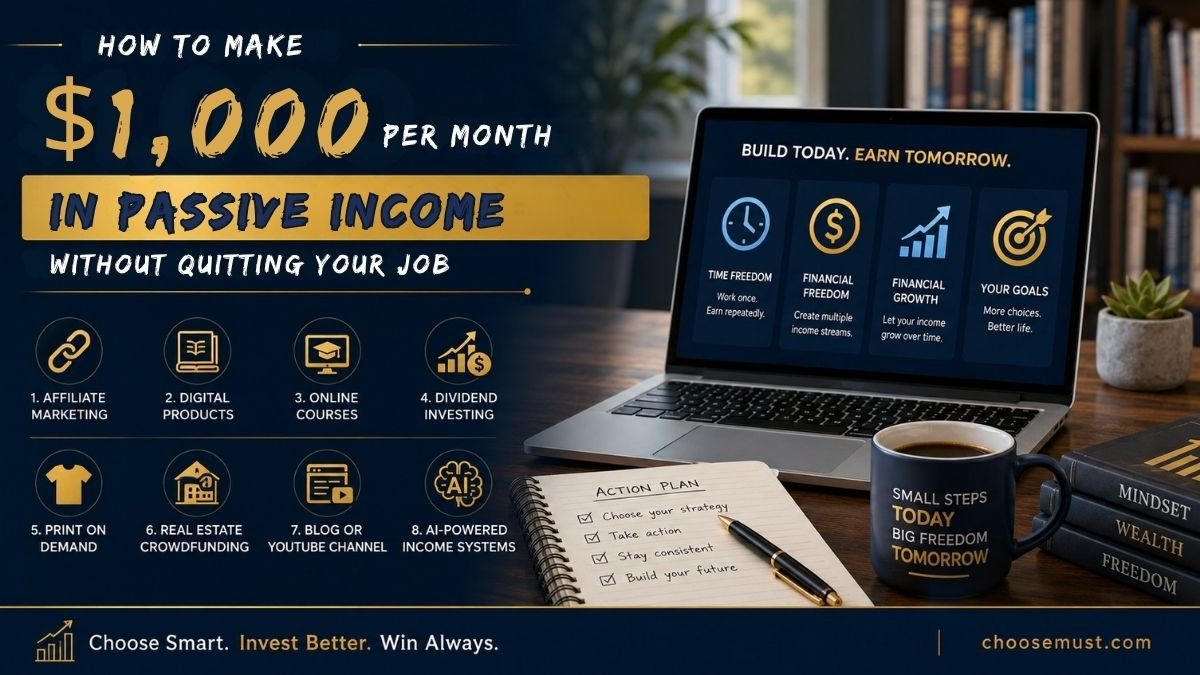
Here’s a quick recap of the 8 strategies covered in this guide:
- Affiliate Marketing, Promote products you believe in and earn commissions on autopilot
- Digital Products, Create once, sell indefinitely
- Online Courses, Package your expertise into a scalable, high-margin product
- Dividend Stocks & ETFs, Let your invested capital generate regular income
- Print on Demand, Sell custom products without touching inventory
- Real Estate Crowdfunding, Earn from property income without being a landlord
- Niche Blog or YouTube Channel, Build a traffic asset that pays you for years
- AI-Powered Income Systems, Use 2025’s most powerful tools to build and scale faster
You don’t need to pursue all eight. In fact, you shouldn’t. The most successful passive income builders start with one strategy, focus on it until it generates consistent results, and only then layer in a second stream. Diversification comes after mastery, not before.
The best time to start was six months ago. The second-best time is right now. Your future self, the one with an extra $1,000 hitting their account every month, is counting on the decision you make today.
Next Steps
Ready to take action? Here’s how to move forward today:
- Pick your strategy. Based on your skills, time, and budget, decide which of the 8 methods above is the best fit for your situation right now.
- Take the first step in the next 24 hours. Open a brokerage account, sign up for an affiliate program, outline your first digital product, or set up your blog. Momentum is built by starting, not by planning to start.
- Consider a structured program. If you want to fast-track your results with a proven framework and community support, revisit the three recommended programs listed at the top of this guide. The Passive Income System 2.0, the Millionaire Partner System, and the Keystone Investors Club all offer step-by-step guidance for building real online income.
- Track your progress monthly. Set up a simple spreadsheet to monitor income from each stream. Seeing growth, even $50 in month one, builds the motivation to keep going.
- Stay consistent for at least 6 months. Most passive income strategies don’t produce significant results instantly. The people who win are those who outlast the learning curve.
You have everything you need. The only thing left is to begin.
Found this guide helpful? Share it with someone who’s been thinking about building passive income, you might just change their financial future.