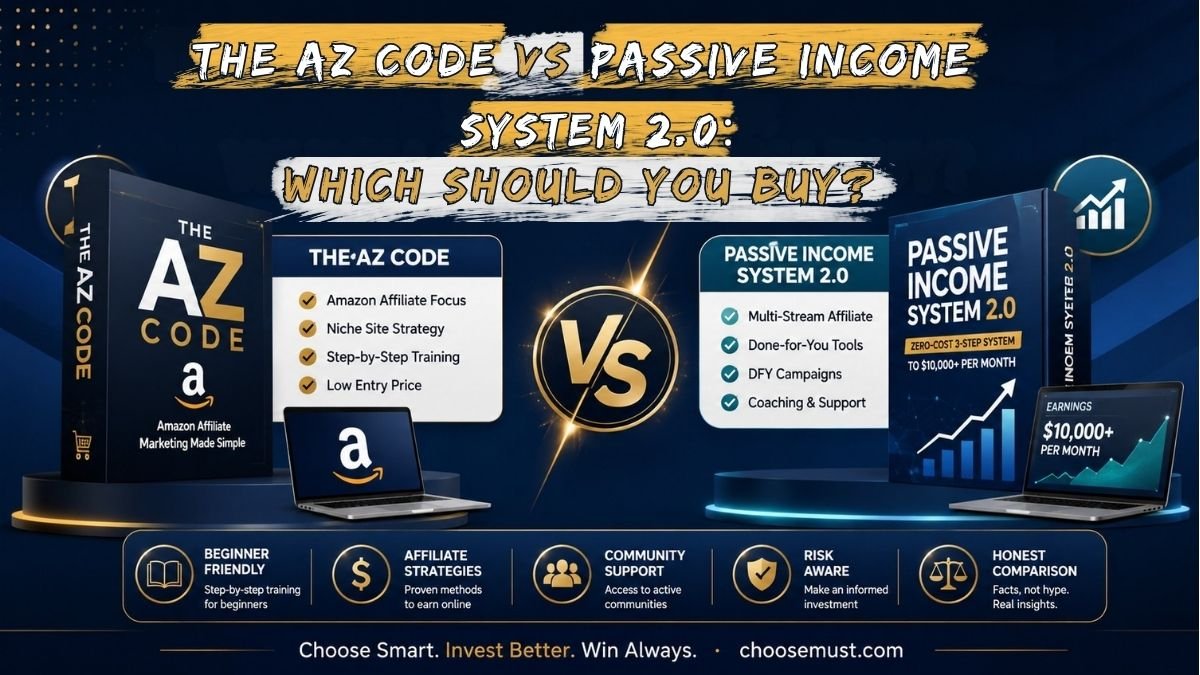
Every year, thousands of people search for a reliable way to generate income online, and every year, a flood of new programs promises to make that dream a reality. Two programs that consistently come up in these conversations are The AZ Code and Passive Income System 2.0. Both target beginners, both promise life-changing results, and both compete for the same audience: everyday people looking to escape the 9-to-5 grind.
But here is the truth: not all online income programs are created equal. Some teach genuine, repeatable strategies. Others rely heavily on hype. Before you spend a single dollar on either, you deserve an honest, side-by-side breakdown that cuts through the marketing noise.
In this post, you will learn exactly what each program offers, who it is designed for, what you can realistically expect to earn, how they compare on price and support, and most importantly, which one (if either) deserves your investment in 2025. If you are still exploring your options, programs like Passive Income System 2.0 and The AZ Code both have entry-level price points worth examining, which is precisely why this comparison exists.
Disclosure: This post contains affiliate links. If you purchase through these links, we may earn a commission at no extra cost to you. All opinions are based on thorough research and analysis.
AZ Code vs. Passive Income System 2.0 at a Glance
| Feature | The AZ Code | Passive Income System 2.0 |
|---|---|---|
| Creator | Andrew Peterson | Glynn Kosky |
| Core Model | Amazon Affiliate Marketing | Multi-stream Affiliate Marketing |
| Entry Price | ~$37 | ~$35–$67 (front-end) |
| Upsells/OTOs | Yes | Yes (4 OTOs) |
| Training Format | Video modules + eBook | 12-module video training + DFY tools |
| Done-For-You Elements | Limited | Extensive (copy-paste campaigns) |
| Money-Back Guarantee | 60 days | 30 days |
| Platform | Digistore24 | Digistore24 |
| Best For | Amazon niche-site beginners | Beginners wanting automation |
| Overall Credibility | Mixed / Controversial | Moderate / Better reputation |
What Is The AZ Code?
The AZ Code is an online training program created by Andrew Peterson that teaches users how to make money through Amazon affiliate marketing. The “AZ” in the name stands for Amazon, and the program claims to provide a step-by-step roadmap to building a profitable Amazon affiliate business from scratch.
On the surface, the pitch is compelling. The sales page promises that complete beginners can earn as much as $3,000 per day by following a simple system, no prior experience no technical skills required. The initial cost sits around $37, which feels like a low-risk entry point for anyone curious about online income.
Inside the program, buyers get access to a series of training videos covering niche selection, website creation, content writing, and driving traffic through SEO and social media. There is also a private members-only community and, theoretically, ongoing support and updates.
However, independent reviews paint a more complicated picture. Multiple reviewers have noted that the core content is largely an eBook, around 70 pages, focused on Amazon FBA (Fulfillment by Amazon) rather than the affiliate marketing model prominently advertised. The program was previously listed on ClickBank but was reportedly removed, likely due to elevated refund rates, before finding a home on Digistore24. The income claims of $3,000 per day are widely criticized as exaggerated and misleading, especially for complete beginners.
That said, the fundamental model it teaches, Amazon affiliate marketing, is entirely legitimate. Building a niche website and earning commissions when visitors click your links and purchase products from Amazon is a well-established method used by thousands of successful content creators. The issue is not the strategy itself, but the gap between what The AZ Code promises and what it realistically delivers.
What Is Passive Income System 2.0?
Passive Income System 2.0 is a comprehensive training program created by Glynn Kosky, a seasoned internet marketer who has reportedly generated over $20 million in online course sales and built a following within the Digistore24 ecosystem. The program bills itself as a “zero-cost 3-step passive income system” that can help users reach $10,000 or more per month in online income.
Unlike The AZ Code’s narrow focus on Amazon, Passive Income System 2.0 covers a broader range of affiliate marketing strategies, including niche research, done-for-you (DFY) campaigns, traffic generation, email marketing, and paid advertising. The training is structured across 12 modules designed to walk users from zero to a functioning affiliate business.
What distinguishes this program is its done-for-you infrastructure. Buyers receive pre-built, copy-and-paste campaigns, access to Glynn Kosky’s vetted list of high-converting affiliate products, and, in upgraded tiers, expedited approval to promote premium offers. The program also includes 12 weeks of full coaching, a supportive community, and bonuses worth a claimed $48,797 in value.
Digistore24 itself has highlighted Passive Income System 2.0 as one of its top-performing business and investment products, noting that Glynn Kosky has surpassed $1 million in sales on the platform with this single offer, a marker of real marketplace traction that The AZ Code cannot match.
The main caveat mirrors most online income programs: the best results typically come with the upgraded OTO (one-time offer) tiers, and consistent effort and follow-through are still required. Passive income is rarely as hands-off as the name implies, especially in the early setup phase.
Key Differences Between The AZ Code and Passive Income System 2.0
1. Scope and Strategy
The AZ Code is narrowly focused on Amazon’s affiliate program. Users learn to build niche websites, create content, and earn commissions ranging from roughly 1% to 10% per sale on Amazon products. This is a perfectly valid model, but Amazon’s commission structure has been trimmed significantly over the years, limiting earnings potential, especially for beginners with low-traffic sites.
Passive Income System 2.0 takes a broader approach. It teaches multiple affiliate marketing channels simultaneously, including email marketing, social media promotion, and paid traffic strategies, and connects students with higher-commission digital products on platforms like Digistore24. Higher-commission digital products (often 50–75% per sale) can produce faster, more significant returns compared to Amazon’s lower physical-product commissions.
2. Done-For-You Elements
The AZ Code provides basic templates, tools, and instructional content, but the actual implementation, building a website, writing content, and generating traffic, falls entirely on the buyer. This requires meaningful time investment and, often, additional spending on web hosting, domain names, and marketing tools not included in the $37 price.
Passive Income System 2.0 includes ready-made, copy-and-paste campaigns, pre-vetted affiliate offers, and automation tools designed to reduce the time-to-earnings gap. For beginners who want structure and speed, this done-for-you approach is a significant advantage.
3. Creator Credibility and Track Record
Andrew Peterson, the creator of The AZ Code, remains a relatively obscure figure with minimal verifiable public presence beyond the program’s own marketing. Multiple independent reviewers have flagged this as a red flag, noting the absence of documented success stories outside the sales page itself.
Glynn Kosky has a substantially more documented track record in the online marketing space. His over-decade-long career, verifiable Digistore24 sales milestones, and presence across legitimate marketing communities give Passive Income System 2.0 a credibility advantage that matters when evaluating where to invest your learning budget.
4. Community and Support
The AZ Code advertises a private members-only group, though user feedback on the quality and responsiveness of this community has been inconsistent.
Passive Income System 2.0 includes access to an active community, 12 weeks of structured coaching, and, in higher tiers, one-on-one mentorship. For beginners who need accountability and guidance beyond static training videos, this ongoing support ecosystem is a genuine asset.
Feature Comparison
Training Quality and Depth
The AZ Code: The training covers the basics of Amazon affiliate marketing, niche selection, site setup, content creation, and SEO fundamentals, but many reviewers have found the material thin and, in some cases, outdated. The eBook format of the core content limits the practical, hands-on guidance modern beginners need to navigate today’s competitive affiliate landscape.
Passive Income System 2.0: The 12-module curriculum is widely praised for its depth and logical progression. Modules range from foundational affiliate marketing principles to advanced traffic strategies, algorithm adaptation, and emerging income channels. Glynn Kosky’s team actively updates the system as market conditions shift, which is critical in a space where what worked in 2020 may not work in 2025.
Our take: Passive Income System 2.0 wins on training quality by a meaningful margin. The structured, up-to-date 12-module format surpasses The AZ Code’s thinner, more static content library.
Income Potential and Realistic Earnings
The AZ Code: The sales page claims users can earn $3,000 per day, a figure widely debunked by independent reviewers. Realistically, Amazon affiliate marketing for beginners requires months of content building and SEO work before meaningful traffic materializes. With Amazon’s commission rates averaging 3–4%, even a site with 17,000 monthly visitors might yield only around $1,000 per month in commissions.
Passive Income System 2.0: The program’s income claims are also ambitious ($10,000+ per month), but its focus on higher-commission digital products and done-for-you traffic tools creates a more plausible path to early earnings. Users across multiple review sites report seeing income within weeks of implementing the DFY campaigns, though results vary widely based on effort and execution.
Our take: Neither program will make you rich overnight. Both require work. But Passive Income System 2.0’s broader strategy, higher-commission product access, and done-for-you infrastructure create a more realistic path to meaningful income for complete beginners.
Ease of Use and Accessibility
The AZ Code: The program is marketed as beginner-friendly, but the actual execution, building and maintaining a niche website, writing SEO content, managing an affiliate link structure, involves a real learning curve. The additional costs of domain registration, hosting, and marketing tools can catch first-time users off guard.
Passive Income System 2.0: The done-for-you elements significantly lower the barrier to entry. Users do not need to build a website or create products from scratch. The copy-and-paste campaign structure is designed to get beginners operational quickly, with a user-friendly dashboard that minimizes technical confusion.
Our take: For true beginners with no technical background, Passive Income System 2.0 is notably more accessible.
Pricing Comparison
Both programs are positioned as affordable entry points into online income, but the real cost of each becomes clearer when you look beyond the front-end price.
The AZ Code starts at approximately $37. However, there are upsells within the members’ area, and once you factor in the costs of building and hosting a website, purchasing additional traffic tools, and spending on paid advertising, the total investment for a functional Amazon affiliate setup can climb well above the initial purchase price.
Passive Income System 2.0 has a comparable front-end price in the $35–$67 range, with four optional OTO upgrades:
- OTO 1: Advanced affiliate and traffic strategies
- OTO 2: Additional high-converting DFY campaigns
- OTO 3: One-on-one coaching for personalized support
- OTO 4: Full reseller rights, sell the system, and keep 100% of the profit
While the OTOs are optional, most experienced reviewers suggest that the full value of Passive Income System 2.0 is realized with at least OTO 1 and OTO 2 activated. Budget accordingly if you’re serious about results.
Both programs offer refund policies: The AZ Code advertises a 60-day money-back guarantee through Digistore24, while Passive Income System 2.0 offers a 30-day guarantee. Digistore24’s refund processing is generally well-regarded, giving buyers reasonable buyer protection on both purchases.
User Experience and Interface
The AZ Code delivers its content through a basic members’ area with video modules and downloadable resources. User feedback on the interface has been largely neutral, functional, but not particularly polished or intuitive. Several buyers have reported difficulty navigating the content or finding clear next steps after completing the introductory videos.
Passive Income System 2.0 offers a more structured dashboard experience, with the 12 modules organized in a logical sequence that guides users step-by-step through the system. The DFY campaign interface is designed to minimize friction, allowing users to deploy campaigns without deep technical knowledge. The community access, integrated directly into the members’ area, adds a social dimension that keeps users engaged and accountable.
Customer Support and Resources
Support quality is one of the most important and most underrated factors when evaluating any online program, especially for beginners who will inevitably hit roadblocks.
The AZ Code’s support has received inconsistent reviews. Some users report satisfactory responses via email; others describe delays or unhelpful replies. The private community group adds a layer of peer support, but the program lacks the structured mentorship that transforms training content into real-world results.
Passive Income System 2.0 provides a notably more robust support infrastructure. The 12-week coaching program ensures structured accountability. The community is actively moderated and populated with users at various stages of their journey. Higher-tier OTO buyers gain access to one-on-one coaching sessions, which can be invaluable for troubleshooting specific implementation challenges.
Use Cases: Who Should Choose Each Program?
When to Choose The AZ Code
- You are specifically interested in building Amazon affiliate niche websites and are willing to invest time in SEO-driven content marketing.
- You want the lowest possible financial entry point and plan to supplement the training with additional free resources from the web.
- You have some familiarity with website building and content creation, and just need a structured framework focused specifically on the Amazon Associates ecosystem.
When to Choose Passive Income System 2.0
- You are a complete beginner with no technical background and want a done-for-you system that minimizes setup complexity.
- You want access to higher-commission digital product offers and a broader multi-channel affiliate strategy rather than Amazon’s relatively lower commission rates.
- You value structured, ongoing coaching and community support over self-directed learning from static training videos.
- You are interested in eventually reselling the system itself and earning 100% commissions through the OTO 4 reseller rights option.
The Bigger Picture: Building Sustainable Online Income
Here is the truth that most comparison articles won’t tell you: no single program — not The AZ Code, not Passive Income System 2.0, not anything else- is a guaranteed ticket to financial freedom. Sustainable online income requires consistency, adaptability, and a willingness to learn from setbacks.
What programs like these can do is shorten your learning curve by giving you a structured framework and tested strategies to follow. The question is not “will this make me rich?”, the question is “does this give me a credible, realistic starting point?”
On that measure, Passive Income System 2.0 edges ahead. The combination of Glynn Kosky’s documented track record, a broader multi-channel strategy, done-for-you tools, structured coaching, and an active community creates a more complete ecosystem for beginner success than The AZ Code’s narrower, thinner offering.
That said, your personal situation matters. If your goal is specifically to build an Amazon niche site and you are comfortable with a more DIY approach, The AZ Code’s entry price makes it a low-stakes experiment; just go in with realistic expectations.
Final Verdict: Which Should You Buy?
After a thorough comparison of both programs across training quality, income potential, ease of use, support, and value for money, Passive Income System 2.0 is the stronger recommendation for most beginners in 2025.
It offers more comprehensive training, a more realistic multi-channel income strategy, done-for-you tools that accelerate implementation, and a creator with a verified track record in the Digistore24 marketplace. The 12-week coaching structure and active community make it a more complete learning environment, not just a product to buy and forget.
The AZ Code is not without merit. For those specifically drawn to Amazon affiliate marketing and comfortable with a leaner, more self-guided approach, it remains an affordable starting point. But the credibility gap, the disconnect between income claims and realistic outcomes, and the limited done-for-you support make it a riskier bet for complete newcomers.
Bottom line:
- Choose Passive Income System 2.0 if you want a structured, done-for-you, multi-channel affiliate marketing system with proven marketplace traction and ongoing coaching support.
- Choose the AZ Code if you specifically want to start an Amazon niche affiliate site and want the lowest-cost entry point available, with full awareness of the program’s limitations.
Whichever path you choose, remember: programs are tools, not shortcuts. Your results will ultimately reflect the effort and consistency you bring to the process. Start learning, start implementing, and stay patient. Sustainable income online is absolutely achievable, but it is built, not bought.
Note: This blog post contains affiliate links. Purchasing through these links supports this site at no additional cost to you. As always, do your own due diligence before investing in any online income program.