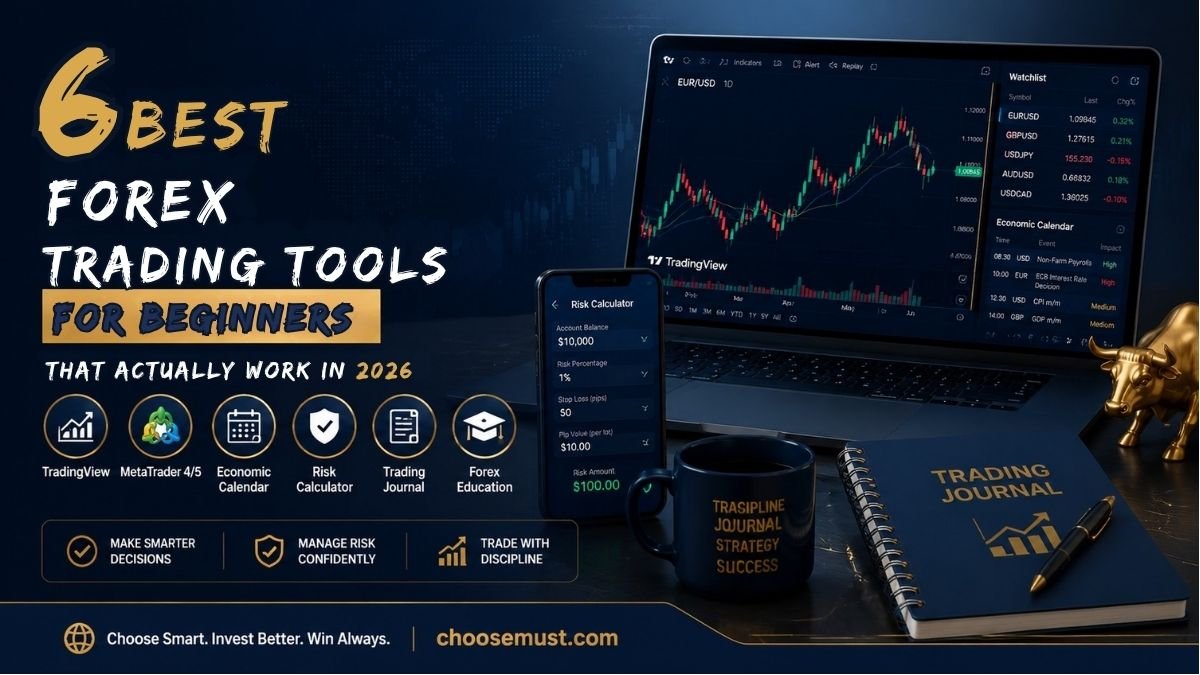
Most beginners enter the forex market with a brokerage account and almost nothing else, and then wonder why their results are inconsistent. The truth is, even experienced traders lean heavily on the right set of tools to stay disciplined, read the market accurately, and protect their capital from preventable losses.
In 2026, the good news is you don’t need to spend thousands of dollars to trade like a professional. The tools in this guide are either free or highly affordable, genuinely useful from your very first trade, and trusted by millions of retail forex traders worldwide. By the time you finish reading, you’ll know exactly what to use, why it matters, and how to put each tool to work immediately.
And if you’re looking to accelerate beyond just the tools, to build a complete income-generating system around trading and financial independence, you may want to explore resources like the Keystone Investors Club, which gives members structured, VIP-level access to investing systems and strategies. Similarly, for those curious about passive income opportunities beyond traditional forex, the Passive Income System 2.0 is worth a look as a complementary resource.
1. TradingView — See the Market Clearly Before You Trade a Single Dollar
Before you place a trade, you need to understand what the chart is telling you. TradingView is the gold standard for browser-based charting in 2026, and its free tier is genuinely powerful enough to support most beginner strategies.
Why it matters for beginners: Reading price action, understanding where a currency pair has been and where it might go, is the foundation of forex trading. Without a quality charting tool, you’re effectively trading blind. TradingView gives you access to real-time forex data from multiple providers, over 100 built-in technical indicators, and a Pine Script editor if you ever want to build custom indicators. Even on the free plan, you can implement most standard strategies using tools like the RSI (Relative Strength Index) for momentum, Bollinger Bands for volatility, MACD for trend confirmation, and Fibonacci retracement levels for identifying key price zones.
How to use it as a beginner: Start by pulling up major currency pairs like EUR/USD or GBP/USD on the daily timeframe. Add no more than two or three indicators at first, one for trend (like a 50-period moving average) and one for momentum (like the RSI). Overloading a chart with indicators is one of the most common beginner mistakes. Clean, simple charts lead to clearer decisions.
TradingView also has an active community where traders publicly share their chart setups and trade ideas. For beginners, browsing these setups is a low-risk way to learn how more experienced traders interpret market structure. The platform’s watchlist feature lets you monitor multiple currency pairs without switching tabs, which is invaluable when you’re scanning for opportunities.
Pro tip: Use the free TradingView plan until you’ve placed at least 50 trades. By that point, you’ll know whether upgrading to a paid tier (which unlocks multiple chart layouts and more indicators per chart) genuinely fits your workflow or is simply an unnecessary expense.
2. MetaTrader 4 & 5, The Platform That Connects Your Analysis to Actual Trades
If TradingView is where you read the market, MetaTrader is where you act on it. MetaTrader 4 (MT4) and its successor MetaTrader 5 (MT5) remain the most widely used trading platforms among retail forex traders globally, and for good reason.
Why it matters for beginners: Nearly every major forex broker in 2026 supports MT4 or MT5, which means the skills you develop on these platforms are immediately transferable regardless of which broker you use. Both platforms include integrated charting with dozens of technical indicators, multiple order types (market, limit, stop, trailing stop), and a one-click trading feature for fast execution. MT5, the newer of the two, adds additional timeframes, more order types, and direct access to an economic calendar, making it the better choice for beginners setting up their first account today.
How to implement it: Download MT5 through your broker’s website and open a free demo account before touching real money. A demo account gives you full access to live market conditions, real-time price data, and all platform features, using virtual funds. Spend at least two to four weeks on a demo account before transitioning to a live account. Practice placing different order types, setting stop-losses, and monitoring open positions until the process feels natural.
One of MT4/MT5’s biggest advantages for beginners is its support for Expert Advisors (EAs), algorithmic trading scripts that can automate strategy execution. You don’t need to write code to use them; thousands of free and paid EAs are available through the MetaTrader marketplace. This is how many traders transition from manual to semi-automated trading as their skills develop.
MT4 vs. MT5, which should beginners choose? Unless your broker only supports MT4, go with MT5. It offers broader functionality, better backtesting tools, and is the platform most actively developed going forward. MT4 remains excellent but is gradually being phased out by brokers.
3. Economic Calendar, Know What’s Moving the Market Before It Moves
Currency prices don’t move in a vacuum. They react, often violently, to economic data releases: central bank interest rate decisions, inflation reports, employment figures, GDP announcements, and geopolitical events. An economic calendar tells you exactly when these events are scheduled and how significant their expected market impact is.
Why it matters for beginners: One of the most painful beginner experiences in forex is entering what looks like a textbook trade setup, only to watch the price explode in the opposite direction seconds later because of a scheduled news release you didn’t know about. An economic calendar eliminates this completely avoidable problem. High-impact events, typically marked in red on most calendars, are the ones that can move a currency pair by 50 to 150 pips in minutes.
How to use it: The most widely used economic calendars among retail traders are Forex Factory and the Investing.com Economic Calendar, both of which are free. Each morning, check the calendar for any high-impact events scheduled during your planned trading session. As a general rule for beginners, avoid entering new trades 15 to 30 minutes before and after high-impact releases on currency pairs directly affected by those events.
Forex Factory’s calendar is particularly well-regarded for its filtering options. You can filter events by currency (so if you only trade EUR/USD, you see only USD and EUR events), by impact level (low, medium, high), and by time zone. The calendar also shows the previous reading, market forecast, and actual result for each event, providing useful context as you develop your understanding of how economic data shapes currency movements.
Real-world example: The US Non-Farm Payrolls (NFP) report, released on the first Friday of every month, is one of the most market-moving events in forex. Traders around the world adjust their positions ahead of this release. By knowing it’s coming and building it into your trading plan, you avoid getting caught in the whipsaw volatility it often creates, and potentially position yourself to profit from the directional move that follows.
4. Position Size Calculator, The Tool That Keeps Beginners Alive Long Enough to Learn
Ask any experienced forex trader what separates the traders who survive their first year from those who blow their accounts, and most will give you the same answer: risk management. A position size calculator is the simplest and most effective risk management tool available, and it’s completely free.
Why it matters for beginners: Every trade you place should risk only a small, defined percentage of your account, typically one to two percent. But converting that percentage into the correct lot size for a specific currency pair, stop-loss distance, and account balance requires a calculation that’s easy to get wrong manually. A position size calculator does this instantly and accurately. Risking too much per trade is the single most common reason beginner accounts are wiped out early, and it’s entirely preventable.
How to implement it: Before placing any trade, open a free position size calculator (BabyPips, MyFxBook, and FxScouts all offer excellent free versions). Enter your account balance, your chosen risk percentage (start with 1%), and the distance in pips from your entry price to your stop-loss. The calculator returns the exact lot size you should trade. This takes under 60 seconds per trade and removes emotion from the position sizing decision entirely.
Here’s a simple three-step process to build this habit from your first trade:
- Identify your entry price and stop-loss level on the chart.
- Open your position size calculator and enter the relevant figures.
- Place the trade at the calculated lot size, never more.
A pip value calculator works alongside the position size calculator to help you understand what each pip of movement is worth in your account currency. Together, these two tools give you complete visibility over your risk on every single trade, a habit that separates disciplined traders from gamblers.
Pro tip: Never skip the position size calculation, even on trades you feel confident about. Emotional certainty is one of the biggest risk factors in forex trading. The calculation removes that variable from your decision-making.
5. Copy Trading Platforms, Earn While You Learn from Real Professionals
Copy trading is one of the most beginner-friendly developments in retail forex over the past decade. Instead of executing your own trades, you allocate a portion of your capital to automatically mirror the trades of a verified, experienced trader in real time, proportionally and instantly.
Why it matters for beginners: Copy trading serves two distinct purposes simultaneously. First, it can generate returns while you’re still developing your own skills. Second, it’s a live, real-money education. Watching how a professional trader manages entries, exits, position sizes, and drawdowns teaches you more than most textbooks ever will. You see the strategy in action, in real market conditions, on your own account.
How to get started: eToro remains the most widely used copy trading platform in 2026, featuring a social media-style interface that makes following other traders intuitive. The platform shows each trader’s complete verified performance history, including return percentage, maximum drawdown, risk score, and the number of people currently copying them. This transparency is critical: only copy traders whose risk score and drawdown figures you’re comfortable with. A strategy that returns 50% annually but has a 40% maximum drawdown may not be appropriate for every beginner’s risk tolerance.
When evaluating a trader to copy, look for these signals of consistency over a minimum of 12 months: stable monthly returns rather than a few massive winning months, a maximum drawdown below 20%, and a clear, recognizable trading style (swing trading, trend following, or carry trading) rather than an opportunistic approach that’s hard to predict. Diversifying across two or three copy traders rather than putting everything behind one is also a sensible approach for beginners.
If you’re also interested in building income streams outside of traditional forex trading, this is a good moment to mention that structured wealth-building programs can complement your trading activity. The Millionaire Partner System is one such program designed to help individuals create online income through affiliate-based strategies, a natural companion to the financial education you’re already pursuing through trading.
6. Trading Journal, The Underused Tool That Actually Tells You If You’re Improving
The most overlooked tool on this list is almost certainly the most important one for long-term improvement. A trading journal is a systematic record of every trade you place, including the entry reason, the setup, the outcome, and critically, what you were thinking and feeling when you made the decision.
Why it matters for beginners: Without a journal, you have no way of knowing whether your results are driven by genuine edge, luck, or recurring mistakes. Winning and losing trades can both teach you nothing if you don’t analyze the underlying reasoning. A trading journal turns your trade history into a performance laboratory. After 50 to 100 logged trades, patterns emerge: the setups that consistently work, the times of day your decisions are sharpest, and the emotional states (impatience, overconfidence, revenge trading after a loss) that lead to your worst decisions.
Best options in 2026: Myfxbook is the top free option for forex traders specifically. It connects directly to MT4 and MT5 accounts, automatically imports every trade, and provides detailed analytics on drawdown, risk metrics, currency pair performance, and trading session analysis. Its community feature also allows you to publish a verified track record, useful if you eventually consider managing funds for others or applying to a proprietary trading firm. For traders who want AI-powered analytics that identify patterns across hundreds of trades automatically, TradeZella scored highest in independent 2026 reviews, offering emotional tracking correlations, trade replay, and performance dashboards across stocks, forex, and crypto.
How to build the journaling habit: Record each trade immediately after closing it, not at the end of the day. Your memory of what you were thinking at the time of the trade fades quickly, and the notes written five minutes after a trade are far more actionable than what you can reconstruct hours later. At minimum, log the pair, timeframe, entry and exit prices, stop-loss, take-profit, your setup rationale, and the outcome. Over time, add an emotional state tag (calm, anxious, impatient, confident) to each entry. The correlation between emotional state and performance outcomes is frequently the most valuable insight a journal reveals.
Wrapping Up: Build Your Toolkit Before You Build Your Account
The six tools covered in this guide form a complete, professional-grade trading workflow, and with the exception of MetaTrader and TradingView’s premium tiers, all of them are available for free. Here’s a quick summary of the key takeaways:
- TradingView gives you clean, powerful chart analysis in your browser. Start here before every trade.
- MetaTrader 5 is your execution platform. Open a demo account today and practice before going live.
- An economic calendar (Forex Factory or Investing.com) keeps you out of high-risk news events and helps you understand what’s driving the market.
- A position size calculator is non-negotiable; use it on every single trade without exception.
- Copy trading on eToro lets you generate potential returns and observe a professional strategy in action simultaneously.
- A trading journal (start with Myfxbook) transforms your experience into genuine, compounding skill improvement.
One final, immediately actionable tip: don’t wait until you feel “ready” to set up these tools. Open your accounts, bookmark your calendars, and start a demo journal today. The habit of using the right tools consistently is what separates traders who make progress from those who simply accumulate losing trades and frustration.
Are you already using any of these tools in your trading? Drop your experience in the comments, and if you found this guide useful, share it with someone just starting their forex journey.
Want to Go Deeper?
If you’re serious about building financial independence, not just through forex but through multiple income streams, these resources are worth exploring alongside your trading education:
- Keystone Investors Club: Structured VIP investor education and community for long-term wealth building.
- Millionaire Partner System: A practical affiliate-based income system that complements active trading.
Disclaimer: Forex trading involves significant risk and is not suitable for all investors. Past performance is not indicative of future results. The affiliate links in this article may earn us a commission at no additional cost to you. Always conduct your own due diligence before making any financial decision.