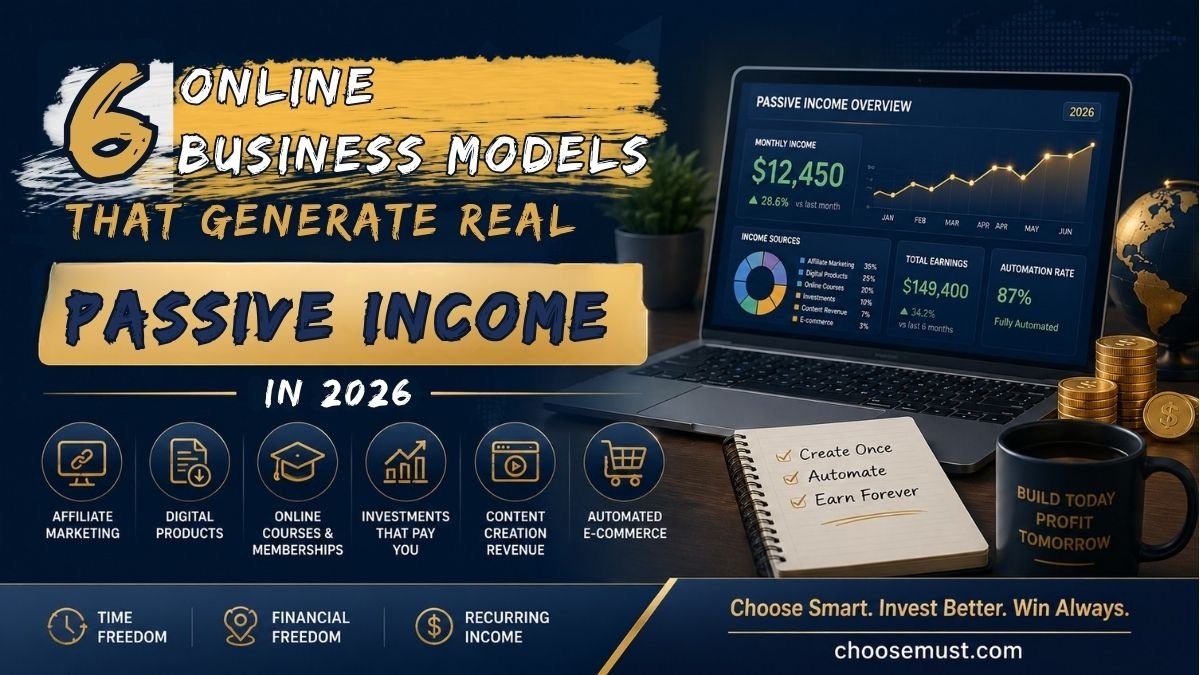
Most people who search for passive income online find generic advice that gets them nowhere. This post is different. We have spent time researching what is actually working in 2026, models that real people are using to build recurring revenue without trading hours for dollars indefinitely. Whether you are starting from scratch or looking to diversify beyond a single income stream, these six business models offer a legitimate path to financial independence. By the end of this guide, you will know which model fits your skills, what realistic earnings look like, and exactly how to take your first step.
One quick note before we dive in: two of the systems mentioned below, Passive Income System 2.0 and the Millionaire Partner System, are structured programs that combine several of the strategies on this list into a guided, done-for-you framework. They are worth exploring if you want a head start rather than building everything from the ground up.
1. Affiliate Marketing, Earn Commissions on Products You Did Not Create
Affiliate marketing remains one of the most accessible and scalable passive income models available in 2026, and the numbers back that up. The global affiliate marketing industry surpassed $20 billion in valuation in 2024 and is projected to reach $71.74 billion by 2034, growing at a compound annual rate of 15.2%. In the United States alone, affiliate marketing spending is expected to exceed $13 billion in 2026, up from under $10 billion just three years ago.
The model is simple: you promote someone else’s product using a unique tracking link. When a visitor clicks your link and makes a purchase, you earn a commission, typically between 5% and 50%, depending on the niche and program. You never handle inventory, deal with customer service, or manage fulfilment. Once your content is live and driving organic traffic, commissions roll in around the clock.
Why it works in 2026: SEO-based content still drives 38% of all affiliate revenue, meaning a well-written blog post or YouTube video continues generating income years after it is published. The education and e-learning niche leads all categories with average monthly affiliate earnings of $15,551, followed by travel at $13,847 and beauty and skincare at $12,475.
How to get started: Choose a niche you understand or are willing to learn. Build a content platform, a blog, a YouTube channel, or a newsletter. Join affiliate programs in your niche (platforms like Digistore24, ClickBank, and Amazon Associates are good starting points). Publish content that solves specific problems your target audience is searching for, and embed your affiliate links naturally within that content.
Real-world earning potential: According to industry data, affiliate publishers earn an average of $8,038 per month, and 35% of affiliates generate at least $20,000 annually. The top 15% report yearly earnings between $80,000 and $1 million. Affiliate marketing also delivers an average return of $12 for every $1 spent on advertising, making it one of the highest-ROI digital marketing channels in existence.
Pro tip: Do not just promote anything. Choose products you would personally use or that have strong social proof. High-ticket affiliate programs, like those that pay $500 or more per referral, can transform a modest audience into a high monthly income. If you want a structured system that shows you exactly how to set this up from day one, the Millionaire Partner System provides a complete affiliate income framework built for beginners and intermediate marketers alike.
2. Selling Digital Products, Create Once, Sell Indefinitely
If affiliate marketing is passive income with someone else’s product, selling digital products is passive income with your own. Digital products, including eBooks, templates, workbooks, stock photos, music, fonts, and software tools, require upfront effort to create and virtually nothing to deliver. There is no shipping, no inventory, no supplier coordination. Once a product is live on a platform, every sale is nearly 100% margin.
Why it works in 2026: Consumer demand for on-demand digital content continues to accelerate. People routinely pay for well-packaged information and tools that save them time or solve an immediate problem. The subscription box market has reached $41.47 billion, and the broader digital product space benefits from the same consumer appetite for convenience and instant access. Product bundles and upsells dramatically increase average order value, meaning a $27 template can become a $97 bundle with a few strategic additions.
How to implement it:
- Identify a specific problem your target customer has that can be solved with information or a tool.
- Create a high-quality digital product, even a well-designed 20-page PDF, can sell for $17 to $97 if it solves a real problem.
- List your product on platforms like Gumroad, Etsy (for digital downloads), or your own website using a checkout tool.
- Drive traffic through SEO, social media, or a small paid advertising budget.
- Automate the delivery process so that every sale happens without manual effort.
One particularly powerful variation of this model is selling products with Private Label Rights (PLR) or Master Resell Rights (MRR). With PLR and MRR products, you purchase the rights to an existing digital product and sell it as your own, keeping 100% of the revenue. This eliminates even the creation phase, letting you go from purchase to profit in days.
Realistic earnings: A single evergreen digital product with consistent traffic can generate anywhere from a few hundred to several thousand dollars per month on autopilot. Creators with libraries of multiple products, or a flagship course, regularly report five-figure monthly incomes from digital product sales alone.
3. Online Courses and Membership Sites, Package Your Expertise for Recurring Revenue
The e-learning market is one of the most durable passive income sectors of the digital economy. It is projected to surpass $375 billion globally by 2026. People are willing to pay significant sums for structured knowledge delivered by someone who has already figured out what they are trying to learn. If you have expertise in any area, cooking, photography, investing, fitness, languages, or niche software, you can package it into a course or membership that generates recurring revenue long after you finish recording.
Why it works: Unlike a blog post that earns ad revenue per thousand views, a course earns the same amount regardless of whether you are at your desk or on the beach. More importantly, membership sites create recurring monthly revenue, the gold standard of passive income. When a member pays $47 per month and stays for 18 months, you have generated $846 from a single customer who signed up once.
How to build it: Start by validating your course idea before you build it. Survey your audience or run a pre-sale to confirm people will actually pay for what you plan to teach. Then record your course content in modules using screen recording or a smartphone. Upload to platforms like Teachable, Thinkific, or Kajabi, which handle payment processing, video hosting, and student management for you. For membership sites, platforms like Skool or Circle make community building and content delivery straightforward.
The recurring revenue advantage: Membership sites are especially powerful because they compound over time. Every new member adds to a recurring revenue base, and monthly churn (the percentage who cancel) tends to be low when the community is engaged. A membership with 200 members at $47 per month generates $9,400 in monthly recurring revenue, whether you actively work that month or not.
Expert insight: The most successful online course creators treat their first course as a minimum viable product. They launch imperfectly, gather student feedback, improve the content, and then sell the improved version at a higher price. Done right, a single course becomes a long-term asset that sells itself through word of mouth and SEO.
4. Crypto Investing, Put Your Capital to Work in Digital Asset Markets
Cryptocurrency investing has matured significantly since its early speculative days. In 2026, digital assets will have become a recognized component of diversified investment portfolios, and several passive income strategies within the crypto space will be accessible to everyday investors. Staking, yield farming, and holding appreciating assets are among the most widely practiced approaches.
Why it works in 2026: The infrastructure supporting crypto has become dramatically more user-friendly. Major exchanges offer built-in staking, where you lock your tokens and earn rewards (similar to interest on a savings account) without any active trading. Staking yields vary by asset, but rates of 4% to 12% annually are common on established proof-of-stake blockchains. For investors willing to research the space, smart portfolio allocation can generate passive crypto income that grows alongside the underlying asset appreciation.
Key strategies for passive crypto income:
- Staking: Hold and lock proof-of-stake coins like Ethereum, Cardano, or Solana to earn staking rewards.
- Yield farming: Provide liquidity to decentralized finance (DeFi) protocols and earn a share of trading fees.
- Dividend tokens: Certain crypto projects distribute a portion of platform revenue to token holders.
- Long-term holding (HODLing): A disciplined buy-and-hold approach to blue-chip assets has historically rewarded patient investors.
Important note: Cryptocurrency markets are volatile, and no passive income from crypto is risk-free. Diversification, research, and only investing what you can afford to lose are non-negotiable principles. That said, for investors who take the time to understand the space, crypto offers income-generating potential unavailable in traditional savings instruments.
If you want a structured education before committing capital, a comprehensive cryptocurrency course covering staking mechanics, DeFi strategies, and portfolio management can significantly shorten your learning curve and help you avoid costly beginner mistakes.
5. Print on Demand and Dropshipping, Run a Product Business Without Inventory
For people who want to sell physical products without the complexity of managing stock, print on demand (POD) and dropshipping offer a compelling path. Both models eliminate inventory: you design or curate products, list them in your online store, and a third-party supplier handles production and shipping when orders come in. Your margin is the difference between your retail price and the supplier’s fulfilment cost.
Print on demand in 2026: POD is especially attractive for creators with a brand, audience, or design sensibility. You create custom designs for apparel, mugs, phone cases, posters, or home decor, and your POD partner prints and ships each item on demand. Because there is no upfront inventory commitment, your startup risk is essentially zero. The POD model scales globally, and platforms like Printify, Printful, and Redbubble make setup accessible to non-technical founders.
Dropshipping in 2026: Dropshipping has evolved considerably. The days of running generic product stores with unreliable overseas suppliers are giving way to more branded, niche-focused approaches. Successful dropshippers in 2026 typically focus on a specific product category, build a branded store experience, and automate order fulfilment through apps like DSers or AutoDS. Profit margins typically range from 20% to 40% after product costs and advertising, and automated stores can reach $2,000 to $10,000 or more in monthly profit.
How to make it passive: The key to making either of these models truly passive is automation. Set up automated order routing so that when a customer purchases, the order forwards to your supplier without your involvement. Use email automation to handle customer communication, and outsource customer service to a virtual assistant once volume justifies it. With the right systems in place, you can run a five-figure monthly product business with only a few hours of oversight per week.
Pro tip: Before investing heavily in paid advertising, validate your products organically through social media. A single viral short-form video on TikTok or Instagram Reels can drive thousands of sales with zero ad spend, giving you data on what sells before you scale with paid traffic.
6. AI-Powered Automation and Software Tools, Build Income Streams That Scale Without You
The most transformative shift in passive income generation since the internet itself is the rise of accessible AI. In 2026, solo creators and small teams are building income-generating tools, agencies, and content systems that operate almost autonomously using artificial intelligence. This is no longer the exclusive domain of developers and engineers; no-code and low-code platforms have democratized access to AI-powered business building.
Why this model is winning in 2026: AI removes the bottleneck of human time. A content creator using AI writing and scheduling tools can publish 10 times more content than a competitor doing everything manually. An affiliate marketer using AI to research keywords, generate content briefs, and draft articles can build a multi-site content portfolio in the time it once took to build one. Software tools built with AI as their core engine, chatbots, content generators, and analytics dashboards, can be packaged as monthly subscription services (SaaS) and sold to businesses that need automation but cannot afford full-time developers.
Practical AI income models:
- AI content systems: Use AI to build and scale niche content sites that earn through affiliate commissions and display advertising.
- AI-powered agencies: Offer services like social media management or SEO content production, with AI handling 80% of the actual work while you manage client relationships.
- SaaS tools: Build a simple AI-powered tool that solves a specific business problem. Package it as a $29 to $99 per month subscription.
- AI automation consulting: Help local businesses automate their operations using existing AI platforms. Charge a setup fee plus a monthly retainer.
The income potential: AI-amplified income systems are especially powerful because they compound. A 500-page content site built with AI assistance earns passively through affiliate links and ads indefinitely. A SaaS product with 100 subscribers at $49 per month generates $4,900 in monthly recurring revenue, with no inventory, no shipping, and almost no marginal cost per additional user.
Among the most talked-about AI-backed income systems in 2026 is M1 AI Army, a platform designed to help everyday people deploy AI-driven income systems without technical backgrounds. It is worth reviewing if you want to combine the power of AI with a structured, beginner-friendly roadmap.
Wrapping Up: Your Path to Real Passive Income Starts With One Decision
Six proven business models. Each one is capable of generating meaningful passive income in 2026. The single biggest mistake people make is consuming information like this and then waiting for the perfect moment to start. There is no perfect moment. There is only the decision to begin.
Here are the key takeaways from everything you have just read:
- Affiliate marketing is the most accessible entry point. Start a blog or YouTube channel, choose a niche, and earn commissions on products you trust. The global industry is growing at 15.2% annually, and average committed affiliates earn over $51,000 per year.
- Digital products and PLR/MRR content offer the highest margin of any model once created. One product can sell thousands of times with zero additional effort.
- Online courses and memberships build recurring, compounding revenue from your existing expertise. A modest membership of 200 subscribers can replace a full-time salary.
- Crypto staking and yield strategies let your existing capital generate passive returns, though they require research and risk management.
- Print on demand and dropshipping offer physical product businesses with zero inventory. Automate fulfilment and pair with organic social traffic for near-effortless scaling.
- AI-powered automation is the multiplier that makes every other model faster, cheaper, and more scalable in 2026 than it has ever been.
One immediate action you can take today: decide which of these six models aligns best with your current skills and resources. You do not need to master all of them; one model executed well is enough to change your financial situation permanently. Then commit to 90 days of consistent effort before judging results. As the data consistently shows, most passive income streams take 6 to 12 months to gain meaningful traction. Those who persist past that point are the ones who succeed.
Ready to start building? If you want a structured, step-by-step system that combines affiliate marketing, digital products, and automation into one cohesive income framework, explore the Passive Income System 2.0, one of the most comprehensive passive income programs available today. It is designed for people who are serious about building real, recurring online income rather than chasing shortcuts.
Do you have a question about which model fits your situation best? Drop it in the comments below, we read and respond to every one.