You’ve narrowed it down to two investment courses. Both look promising. Both have sales pages that practically scream “this will change your life.” And now you’re sitting there, credit card in hand, paralyzed.
I’ve been exactly there. Twice, I paid for the wrong course. Not because I wasn’t serious about learning, but because I was using the wrong filter. I was looking at price and hype instead of the things that actually predict whether a course will grow your money or just drain it.
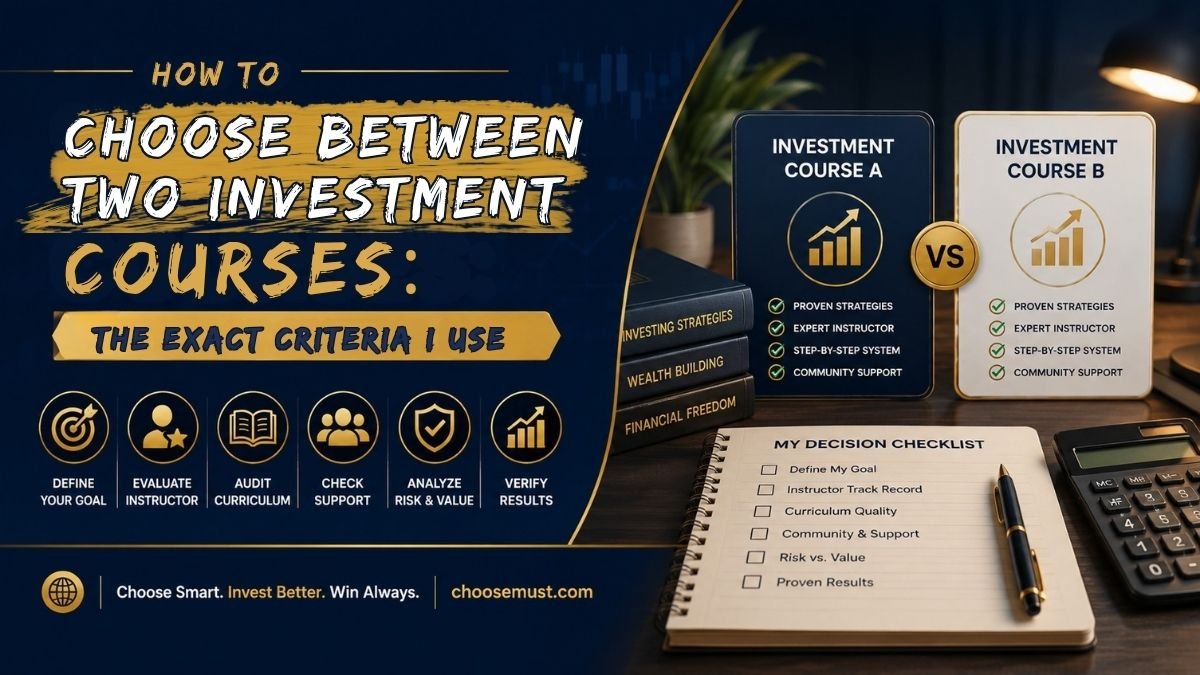
After going through more than a dozen investing and passive income programs, I’ve developed a repeatable decision framework with six specific criteria I apply before I spend a dollar. Whether you’re weighing a crypto masterclass against a stock investing program, or comparing a community-based coaching system with a self-paced video course, these criteria cut through the noise fast.
If you’re considering building a serious, structured passive income system right now, two programs worth putting through this exact filter are the Keystone Investors Club, a community-based investing program with 3-year VIP access, and the Millionaire Partner System, a structured webclass-based program built around real income generation. I’ll show you how both hold up against each criterion below.
Let’s get into it.
Why You Can Trust This Framework
I am not a financial advisor. What I am is someone who has spent years testing online education in the wealth-building and passive income space, and who has made the expensive mistake of choosing based on price alone, twice.
The wake-up call came when I realized that a $997 course that teaches you actionable, proven strategies will generate more return than a $99 course you never finish or apply. The problem isn’t always the course. It’s often the buyer picking on impulse rather than running a structured comparison.
This framework was built from real trial and error, from reviewing student outcomes, and from applying the same questions a savvy investor would ask before putting money into any asset: What’s the risk? What’s the upside? Who is behind it? What do other people’s results actually look like?
Use it every time you’re staring down two options. It takes about fifteen minutes and has saved me thousands.
Step 1: Define Your Investment Goal Before You Compare Anything
This sounds obvious, but almost nobody does it properly. Most people open two course pages and start comparing features. That’s backwards.
Before you look at anything else, write down (literally write it down) what you want from this course in concrete terms. Not “I want to make more money.” Be specific:
- Do you want to generate a second income stream within 90 days?
- Are you building toward full financial independence over 2 to 3 years?
- Do you want to understand crypto, stock markets, affiliate income, or all three?
- Are you a complete beginner, or do you have some investing foundation already?
Your goal acts as the filter through which everything else passes. A course built for advanced stock traders is useless to someone who doesn’t yet understand what a portfolio is. A course focused on passive income automation is the wrong pick for someone who needs active income right now.
The practical test: Read the course’s stated outcome statement. Ask yourself: “If I achieve exactly this outcome and nothing more, will I be satisfied?” If the answer is no, the course is likely misaligned. No matter how polished the sales page looks.
For example, the Passive Income System 2.0 is explicitly structured around building automated income streams from scratch. If your goal is active day trading, it’s the wrong tool. But if your goal is to build income that works while you sleep, that alignment alone moves it up the shortlist.
Goal-first thinking also prevents one of the most common mistakes: buying a course because it’s popular, not because it’s relevant to where you are and where you want to go.
Step 2: Evaluate the Instructor’s Real-World Track Record
Credentials matter, but not the kind you might think. A course instructor with a finance degree but no history of building actual income outside academia is far less useful than a practitioner who has done what they’re teaching in live market conditions.
When comparing two courses, research the instructor with the same rigor you’d apply to researching a business partner. Look for:
- Documented results: Has the instructor publicly demonstrated the income, portfolio returns, or business outcomes they teach? Screenshots can be faked, but case studies, interviews, and verifiable track records are harder to fabricate.
- Skin in the game: Are they still actively investing, trading, or building the systems they teach? A crypto educator who stopped trading in 2019 and has since pivoted to selling courses is a yellow flag.
- Longevity and reputation: How long has this person been in the space? A program that has been running for several years with consistent student results is a stronger signal than a new launch with big promises.
- Transparency about failures: The best instructors talk openly about what didn’t work. Anyone who presents an unbroken string of wins is either lying or hasn’t tried enough.
This step alone eliminates a large portion of online investment courses. The internet is full of educators who got lucky once, packaged it into a course, and are now selling the “method” without having consistently repeated it themselves.
When in doubt, search the instructor’s name alongside words like “review,” “results,” and “scam.” Not because every complaint is valid, but because the pattern of feedback tells you something the sales page never will.
Step 3: Audit the Curriculum for Depth, Specificity, and Applicability
A good investment course curriculum should do three things simultaneously: teach you how to think, show you what to do, and give you the tools to do it without the instructor present.
Here’s how to audit the curriculum before buying:
Check for specificity over breadth. A course that covers “stocks, bonds, crypto, real estate, and forex” in twelve hours is likely teaching you none of them deeply. Depth beats breadth. The best courses pick a lane and go all the way down it.
Look for real-world application components. Does the curriculum include actual exercises, case studies, live trades, portfolio walkthroughs, or simulations? Passive video watching without application produces passive learning, which rarely translates into active results.
Identify what’s actionable on day one. A strong course gives you something you can do immediately. If the first three modules are all theory with no action steps, that is often a sign that the course is designed to feel comprehensive rather than to produce results quickly.
Check for updates. In fast-moving spaces like crypto or digital income, a course built on 2020 strategies that hasn’t been updated is dangerously outdated. Always check when the content was last revised.
Legitimate programs will show you at least a partial syllabus or module breakdown before purchase. If a course guards its curriculum completely behind the paywall with no preview, that opacity is a warning sign.
Step 4: Examine the Community and Ongoing Support Structure
This is the most underrated criterion of all, and it’s the one that most differentiates a course that actually changes your financial life from one that collects digital dust in your downloads folder.
Learning doesn’t end when the video does. You will hit a wall. You will have a specific question the course doesn’t answer. You will need someone to look at your actual situation and give you real feedback. What happens then?
When comparing two courses, ask:
- Is there a live community (a forum, Discord, Facebook group, or similar) where students interact?
- Is the instructor or their team actively present in that community, or does it run itself?
- Are there live Q&A calls, office hours, or coaching components?
- How long does community access last? Is it lifetime, or time-limited?
This is one reason the Keystone Investors Club model is worth examining carefully. The 3-year VIP access structure means you’re not just buying a course. You’re buying sustained community membership over a period long enough to actually see your investments grow and evolve.
Compare that to a one-time video course with no community component. The information might be identical. The outcomes rarely are. Research consistently shows that accountability and community support are among the strongest predictors of whether learners actually apply what they’ve studied. In investing, application is everything. Knowing and not doing is the same as not knowing.
Step 5: Stress-Test the Price Against Expected Return
Price should be the last criterion you consider, not the first. And it should never be evaluated in isolation. It only makes sense in relation to the expected return on investment.
Here is a simple mental model: If a $997 course genuinely teaches you how to generate an extra $1,000 per month in passive income, it pays for itself within 30 days. A $99 course that teaches you nothing actionable costs you more, because the real cost is the time you spent on it and the opportunity cost of not learning the right thing sooner.
Questions to ask about price:
- What is the documented outcome range for students who complete this course?
- What is the refund or guarantee policy? A confident instructor offers one.
- Are there payment plans that reduce upfront risk?
- What’s included beyond the core modules: bonuses, tools, templates, access?
Be especially alert to courses that are perpetually “on sale” or use aggressive countdown timers. Manufactured urgency is a sales tactic, not a quality signal. The best programs sell on outcome, not on manufactured scarcity.
At the same time, do not let price be a proxy for quality in either direction. Not every expensive course is worth it. Not every affordable one is a bargain. The number that matters is the ratio of cost to expected outcome, and that ratio only becomes clear after you’ve applied the first four criteria above.
Step 6: Run the Final Gut-Check on Learning Style
This final step is the one most analytical frameworks skip, and it matters enormously. You could find a technically perfect course with a brilliant instructor, proven curriculum, strong community, and fair price, and still get no results from it if the delivery format doesn’t match how you actually absorb and retain information.
Ask yourself honestly:
- Format: Do you learn better from video, live sessions, written guides, or interactive challenges? Many courses are predominantly video. If you struggle to retain information that way, the best video course in the world won’t serve you.
- Pace: Are you a sprint-learner who works best through intensive programs, or do you need long, sustained exposure to topics to internalize them?
- Time availability: How many hours per week can you realistically commit? A course that requires 20 hours per week of engagement is the wrong choice for someone working full-time with family commitments, regardless of how good it is.
- Accountability style: Do you work better with external deadlines and live accountability, or are you highly self-directed? Self-paced courses work beautifully for the latter and catastrophically for the former.
This isn’t about excuses. It’s about honest self-assessment. You are not going to change your fundamental learning style by purchasing a new course. Match the course to the learner, not the other way around.
Final Thoughts: The Decision Is Simpler Than It Feels
When you’re standing between two investment courses, the decision feels enormous because you’re thinking about money, time, and hope all at once. That emotional cocktail leads to analysis paralysis or, worse, impulse decisions.
Run the six criteria in order:
- Does it align with my specific goal?
- Does the instructor have a real, verifiable track record?
- Is the curriculum deep, specific, and actionable?
- Is there community and support that outlasts the course?
- Does the price make sense relative to the expected return?
- Does the format match how I actually learn?
Score each course honestly against each criterion. The one that scores higher on the criteria that matter most to your specific situation is the right choice. Not the one with the flashier sales page or the bigger discount.
Investing in financial education is one of the highest-leverage decisions you can make. The market will fluctuate. Strategies will evolve. But a strong educational foundation, built through the right course at the right time, compounds just like a good investment does. And it never loses its value.
Next Steps
Now that you have the framework, put it to work. Go back to the two courses you’re comparing and run each criterion systematically. Write your scores down. Then act, because the cost of delay in financial education is real, even if it’s invisible.
If you’re ready to explore structured investing programs that check multiple boxes on this list, take a closer look at the Keystone Investors Club and the Millionaire Partner System. Both are worth running through this exact filter yourself.
And if you found this guide useful, bookmark it. You’ll use these criteria again, because the best investors never stop learning, and there will always be another course to evaluate.