You’ve seen the ads. A smiling instructor standing in front of a Lamborghini, promising you’ll “quit your job in 90 days” if you just enroll in their investment course today, but only if you act before the timer hits zero.
The online investment education market is worth billions, and it’s growing every single year. The problem? For every genuinely transformative course, there are dozens of overpriced video packages dressed up with slick sales pages, fake testimonials, and zero real-world value. Making the wrong choice doesn’t just waste your money; it can cost you months and, worse, lead you to make catastrophically bad financial decisions based on bad information.
The good news: evaluating an online investment course before you pay for it is a learnable skill. Whether you’re researching a crypto trading program, a passive income system, or a comprehensive investing curriculum, there are specific, concrete checkpoints that consistently separate the legitimate from the fraudulent.
This guide walks you through exactly what to look for before you hand over a single dollar.
Looking for a place to start? If you’re exploring beginner-friendly investment and wealth-building programs right now, the Millionaire Partner System offers a free webclass that breaks down passive income fundamentals in plain English, a solid benchmark to compare other courses against. For those specifically focused on digital asset strategies, the Smart Crypto Club (SCC) delivers structured, community-backed education with a clear, verifiable curriculum. Use both as reference points as you work through the evaluation criteria below.
Why You Can Trust This Evaluation Framework
Consumer protection agencies and independent educators have spent years documenting the tactics that separate legitimate online education from costly scams. The warning signs are well-established and consistent: pressure tactics, vague curriculum, unverifiable instructors, and refund policies designed to trap you. This framework synthesizes those findings into a practical checklist you can run in under an hour, before committing to any program.
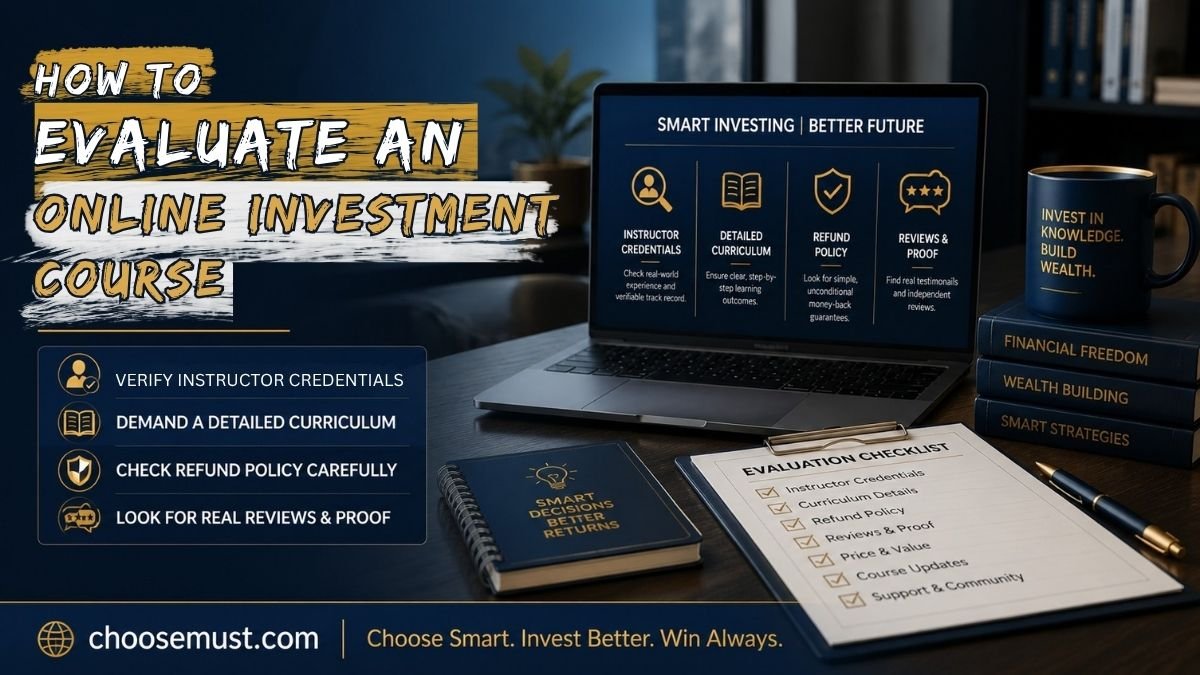
1. Scrutinize the Instructor’s Real-World Credentials
The most important question you can ask about any investment course is: Has this person actually done what they are teaching?
Legitimate instructors have a verifiable track record. They have published research, run documented portfolios, appeared in credible financial media, or built real businesses with auditable results. Their LinkedIn profiles, public bios, and online presence are consistent and searchable. When you Google their name plus the word “review,” or their claimed specialty, a clear, coherent professional history emerges.
Red flags to watch for here include instructors who are vague about their background, who only show lifestyle imagery (luxury cars, travel) as proof of success, or whose claimed credentials cannot be independently verified. Legitimate course creators don’t just tell you they’re successful; they show you a body of work that existed before they started selling courses about it.
Action step: Search the instructor’s full name on LinkedIn, Google, and YouTube. Cross-reference their claimed expertise with any verifiable public record. If you can’t find them anywhere outside their own sales page, that is itself a significant red flag.
2. Demand a Detailed, Specific Curriculum
A trustworthy investment course will show you exactly what you will learn, lesson by lesson, before you pay. Not a vague list of buzzwords like “discover the secrets to financial freedom” or “master the market”, but a granular syllabus that specifies topics, skills developed, and measurable learning outcomes.
Vague descriptions filled with language like “exclusive knowledge” or “life-changing secrets” without specifics are a consistent marker of low-value content. Legitimate courses provide a detailed syllabus, showing exactly what topics will be covered and what skills will be developed. If a course lacks this transparency, it is worth questioning whether the content is valuable at all.
A strong curriculum should tell you: What level of prior knowledge is assumed? What tools, platforms, or software will be used? Are the strategies taught applicable to current market conditions, or is the content recycled from years ago without updates?
Action step: Ask for a full module breakdown before purchasing. If the provider refuses or the information isn’t available on their site, treat it as a significant warning sign.
3. Verify the Refund Policy, Word by Word
How a course handles refunds tells you almost everything about how much confidence the creator has in their own product. Reputable programs offer clear, unconditional money-back guarantees, typically 30 days, because they know their content delivers value and they’re willing to stand behind it.
Before purchasing, read the refund policy carefully. Watch specifically for conditions that effectively make a refund impossible: requirements to complete a certain percentage of the course, subjective clauses where the instructor judges whether your “effort was genuine,” or refund windows designed to expire before you’ve had time to properly assess the content. If a refund policy is longer than two paragraphs or contains the word “conditional,” assume the money is gone the moment you pay.
Also pay attention to the payment platform. Courses sold through established marketplaces like Udemy, Coursera, or Skillshare carry platform-level buyer protection. Courses sold through self-hosted checkout pages mean the instructor controls the payment gateway entirely. If they refuse a refund, your only recourse is a bank chargeback, which is difficult to win once you’ve agreed to their terms of service.
Action step: Screenshot and save the refund policy before you buy. If it’s conditional, ambiguous, or located somewhere difficult to find, that’s a deliberate choice by the seller, not an oversight.
4. Check for Independent Reviews (Not Just Testimonials on the Sales Page)
Every online course has a testimonials section on its sales page. Almost none of them are independently verifiable. Real due diligence means searching for student feedback in places the course creator does not control.
Start with Reddit. Search the course name or instructor’s name in relevant subreddits (r/personalfinance, r/investing, r/passive_income, r/scams). Reddit users are notably blunt and have no incentive to protect a product’s reputation. Then check Trustpilot, Google Reviews, and the Better Business Bureau. Search the course name followed by “review,” “scam,” or “results” on Google, and look past the first page of results. Affiliate review sites tend to dominate page one with overly positive content.
Generic, vague praise like “This course changed my life!” without specific details of what was learned or applied is itself a red flag. Authentic student reviews reference specific modules, techniques, or outcomes. They mention what worked and what didn’t. They are specific because real experiences are specific.
Action step: Spend 20 minutes reading independent reviews on at least three platforms that the course creator does not control. Look for patterns, both positive and negative, across multiple reviews.
5. Identify and Reject High-Pressure Sales Tactics
Countdown timers. “Enrollment closes in 24 hours.” “Only 7 spots left.” “This price disappears at midnight.” These are among the most reliable indicators that the seller’s primary concern is closing a sale quickly, not whether the product is right for you.
Legitimate educational products don’t require you to make a rushed, emotionally charged decision. High-quality courses sell on their merit, and their pricing doesn’t fundamentally depend on preventing you from thinking. High-pressure tactics, countdown timers, and phrases like “this is your last chance” are common signs of a scam. The urgency is manufactured to prevent you from doing exactly what this article is teaching you to do: research thoroughly before committing.
This doesn’t mean a limited-time discount is automatically fraudulent. But when scarcity and urgency are the primary selling arguments, when the pitch focuses more on the ticking clock than on what you’ll actually learn, that imbalance is worth noticing.
Action step: Close the sales page and come back to it 48 hours later. If the “limited time” offer is still running, you’ve learned something important about how honest the seller is with their marketing.
6. Assess the Course Community and Ongoing Support
Investing is a skill that evolves continuously. Markets change, regulations shift, and new instruments emerge. A course that delivers content once and then disconnects you is far less valuable than one that includes an active community, regular updates, and instructor accessibility.
Look for courses that offer a live community, a private Facebook group, a Discord server, or a forum where students interact with the instructor and with each other. Ask whether the instructor participates in the community directly or whether it’s purely peer-to-peer. Check whether the course materials are updated regularly to reflect current market conditions. A course on cryptocurrency investing, for example, that hasn’t been updated since 2021, is teaching a very different market landscape than the one students will actually operate in.
Community also serves as a natural authenticity check. An active, engaged community with thousands of real members who post regularly, share results, and ask genuine questions is very difficult to fake. A community with 10,000 members but no recent posts, no authentic discussions, and no visible instructor presence is a warning sign.
Action step: Ask for access to the course community before purchasing, or request proof of community activity. A confident seller will have no problem showing you this.
7. Evaluate the Price-to-Value Ratio Honestly
Both extremes of course pricing carry risks. Suspiciously low prices can indicate low-quality or outdated content, or a loss-leader designed to upsell you into higher-priced programs later. But expensive courses are not automatically superior. Price alone tells you almost nothing about educational quality.
The right framework is to evaluate what you’re getting relative to what comparable education costs through other channels. A $997 investment course that includes a structured curriculum, a live community, quarterly updates, and direct instructor access may be an excellent value. The same price for 10 pre-recorded videos with no support and no updates almost certainly isn’t.
Also, watch for hidden fees. Legitimate courses list their full costs publicly, the enrollment price, any required subscriptions, recommended tools, and whether the curriculum requires paid software to implement. Courses that only reveal additional costs after enrollment are using a deliberate strategy to get your initial commitment before revealing the full price of participation.
Action step: List every cost required to fully participate in and implement the course, enrollment fee, tools, subscriptions, any upsells, and compare the total to the stated price before committing.
8. Look for Free Trial Content or Preview Material
Would you buy a car without a test drive? Would you sign a lease on an apartment you’d never visited? The same logic applies to online education. Reputable providers often offer free introductory lessons or trial periods before requiring payment, because they’re confident their content will sell itself once you experience it.
Most legitimate platforms, Udemy, Coursera, and Skillshare, offer free previews of course content. Independent course creators who are confident in their product will share sample lessons, free webinars, or introductory modules before asking for payment. This preview content also gives you an important signal about teaching quality: Is the instructor clear and engaging? Is the production professional enough to make the content easy to absorb? Does the style of instruction match your own learning preferences?
Action step: Before purchasing, find and consume every piece of free content the instructor has produced, YouTube videos, blog posts, free webinars, and podcast appearances. This gives you a genuine, low-stakes preview of what their paid content will likely deliver.
9. Verify the Website and Business Legitimacy
A professional, trustworthy online course provider maintains a website that reflects the level of care they invest in their education. Look for a clearly listed legal business name, a physical or verifiable registered address, direct contact information (not just a form), and transparent terms of service and privacy policy.
Warning signs at the website level include spelling and grammar errors, generic stock photography used as “student testimonials,” no identifiable business registration, contact options limited to anonymous forms, and domain ages under one year selling a supposedly established “academy.” A domain less than one year old selling a “comprehensive academy” is a high-risk signal worth taking seriously.
You can check a domain’s registration age using free tools like WHOIS. You can verify business registration through your country’s official business registry. These checks take five minutes and can save you hundreds or thousands of dollars.
Action step: Run the website through a WHOIS lookup to check the domain age. Search the business name in the relevant government business registry. If neither can be confirmed, exercise significant caution.
10. Understand Exactly What Outcomes Are Being Promised, and What Aren’t
Every investment course makes implicit or explicit promises about what you’ll be able to do after completing it. The most important due diligence question is whether those promises are realistic, specific, and based on your own effort, or whether they’re outcome guarantees that no ethical educator can honestly make.
No legitimate financial education program can guarantee you will make money. Investment always carries risk. Courses that promise guaranteed returns, guaranteed income, or guaranteed financial independence are making claims that are not only unrealistic but, in many jurisdictions, legally problematic. The FTC and various financial regulators have taken enforcement action against course sellers who make unsubstantiated income claims.
Contrast misleading promises with legitimate outcome framing: “This course will teach you the specific frameworks professional traders use to evaluate risk-reward ratios” is a verifiable, honest claim. “Join and earn $10,000 per month within 90 days” is not. Understanding the difference between skills-based education and income guarantees protects you from both disappointment and potentially significant financial loss.
Action step: Write down every income or outcome claim made on the sales page. Ask yourself: Is this a skill I will develop, or a result the seller is guaranteeing? If it’s a guarantee, it’s a red flag.
Final Thoughts: The Right Course Can Be a Genuine Financial Turning Point
The purpose of rigorous evaluation isn’t skepticism for its own sake. High-quality online investment education genuinely exists, and for learners who approach it with the right discernment, it can be transformative. The goal of this framework is to help you find those courses, and confidently avoid the rest.
Verify the instructor’s credentials. Demand a specific curriculum. Read the refund policy word for word. Seek independent reviews. Reject artificial urgency. Evaluate the community. Understand the full cost. Consume free preview content. Confirm business legitimacy. And hold any income promises to a rigorous standard.
Run these ten checks on any program before you pay, and you will dramatically increase your odds of finding an investment course that actually delivers on what it promises.
Next Steps: Where to Apply This Checklist Today
Now that you have a proven evaluation framework, the most effective next move is to apply it immediately to courses you’re already considering. Use the criteria above systematically, not just for a general sense of whether something “feels” right, but as a formal checklist you complete for every program.
If you’re early in your research and looking for a benchmark, consider starting with programs that are transparent about their methodology and community results. The Keystone Investors Club is one example of a structured, community-anchored investment education platform that offers a clear program overview and verifiable member activity, making it a useful reference point when benchmarking other courses you’re evaluating.
Whatever you choose, remember: the best investment you can make before enrolling in any financial education program is the hour it takes to run a proper due diligence process. The ten steps above are the process. Use them every time.
Disclaimer: This article contains affiliate links. If you click through and make a purchase, this site may earn a commission at no additional cost to you. All recommendations are based on independent research and are intended for informational purposes only. Investment involves risk; past performance is not indicative of future results. This content does not constitute financial advice.