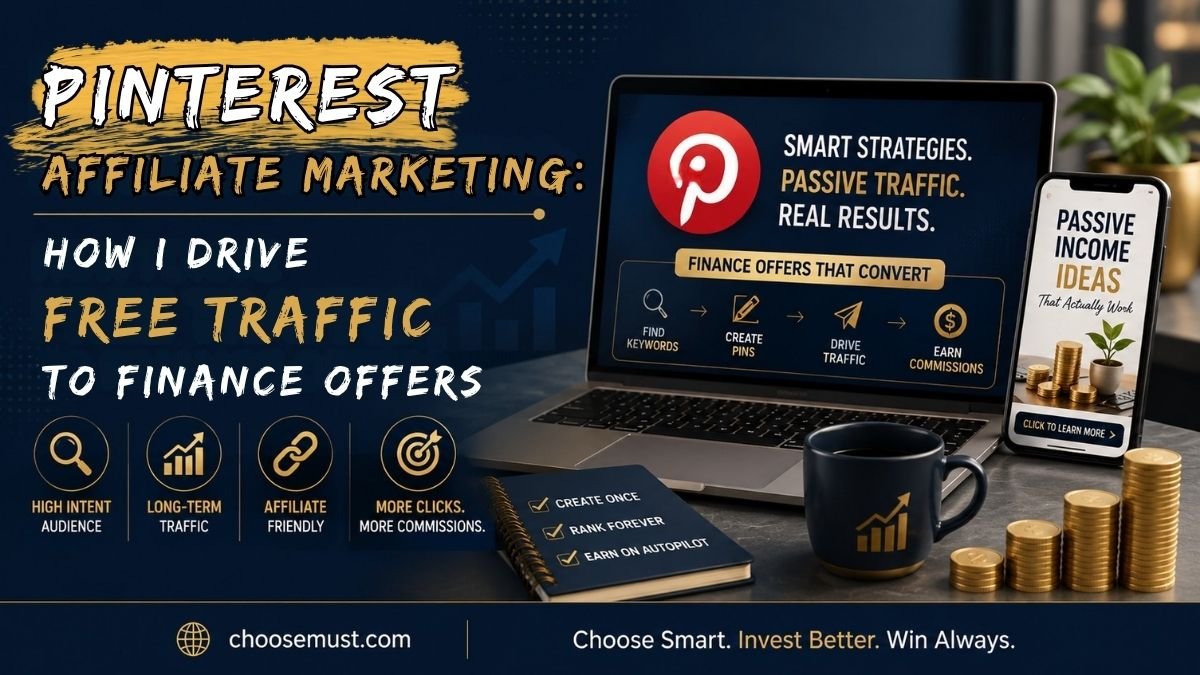
Most people look at Pinterest and see a platform for recipes and home decor. Affiliate marketers who know better see something entirely different: a visual search engine with 5 billion searches per month and an audience that is actively planning purchases.
I have been using Pinterest to drive free, targeted traffic to finance offers for well over a year. Pins I created months ago still bring in clicks today. No ad spend. No algorithm chasing. Just a compounding content library that keeps working in the background. Here is exactly how I do it.
Why Pinterest Works Differently From Every Other Platform
Before diving into tactics, you need to understand the fundamental reason Pinterest outperforms other free traffic sources for affiliate marketers in the finance niche.
Pinterest is not a social media platform. It is a visual search engine. The difference matters enormously:
- On Instagram or TikTok, your content is designed to entertain. Attention spans are short, intent is low, and posts disappear within hours.
- On Pinterest, people search with future purchase intent. Someone saving a pin about “how to build passive income in 2026” is not just browsing. They are planning a decision they intend to act on.
This is what makes Pinterest so powerful for finance affiliate marketing. The audience you reach is already in research mode. They want answers, and if your content delivers those answers and points toward a product that genuinely helps, the conversion path is remarkably short.
Beyond intent, there is the longevity factor. A tweet lives for minutes. An Instagram post lives for hours. A well-optimized Pinterest pin can drive traffic for months, sometimes years, after you created it. That is the compounding effect that makes Pinterest feel like an unfair advantage once you understand it.
Additional data points worth knowing:
- One in three Pinterest users has an annual household income above $100,000, making them an ideal audience for premium finance and investment offers.
- Pinterest explicitly allows affiliate links within pins, making it one of the most affiliate-friendly major platforms available.
- A free business account gives you access to analytics, rich pins, and audience insights at zero cost.
Setting Up Your Pinterest Account for Finance Affiliate Success
Switch to a Business Account (It’s Free)
A personal profile gives you nothing measurable. A Pinterest Business Account gives you:
- Pin-level click tracking so you know exactly which content drives traffic
- Audience insights to understand who is finding your content
- Rich pins that pull metadata from source URLs and appear more credible in feeds
- Access to Pinterest Analytics, which helps you refine your strategy over time
Optimize Your Profile for Your Finance Niche
Your profile is your first impression. Pinterest’s algorithm reads it for relevance signals, and so do potential followers. When setting up or refreshing your profile:
- Use your niche keywords in your display name (e.g., “Passive Income Tips | Finance Freedom Guide”)
- Write a bio that speaks directly to your ideal audience and includes natural keyword phrases like “build passive income,” “saving money strategies,” or “investment ideas for beginners.”
- Verify your website if you have one. Pinterest rewards verified accounts with better search placement.
- Use a consistent, professional profile image that builds brand recognition
Create Niche-Specific Boards
Your boards are essentially categories, and Pinterest uses them to understand what your account is about. For finance affiliate marketing, consider boards like:
- “Passive Income Ideas for Beginners”
- “How to Make Money Online in 2026”
- “Crypto Investing for Everyday People”
- “Financial Freedom Tips”
- “Online Business and Digital Income Strategies”
Write keyword-rich descriptions for each board. These descriptions are indexed by Pinterest’s search algorithm, so they matter.
Pinterest SEO: The Engine Behind Free Traffic
Pinterest SEO is different from Google SEO, but the core principle is the same: match what you publish to what people are searching for.
How to Find the Right Keywords
Pinterest’s own search bar is your best keyword research tool. Type a broad finance term and watch what auto-completes. These suggestions represent real searches happening right now:
- “passive income” might surface: “passive income ideas 2026,” “passive income online,” “passive income for beginners.”
- “make money” might surface: “make money from home,” “make money online fast,” “make money while you sleep.”
Build your pin titles, descriptions, and board names around these real search terms.
Where to Use Keywords
| Location | Keyword Placement Strategy |
|---|---|
| Pin Title | Lead with the primary keyword naturally (e.g., “Passive Income Ideas That Actually Work in 2026”) |
| Pin Description | Use 2 to 3 related keywords naturally within 2 to 3 informative sentences |
| Alt Text | Describe the image accurately using your target keyword |
| Board Title and Description | Primary keyword in title, secondary keywords woven into description |
| Profile Bio | 2 to 3 niche keywords placed naturally within your profile description |
Designing Pins That Stop the Scroll and Drive Clicks
Your pin’s visual is the difference between someone scrolling past and someone clicking through. Here is what works in the finance and online income niche specifically:
Technical Specifications That Maximize Visibility
- Use a vertical image ratio of 2:3 (1000 x 1500 pixels). Pinterest gives this format priority in feeds.
- Use high-contrast colors. Dark backgrounds with light text or bold accent colors perform well in finance-related content.
- Include bold, legible text overlay that communicates the value proposition immediately. Viewers should understand what they will get before reading a single word of your description.
What to Put On the Pin Itself
- A clear, specific headline: “12 Real Passive Income Types Explained” outperforms “Make More Money.”
- A visual that reinforces the topic (charts, money imagery, clean infographic layouts)
- Your website URL or brand name at the bottom to build recognition over time
- A subtle call to action: “Click to Learn More” or “Save This for Later.”
What to Avoid
- Clickbait headlines that promise things the content cannot deliver. Pinterest’s algorithm now cross-references pin content with destination pages.
- Text-heavy images with small fonts that are unreadable in the feed
- Generic stock photo aesthetics that blend in instead of standing out
The Two Traffic Strategies That Work Best for Finance Offers
Strategy 1: Pin Directly to a Blog Post or Landing Page
This is the most common setup and it works well. You create a detailed blog post around a finance topic (like passive income strategies or how to start with crypto investing), then create multiple pins that all link back to that post. The blog post does the heavy conversion lifting, explains the topic in depth, and naturally introduces the affiliate product at the right moment.
The advantage of this approach is that it builds your own platform simultaneously. Every visitor from Pinterest to your blog is a potential email subscriber, a return reader, and a long-term customer.
Strategy 2: Pin Directly to Affiliate Offers
Pinterest allows direct affiliate links in pins as of 2026. For offers with strong visual appeal and a clear value proposition, this can work for faster conversions. The tradeoff is that you do not capture the visitor’s email or build your own audience.
Use this strategy selectively for offers where the product page itself converts well and where a warm-up piece of content is not strictly necessary.
For finance products aimed at people who want to build a real online income system, routing through a blog post or pre-sell page almost always produces better results. Your content does the trust-building work that cold traffic needs before clicking a buy button.
Pinning Schedule and Consistency: What Actually Matters
There is a lot of conflicting advice about how often to pin. Here is what actually works based on the current algorithm:
- Quality over quantity: Pinterest’s updated algorithm penalizes low-effort, repetitive pinning. Fresh, high-quality pins with unique images and URLs perform far better than recycling the same content repeatedly.
- Aim for 5 to 15 fresh pins per week across your niche boards. Consistency matters more than volume.
- Pin across all your boards strategically: Do not dump all pins to one board. Distribute them to relevant boards to increase reach.
- Use scheduling tools: Tools like Tailwind or Pinterest’s native scheduler let you create pins in batches and release them at optimal times, reducing the daily time investment significantly.
When to Expect Results
| Timeline | What to Expect |
|---|---|
| Months 1 to 3 | Building momentum. Impressions grow but clicks may be modest. Focus on consistency. |
| Months 4 to 8 | Traffic starts compounding. Old pins continue driving clicks while new ones gain traction. |
| Months 9 to 18 | Compounding effect is visible. Both old and new pins drive consistent traffic and affiliate clicks. |
| Months 18 and beyond | Mature accounts benefit from accumulated authority. Refinement and scaling become the focus. |
Matching Finance Offers to Pinterest Audiences
Not every finance product will work equally well through Pinterest. Here is how to match the right offer to the Pinterest audience:
What the Pinterest Finance Audience Responds To
- Products that promise a clear, specific outcome (e.g., “build a passive income stream online”)
- Educational programs with a step-by-step structure that feel accessible and beginner-friendly
- Systems that remove complexity and do the heavy lifting for the user
- Products in the $37 to $197 range for impulse-friendly conversions, or premium programs for high-intent searchers
How to Frame Affiliate Content on Pinterest
The most effective Pinterest affiliate content in the finance niche is framed as helpful discovery, not advertising. Your pins should answer: “I found something that actually solves this problem, and here is how it works.”
For example, if you are promoting a system designed to help people generate income online without prior experience, your pin might be titled “How Beginners Are Building Online Income in 2026 (Step-by-Step System)” with a description that explains the problem the product solves. The click and eventual purchase feel like a natural next step in the reader’s journey, not a sales pitch.
Tracking, Testing, and Improving Your Pinterest Results
Free traffic is only valuable if you know what is working. Pinterest Analytics (available on every business account) gives you:
- Impressions per pin: how many people saw your content
- Click-through rate: how many people clicked on your site or offer
- Saves: how many people saved your pin for later (a strong intent signal)
- Top-performing boards: which categories drive the most engagement
Review your analytics every two weeks. Double down on what is working. Retire or redesign pins that are getting impressions but no clicks, as this usually signals a headline or design issue.
Test different pin designs for the same destination page. A pin that gets 20 clicks per week from the same URL as one that gets 200 tells you exactly what your audience responds to visually.
One More Thing: Pinterest Compliance Rules to Know
Pinterest allows affiliate marketing, but there are rules to follow to keep your account in good standing:
- Do not operate multiple Pinterest accounts under the same brand or niche. This is against platform guidelines.
- Disclose affiliate relationships. Add a simple note like “affiliate link” in your pin description to stay transparent.
- Do not use misleading headlines that do not match the destination page. Pinterest’s algorithm now checks for mismatches and will reduce the distribution of pins that do not deliver on their promise.
- Do not spam boards with identical content. Variety and freshness are rewarded; duplication is penalized.
The Bottom Line: Pinterest Is a Compounding Asset
Pinterest affiliate marketing for finance offers is not a shortcut. It is a compounding strategy. Every pin you publish is a piece of content that can drive traffic tomorrow, next month, and two years from now without additional work.
The people who dismiss Pinterest as a decorating platform are leaving one of the most cost-effective free traffic channels in affiliate marketing completely unused. While everyone else chases algorithm changes on Instagram and TikTok, your Pinterest library keeps growing quietly in the background.
Start with one board, one niche topic, and five quality pins. Build consistency before you build volume. Your first commission from a Pinterest click will not be the last, and from there, the math starts working in your favor.
If you are looking for a proven system to promote alongside your Pinterest strategy, explore the Passive Income System 2.0, which is one of the more beginner-friendly digital income programs currently available and converts well with the kind of audience Pinterest consistently delivers.
Affiliate Disclosure: This article contains affiliate links. If you click through and make a purchase, we may earn a commission at no extra cost to you. We only recommend products we believe offer real value to our readers.