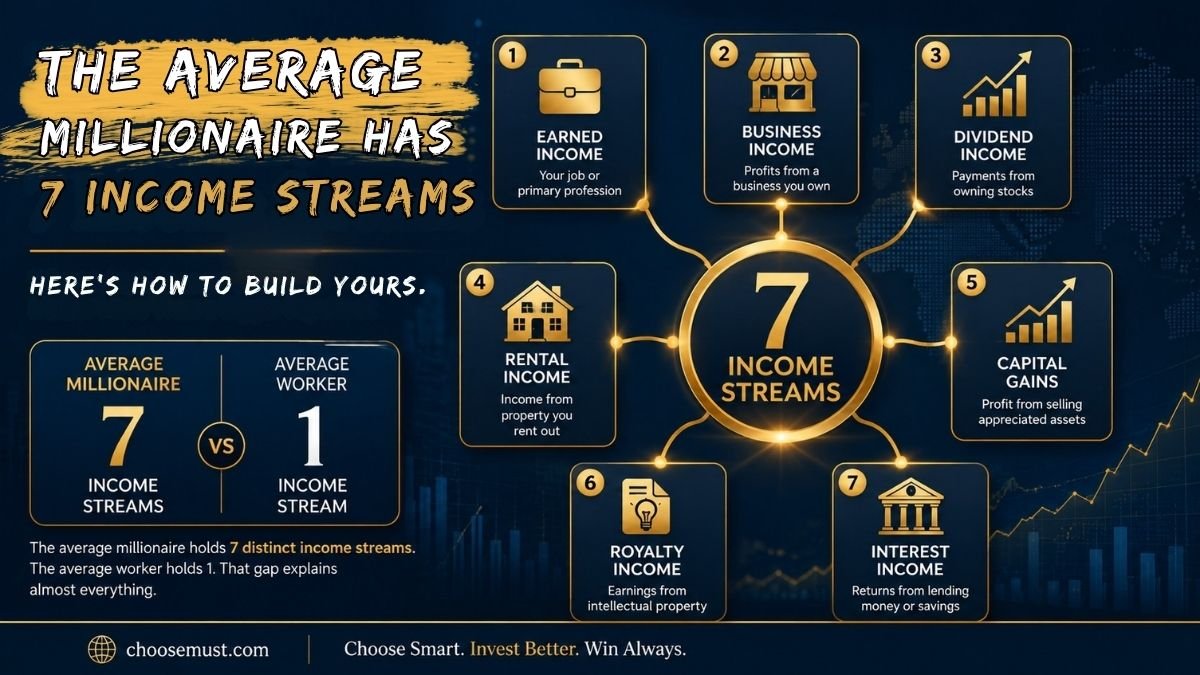
Key Stat: The average millionaire holds 7 distinct income streams. The average worker holds 1. That gap explains almost everything.
One Paycheck Is a Financial Trap
Think about it honestly. If your only income source disappeared tomorrow, how long could you survive? For most people, the answer is terrifying: less than three months.
That single vulnerability is the most dangerous thing about how the majority of people earn money. One job. One source. One point of failure.
Millionaires understand something different. Wealth is not built by earning more from one source. It is built by creating more sources.
According to a 2024 survey by Northwestern Mutual, nearly 80% of millionaires consider themselves self-made. They didn’t inherit wealth. They engineered it, often starting with nothing more than a salary and a decision to stop depending on it.
The IRS data behind the “7 income streams” figure has circulated for years, but most people never ask the obvious next question: What are those streams, exactly? Here they are, broken down with what you need to know about each.
The 7 Income Streams Millionaires Actually Use
| # | Income Stream | What It Means | Difficulty to Start |
|---|---|---|---|
| 1 | Earned Income | Your job or primary profession | Already have it |
| 2 | Business Income | Profits from a business you own | Medium |
| 3 | Dividend Income | Payments from owning stocks | Low (needs capital) |
| 4 | Rental Income | Income from property you rent out | Medium-High |
| 5 | Capital Gains | Profit from selling appreciated assets | Low (needs capital) |
| 6 | Royalty Income | Earnings from intellectual property | Medium |
| 7 | Interest Income | Returns from lending money or savings | Low |
Notice something important. Most of the streams 2 through 7 do not require you to trade hours for dollars. They require you to build or buy something that generates returns while you sleep.
Over 42% of millionaires earn regular income through dividends, interest, royalties, and property rental, maintaining stable cash flow even without full-time employment. That is not luck. That is architecture.
Breaking Down Each Stream (With Real Numbers)
1. Earned Income: Your Launchpad, Not Your Destination
Every millionaire story starts here. Your job is not the goal. It is the seed capital for everything else. The smartest move you can make is to treat your paycheck as raw material for building the other six streams, not as the finish line.
Use your earned income aggressively: invest a percentage automatically, fund a side business, and put money into dividend-paying assets before lifestyle inflation eats it all.
2. Business Income: The Stream That Changes Everything
Starting a business, even a small one, is the single most transformative financial move most people can make. It creates tax advantages unavailable to employees, opens access to leverage, and can generate income that exceeds a salary within years, not decades.
The barrier to entry has collapsed. A service business, a digital product, an online system. The capital required is often just time and intent. If you want a structured path into a proven online business system, the Passive Income System 2.0 walks you through building a monetized digital business from scratch, without needing a product, a team, or prior experience.
3. Dividend Income: Getting Paid to Own
When you buy shares of a dividend-paying company, you become a part-owner of a business that pays you quarterly just for holding it. Close to half a millionaires (47%) own stocks with an average portfolio value of around $949,000.
You don’t need that amount to start. You need consistency. Reinvest dividends automatically, add to your positions regularly, and compound takes over.
4. Rental Income: The Classic Wealth Builder
Real estate has created more millionaires than almost any other asset class. Average Airbnb hosts earn around $924 per month, while top hosts regularly clear $5,000 and beyond. For many self-made millionaires, real estate is not just one property. It is a portfolio.
You don’t need to own a building to start. House hacking, co-ownership structures, and REITs (Real Estate Investment Trusts) all provide entry points at different capital levels.
5. Capital Gains: Profiting from Appreciation
When assets grow in value, and you sell them, the profit is a capital gain. Stocks, real estate, businesses, even digital assets. Long-term capital gains are taxed at preferential rates in most jurisdictions, making this one of the most tax-efficient income streams available.
The key is buying and holding quality assets long enough for compounding to do its work.
6. Royalty Income: Earn Once, Collect Forever
Write a book, license a photograph, create an online course, develop software, record music. Once created, these assets can generate royalty income for years, sometimes decades, without additional effort.
The digital economy has democratized this stream dramatically. Platforms exist today that allow anyone to create and monetize content at scale, with zero inventory or shipping required.
7. Interest Income: The Quiet Stream
Lending money earns interest. This works through high-yield savings accounts, certificates of deposit, treasury bonds, or private lending arrangements. As interest rates have shifted in recent years, this stream has become more meaningful than it was in the near-zero rate environment of the early 2020s.
It may not make you rich on its own. But combined with six other streams, it becomes a meaningful contribution to total monthly cash flow.
The Sequence Matters More Than the Speed
A common mistake is trying to build all seven streams at once. That leads to fragmented focus, diluted effort, and usually, failure in all of them.
The millionaire approach is sequential. Master one stream, let it produce, then use those proceeds to fund the next. Here is a logical build order for most people:
- Start: Earned income (stabilize and optimize your primary income)
- Step 2: Business or royalty income (build something that works without you)
- Step 3: Dividend and interest income (invest what your business generates)
- Step 4: Rental income (scale into physical assets once the capital base is solid)
- Step 5: Capital gains (reinvest gains across all asset classes)
Every stream becomes fuel for the next. The compounding effect is not just financial. It is structural.
What Most People Get Wrong About Building Wealth
The myth of the overnight millionaire persists online. Social media is full of people claiming to have built empires in 90 days. Real wealth, the kind that survives market cycles, economic shocks, and personal setbacks, takes longer and looks less dramatic.
A 2024 Northwestern Mutual survey confirmed that 80% of millionaires are self-made. They built their wealth over years, not weeks. The difference between them and everyone else was not intelligence, not luck, not connections. It was the decision to stop treating a single paycheck as a financial ceiling and start treating it as a foundation.
The number 80 million matters here, too. As of early 2025, the total number of millionaires globally surpassed 80 million for the first time in history. Nearly 1% of all adults on Earth now hold $1 million or more in net assets. The path is more accessible than it has ever been. The tools, platforms, information, and systems available today did not exist a decade ago.
Practical Steps to Begin Building Your Streams Today
You don’t need to be wealthy to start. You need to start becoming wealthy. Here is what actionable looks like:
- Audit your current income: Write down every source of income you have today. Most people have one. That list should grow every year.
- Open an investment account: Set up automatic contributions to a brokerage account. Even $50 per month invested consistently builds the dividend and capital gains streams over time.
- Launch something small: A freelance service, an affiliate site, a digital product. Business income does not require a corporation. It requires a first customer.
- Invest in your knowledge base: The fastest way to accelerate wealth-building is to shorten your learning curve. The Keystone Investors Club provides structured investor education and community access for those serious about building lasting financial intelligence.
- Automate ruthlessly: Set up automatic transfers to savings and investment accounts on payday. Remove the decision from the equation.
- Review quarterly: Every three months, assess which streams grew, which stalled, and where to direct new capital.
The Math Behind 7 Streams
Here is a simple illustration of what diversified income looks like at a modest scale:
| Income Stream | Monthly Amount | Annual Total |
|---|---|---|
| Earned (salary) | $4,500 | $54,000 |
| Business / freelance | $1,200 | $14,400 |
| Dividends | $380 | $4,560 |
| Rental (one unit) | $900 | $10,800 |
| Interest | $150 | $1,800 |
| Royalties / digital | $275 | $3,300 |
| Capital gains (annualized) | $400 | $4,800 |
| TOTAL | $7,805 | $93,660 |
None of those individual streams is dramatic. Combined, they represent a near-six-figure annual income with multiple safety nets built in. If any single stream disappears, the others absorb the impact. That is financial resilience. That is what millionaires build.
The Bottom Line
The average millionaire does not have a secret. They have a system. Seven streams, built deliberately, stacked over time, each one funding the next.
The question is not whether you can do this. The data shows clearly that tens of millions of people have. The question is whether you start with stream two today or wait another year while your single income source carries all the risk.
Start somewhere. Start small. Start now. Your future financial life will be built on decisions made in moments exactly like this one.
This article contains affiliate links. If you purchase through these links, we may earn a commission at no additional cost to you. All recommendations are based on research and relevance to the topic.